

A Minimum Viable Product (MVP) is a popular concept and methodology used in software development. An MVP is the basic version of a product that requires minimal effort by integrating core features that solve a specific problem. Frank Robinson coined the term ‘MVP’, and Lean Startup genius Eric Ries popularized it.
Reis defines an MVP as “The version of a new product which allows the team to collect maximum amount of validated learning about customers with the least effort.” MVPs have now been adopted into the startup world and product development landscape to develop products and validate ideas while minimizing resources used in the process.
An MVP in software development is a basic version of a product that allows you to validate your idea by gathering feedback from customers with minimal effort.
Key Benefits of using an MVP Approach
Using the MVP approach will provide many benefits to your business. Here are five key benefits of using an MVP for your business:
- MVPs allow you to mitigate risk by reducing costs that would otherwise be higher when developing a full-fledged product.
- The approach allows you to test and validate your hypothesis with a little upfront investment. For example, Facebook’s MVP was Thefacebook, which was developed in 2004. It was a simple directory that connected students at Harvard University. The idea proved popular –validation –enough to expand to other universities and eventually become the platform we know today.
- MVPs allow you to build a functional product by focusing on core features that offer a solution to target consumers.
- The MVP approach allows quick and early entry into the market since they take a short time to develop.
- The MVP approach is efficient for gradually developing a product through iteration. Incremental features are based on consumer feedback, allowing you to build a viable product that offers your target audience maximum value.
The MVP approach is a powerful force in software development that allows you to build a basic version of your product and validate your idea by gathering consumer feedback while using minimal resources.
Key Components of an MVP
MVP development involves creating a product idea in minimal form by incorporating essential features. These core elements serve as a means for companies to effectively test, gather meaningful feedback, and make an informed decision on their product.
Core features and functionalities
When designing an MVP, feature prioritization is one of the significant aspects that you should consider, as it gives you leeway between wants and needs. ‘Needs’ are the features that your product will need to function, while ‘wants’ are features that your product can still work fine without.
The approach of MVP will involve leaving out features that are not core to your product. Simply put, you will just need features that shall resolve the consumer’s problem directly. The initial version of your product is very simple, and the major objective of releasing it is to gather user feedback. Feedback helps you iterate in the product by adding the essential features needed by the users while eliminating non-essential features.
Essential criteria for a product to be considered an MVP
Now that you understand what essential and non-essential features are, let us look at the criteria your product should meet to be considered an MVP:
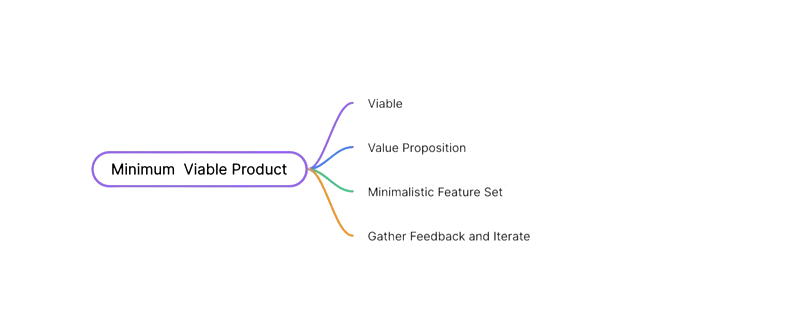
- Your product should be viable. An MVP is not a half-built product. Rather, users should be able to perform an entire task using your product for the purpose it was intended.
- The product should have a clear value proposition, meaning it should solve a specific problem for your target audience.
- Your MVP should also have a minimalistic feature set that directly solves users’ problems.
- Your MVP should have the capability of gathering data and feedback from users. Feedback from users is essential in testing and validating your idea. Feedback also helps you iterate your product to suit the needs of your target consumers.
When you use the MVP approach, the needs of the customer are your priority. Your product should offer maximum value to customers to increase its viability in the market.
Difference between MVP, a prototype, and a full product
Most people confuse an MVP for a prototype. Let us compare the difference between an MVP, a prototype, and a full-fledged product. An MVP is a functional version of your product, which includes only the core features that allow you to gather feedback from users and validate your idea.
A prototype refers to a mockup of your product; it is basically a non-functional model to test an idea. A full-fledged product is fully developed, and its features are more comprehensive than those of an MVP. One iterates an MVP; thereafter, after refinement and polishing, it becomes a full-fledged product.
How to Develop an MVP: A Step-by-Step Guide
A strategic and well-thought-out approach is essential when building your MVP. Here is a step-by-step guide to develop your MVP and gauge the response of your target audience:
○ Market research
MVP development begins with market research. This allows you to gather information related to your product and its landscape. In simple words, market research includes the gathering and then analysis of data about the relevant industry, target market audience, and scope of operation. You would have to analyze what the competition is doing and what you can do to get an edge in this competitive world of product development by catering to the needs of the target audience.
○ Prioritizing features for the MVP
The next step is to select the features that need to go into your MVP. For prioritization of features, you may use the MoSCoW method. It allows you to divide all the features into four categories: Must-have, Should-have, Could-have, and Will-Not-Have. The approach makes it easier when it comes to defining the features most critical for delivering value to your target audience.
○ Creating a roadmap and timeline
Next, you will have to make a roadmap for your MVP. A roadmap is a visual representation of all processes involved in bringing your MVP into reality right from start to finish. It shows the developmental stages of your MVP and includes all the roles and responsibilities of your team. A roadmap also includes a timeline for when specific goals and objectives should be met.
○ Developing and testing the MVP
After having a clear visual plan, you should proceed to develop your MVP. The development stage is hands-on because it involves building your product. After development, you should release the first version, which is essential in testing your product idea. Early adopters provide feedback on this version, which is then used for iteration to improve your product and make it more usable.
The process is simple but comprehensive, allowing you to build and launch a viable product that provides customers with value. It also allows you to gather feedback and fine-tune your product into something that attracts more users.

Best Practices for MVP Development
MVP development needs a strategic approach to make it successful. Best practices will help to effectively convert your idea into a product ready for the market. These practices will help in keeping away the pitfalls and optimizing the development process. Let us see how to develop your MVP effectively:
Tips and strategies for effective MVP development
The MVP approach enables you to build a ‘good enough’ product that addresses your target audience’s pains and also lets you collect feedback that helps in iteration. Ten tips on building an MVP that works well include:
- Describe your MVP; know what pain you are trying to solve and what solution your product is offering.
- Who are your target customers; who will use your product the most, or who is most likely to use your product?
- Conduct thorough market research and describe what value your product will have; What differentiates your product from the rest in the market? Why should a customer come to your product and not others?
- Invest in the team; see to it that your team is competent in what they do.
- Design an MVP roadmap; clearly show the whole aspect that will ensure the success of your MVP.
- Plan a milestone budget for your MVP; remember to also include all other hidden charges.
- Stick to the core functionalities of your product; distinguish between needs and wants.
- Make sure your MVP is agile and can be iterated repeatedly.
- Gather feedback from your users.
- Iterate the feedback; remember, this is the audience who eventually will use your product.
Fulfilling the requirements mentioned above will bring you one step closer to setting up a successful MVP that will speak to your target audience.
Common pitfalls to avoid during MVP development
Everyone wants their business idea to succeed. The sad truth is that not all ideas work just like they had been planned. One-third of MVPs fail, while 90 percent of startups fail in the first five years of operation. Three mistakes that place limits on the success of your MVP include:
- Feature creep; addition of too many features by an MVP-a factor that affects functionality. Feature creep makes a product complicated to use.
Solution: Emphasize the features of the product that make it usable.
- Poor market research inhibits your understanding of the market where your product operates.
Solution: Conduct market research; analyze competition, trends, and your target audience.
- Underestimating the budget for your MVP itself, which delays and causes stalling of the project.
Solution: Develop a clear roadmap of your MVP and plan resource allocation accordingly, but also budget for unexpected expenses.
By following these tips and sidestepping common challenges, the chances of your MVP’s success increase. You will be building up and getting ready properly for the launch of your MVP so that you do not become part of that one-third or 90%.
Tools and Technologies for MVP Development
Recommended tools, platforms, and frameworks for building an MVP:
Having the right set of tools while developing an MVP is essential. The tools refine the process right from ideation to launch. They include prototyping tools and development frameworks. Examples of prototyping tools for MVP development include Figma, Sketch, InVision Studio, Webflow, and Axure RP.
On the other hand, development frameworks can either be front-end or back-end. The front-end frameworks are those that are used to develop the user interaction (UI) side. They include HTML, CSS, and JavaScript components. The backend frameworks are focused on the server side of your product. Examples of backend frameworks are Django, Laravel, Next.js, and Ruby on Rails.
What is the difference between MVP and a full product?
An MVP is the basic version of your product with functional features that allow you to test your idea, gather feedback, and iterate. The focus of an MVP is functionality. A full product has all the desired features. An MVP undergoes many processes before becoming a full-fledged product.
How long does it take to develop an MVP?
An MVP takes approximately three to four months to develop. The MVP can however take a shorter or longer time depending on its complexity, the size and expertise of your team, and the resources you have available to develop it.
Can an MVP be changed after launch?
Not only is having an MVP with post-launch activities common, but it is also a very vital approach. With the MVP approach, you can iterate post-launch based on user feedback and how your product has performed in the market. Post-launch activities enhance your MVP and make it more user-centric so as to derive better market viability.
How much does it cost to develop an MVP?
The cost of developing an MVP ranges from $5000 to $250,000. The cost depends on the complexity of your product, the cost of hiring your development team, platform fees, and budgeting.






[…] Did your MVP flounder? Good. Now you know what not to build. Use the data (a.k.a. the cold, hard truth) to […]
[…] for Everyone” Trap – “Our tool helps HR, sales, AND engineers!” → Focus on one core problem you solve better than […]
[…] is yet another platform to hire freelancers that help you hire software developers, designers, marketing experts, finance experts, product managers, and project managers worldwide. […]