
Effective strategies for Minimum Viable Product (MVP) web development begin with ensuring you do not develop something without demand. They ensure you develop something that will attract consumers; you should conduct adequate market research to spend time in your consumers’ ecosystem and develop an in-depth understanding of their pain points.
This lays a foundation for you to build a good product with a minimal set of features that meets the needs of consumers. A clear understanding of your consumers guides your web development process and ensures your approach is user-centric because meeting user expectations enhances their willingness to use and spend money on your product.
Market Research and Validation
Market research is essential before you start with the development stages of your MVP. It is crucial to help you understand your target market, the demand of the product in the market, and competitors. Market research also enables you to know how to position your product correctly. The point of validation is testing the target audience to prove their need for an MVP and that it solves a problem.
Methods for Validating Ideas:
There can be various ways in which you can validate your MVP web development idea.
- Spending a couple of years working in your target industry is one way to understand the demand if you are in the early stages of your work life.
- A perfectly designed landing page and promotion through social media marketing is another way to test the potential of your idea If you are launching a coaching business.
- Checking the demand for similar products and reading buyers’ reviews on Amazon might be the way to validate your idea if you are launching an e-commerce or drop-shipping business.
- Reach out to potential customers, talk to them, and read the competition review on sites like G2 to help understand the market and gaps if you are developing a SaaS product.
- Talking to as many customers as possible, even selling your competition’s product, will give you many insights on validating your idea if you are launching a B2C or D2C business.
Market research depicts industry trends, the competitor landscape, and customer preferences. It allows you to identify any gaps in the market and shows, to an extent, the validity of the demand for your proposed solution. Your idea is validated with real users through testing to ensure your product resonates with them.
Identifying the Core Features
The core features of your MVP are necessary to make your product functional. Feature prioritization involves identifying these features by separating the needs and wants of your MVP.
Techniques for Identifying Core Features
To start with, customer interviews to identify the problems, prioritizing the problem statements, and competitor analysis are great techniques for identifying essential features for your MVP. When you’re developing a tech product, end users should be the center of the conversation because they are the people who will pay to use your product.
User stories explain a software product from an end-user’s perspective to show the end goal of your product and how it offers value to them. Competitor analysis, on the other hand, helps you identify the strengths and weaknesses of your competitors. By conducting a competitor analysis, you will establish the market gaps they have left behind and how you can fill that gap to gain a competitive edge with your product solution.
How to Prioritize Features
The essence of developing an MVP is having a version of your product with just enough features for early adopters. The term minimum should guide you when you’re building your MVP. You don’t want to include too many features in an early version of your product because it will lose its core value proposition. The MoSCoW method, which stands for Must Have, Should Have, Could Have, and Won’t Have, is a recommended framework to guide you in feature prioritization. It will help you differentiate between the needs and wants of your MVP.
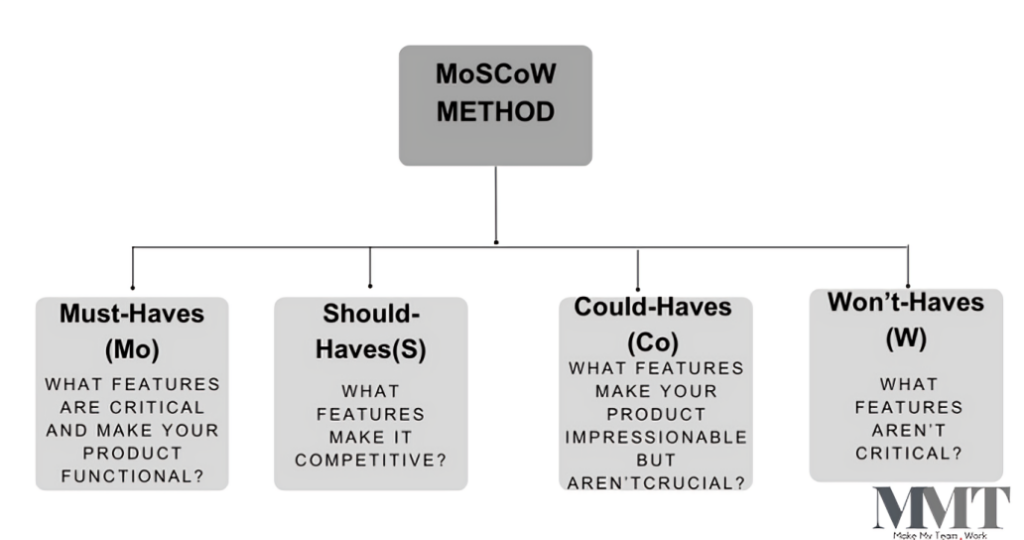
Feature prioritization involves identifying what is crucial for your product to deliver its desired solution and validating your concept.
Rapid Prototyping and Iteration
Rapid prototyping is used in the design stage before building your MVP. It demonstrates your MVP’s design and functionality in short iterative cycles.
Benefits of Rapid Prototyping
Rapid prototyping identifies and solves design and functionality issues before product development. It helps visualize a product idea and test its usability to create a seamless user interface that is appealing to your target audience.
Since rapid prototyping occurs in the very early stages of MVP web development, different prototypes can be made and then tested to choose which one performs best with regard to design and functionality. It is also an important approach toward gathering feedback used in designing a product from the perspective of an end-user.
Iteration Process and Feedback Loop
Iteration involves designing your prototype, gathering feedback, and refining it to develop something viable. It is an ongoing process that extends to your MVP to ensure the product that customers receive is of high quality.
Your prototype(s) is subjected to a feedback loop that includes gathering and analyzing feedback and then iterating on it. A feedback loop refines the design and functionality of your future product. This process employs the fail-fast mechanism that allows testing of the prototype and discarding those showing no promise while going ahead with the best performer.

Rapid prototyping visualizes your product and tests concepts and functionalities before commencing actual development. Iteration means continuously refining and improving these prototypes with continuous testing and feedback. A feedback loop ensures that your MVP is refined to meet users’ actual needs and preferences, thus resulting in an efficient product.
User-Centric Design
A user-centric design pays close attention to the needs of your target audience. How your audience responds to your product is critical for market adoption and success. You focus on customers’ needs, preferences, and pain points, building a product they actually want to use and pay for.
Importance of User-Centric Design
You should always have the user in mind when designing and building your MVP. User experience will always be crucial to the success of your product because users are more likely to use and pay for your product if they have a positive experience. Similarly, they will seek better alternatives if they don’t receive value from your product.
A user-centric design is built from the user’s perspective by gathering feedback, understanding their needs, and building a product that delivers maximum value.
Techniques for User Research and Testing
Usability testing, conducting interviews, and A/B testing are techniques used to gather insights into user behavior and preferences. Usability testing involves observing how real users interact with your digital product.
It involves observing them as they attempt to complete tasks with your product. Your digital product needs improvement if many people cannot attain the solution your product offers. Interviews involve real interactions with individuals who have used your product.
They provide feedback on their experience, what they liked, and what can be improved. A/B testing involves running two designs concurrently and gathering feedback on which one performs better, that is, the one that users prefer.
It is essential to understand what motivates your users to pay for your product, their needs and the challenges they experience. A user-centric design prioritizes the end-user because they are real people who pay to use your product, making them critical to its success.
Lean Development Methodology
The Lean development methodology is a streamlined development process intended to maximize value by reducing waste in product development. It focuses on efficiently delivering quality products by emphasizing continuous improvement, customer feedback, and iterative design.
Overview of Lean Methodology
Lean methodology is an idea in product development that sets a goal of creating maximum value by using minimum resources with reduced waste. It is a system directed at reducing the wastage of resources by using feedback for iteration.
You should first identify your product’s value based on how an end user would see it. Then, proceed to map out the steps involved in creating and delivering the said value of your product.
The third step is creating flow, where you design a process that removes delays. Next, you iterate to reduce waste by iterating on a product based on real customer feedback. Finally, focus on attaining perfection by learning from feedback and maximizing customer value.
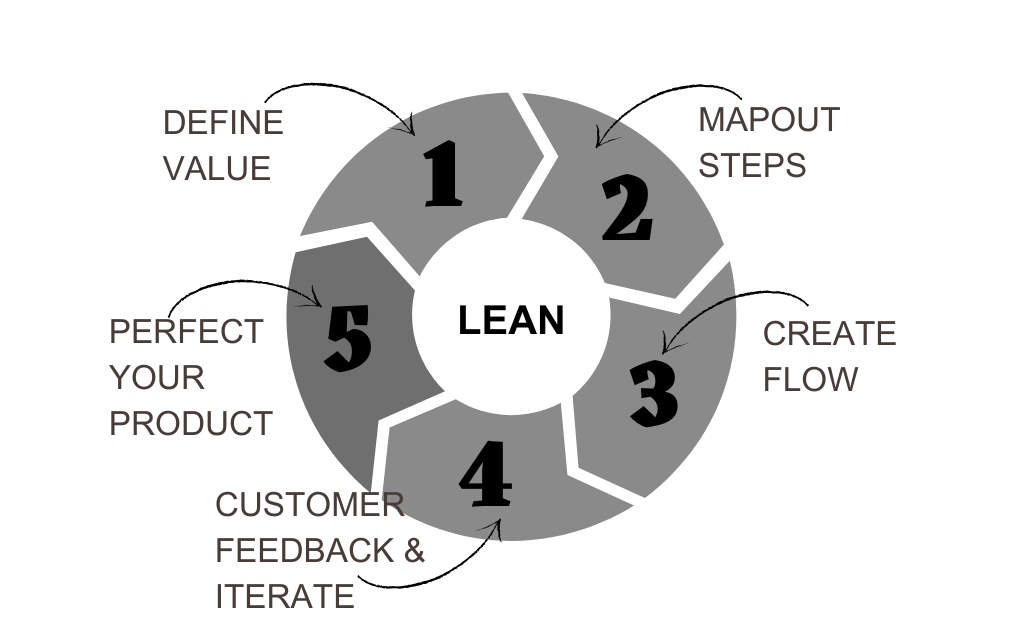
Fig 3: Lean Methodology
How to Apply Lean Principles in MVP Development
The MVP approach is central to the lean methodology. When building an MVP, you only incorporate the core features that make your product functional. Subsequently, you release your product to early adopters, gather feedback from them, analyze it, and use it to iterate on the product.
The development process aligns with the principles of lean because you use minimum resources and feedback from real users who have interacted with your product to iterate, hence minimizing waste.
The lean methodology fosters building only what is needed, checking assumptions early to make decisions based on user data. It is also essential to help you focus only on the essential features, cut non-essentials, and allow digital products to be built and iterated rapidly.
Choosing the Right Tech Stack for Your MVP
Choosing the right minimalist tech stack for your MVP is an important decision that affects the success of a product. The tech stack should correspond to the goals, technical requirements, and limitations of your MVP.
Criteria for Selecting a Tech Stack
The failure to select a proper tech stack to develop your MVP will lead to scalability, maintenance, and security issues for your product. Selecting the right tech stack is important because it also influences the cost of developing your tech product. When building your MVP, you need to consider the four layers of creating a tech product, i.e., frontend, backend, database & hosting platform.
Different programming languages & software packages apply to each layer, and you need to identify the appropriate stack for your product’s development while considering the ease of scalability, maintenance, and security levels.
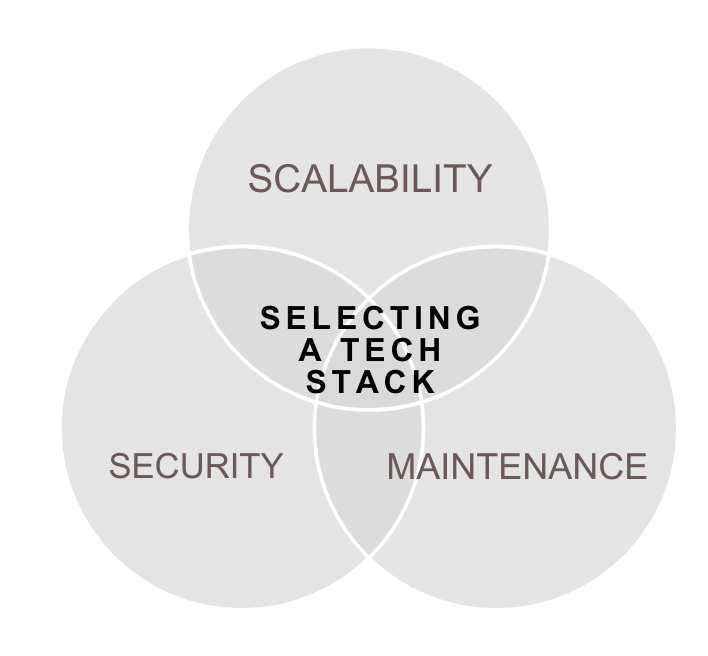
When selecting the tech stack for your MVP, it is essential to weigh the long-term considerations against the immediate needs. You should consider long-term factors such as the technology’s scalability, maintenance, and security because they are fundamental to the success of your product.
Effective Project Management
Effective project management is essential in MVP development to keep the project focused, timely, and within scope. It is a strategic process of planning, executing, and monitoring product development while incorporating flexibility and iterative improvement.
Project Management Methodologies
Different MVP approaches enhance efficiency and adaptability. Three relevant project management methodologies for MVP development include:
- Agile: Within agile, the MVP helps increase the pace of your tech product and ensures delivery is regular. This methodology encourages flexibility, where your development team responds quickly to customer feedback and then iterates the product to release a better version. It is repetitive in nature and a process done continuously in order to achieve maximum value delivery to consumers.
- Scrum: An incremental approach that, based on agile and lean methodologies, focuses on the project timeline, including the roles your team would have for each delivery cycle.
- Kanban: Just like Scrum, Kanban also borrows from agile and lean. It is the visualization of your project objectives and each of the members’ roles to ensure a flow of work continuously.
Agile, Scrum, and Kanban form the basis for speedy and effective product development.
Managing Costs During MVP Development
The success of MVP development depends on proper cost management and budgeting. Good cost management will not only keep your project on track but also ensure resources are allocated efficiently.
Estimating Costs and Strategies for Staying Within Budget
Planning your MVP budget efficiently is critical to its success. The failure to budget for your MVP well can stall your project, especially if the funds you have are depleted before completion. Proper budgeting ensures that your MVP aligns with your financial capabilities.
Common Mistakes to Avoid in MVP Web Development
Undertaking an MVP is a remarkable journey because you hope to create a tech product that will be successful one day. However, the journey to developing an MVP is not short of challenges:
- Feature Creep: Including too many features in your MVP may overcomplicate things for your target audience. Feature creep makes it difficult for users to use your product, and that undermines its value.
Solution: Concentrate on the core features of your MVP. Apply the MoSCoW method to prioritize what to include in your MVP.
- Inadequate Market Research: Conducting market research is fundamental to the success of your MVP. Failure to do this will limit your understanding of the market, your target audience and your competitors. Improper market research affects the success of your MVP because you will not sufficiently understand how it fits with the target market.
Solution: Gather and evaluate data on your target consumers, competitors and the market in which your MVP will operate. Gaining these insights will help you understand how to position your MVP in the market properly.
- Poor User Experience: Poor user experience is caused by the failure to balance the simplicity and functionality of your MVP. Users face challenges such as crashing and long loading times when interacting with your product.
Solution: Use user stories to guide you in developing your MVP. Gather feedback and iterate your MVP based on the information that real users who have interacted with your product provide.
- Scalability Challenges: Scalability challenges arise once your product starts gaining more users, but its architecture cannot handle them. Scalability challenges arise due to increased costs to build and maintain your MVP, database limitations, and a lack of proper technical infrastructure.
Solution: Design your MVP to handle growth by selecting the proper technologies before you build it. You should also select cloud-based solutions that will save you on costs in the future.
Addressing common mistakes when developing your MVP will remarkably affect its success. To address these challenges, you need to understand the scope of your MVP and why you’re building it. This helps create a clear roadmap for your MVP and informs the development process.
What Tools and Resources are used for Market Research?
Tools and resources that aid in market research and validation include SurveyMonkey, Google Trends, and Typeform.
What Tools are used in Project Management?
What tools are used to create user-friendly designs?
What are the popular Tech Stacks for MVP Web Development?
MEAN stack, MERN stack, LAMP stack, and MEVN stack are popular tech stacks used for MVP Web Development.