
MVP benefits startups and small businesses as it helps them to validate their assumptions about customer needs, market demand, and the business idea’s potential. It benefits you as the founder by enabling you to get into execution mode and start working on your business idea.
Nolan Bushnell, founder of Atari and godfather of the computer gaming industry, aptly says, “Everybody who has taken a shower has an idea, but who got out of the shower, towel off and execute on those ideas do make a difference”. In an era where tangible results are paramount, focusing on practical implementation and delivering outcomes leads to triumph in the competitive business world.
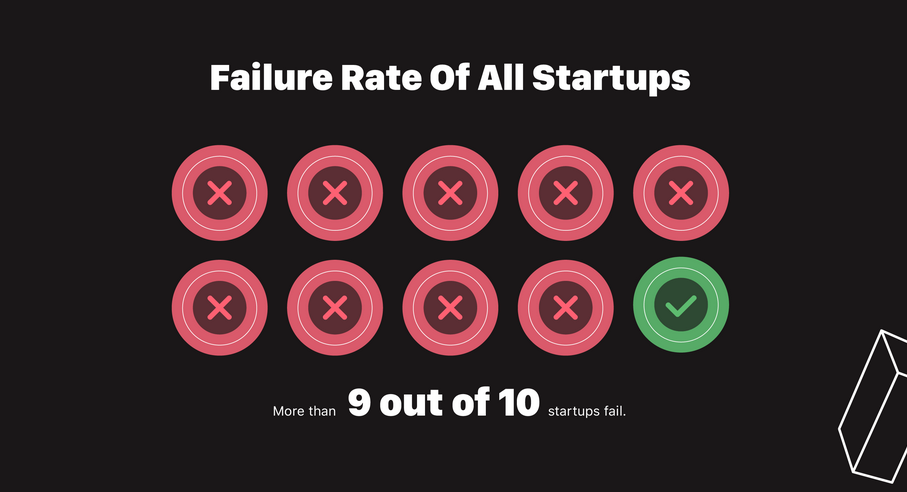
As the CEO or founder of a startup, what matters is the results. According to statistics, less than 1.5% of firms worldwide make it to the list of successful startups(source: Startup Genome)
But why so much failure? Why are the new ideas not working? Many variables lead to successful outcomes, and the most essential variables include
- Your ability to figure out market demand and how high the demand is
- How effectively do you reach out to the customer to serve the demand in the market
- Your ability to identify the customer needs and validate those needs
- Building a tech product that can effectively address those needs
- The team that will make all this happen
Why start with an MVP?
Eric Ries introduced the concept of MVP, or Minimal Viable Product. According to him, an MVP is “the version of a new product that allows a team to collect the maximum amount of validated learning about customers with the least effort.” A business needs to understand customer expectations to create a successful MVP.
For example, Amazon started as an online bookstore on July 16, 1995, offering Internet users a vast selection of books. By focusing on listing books and enabling online purchases, they solved a specific problem. They learned about customer needs, paving the way for future growth.
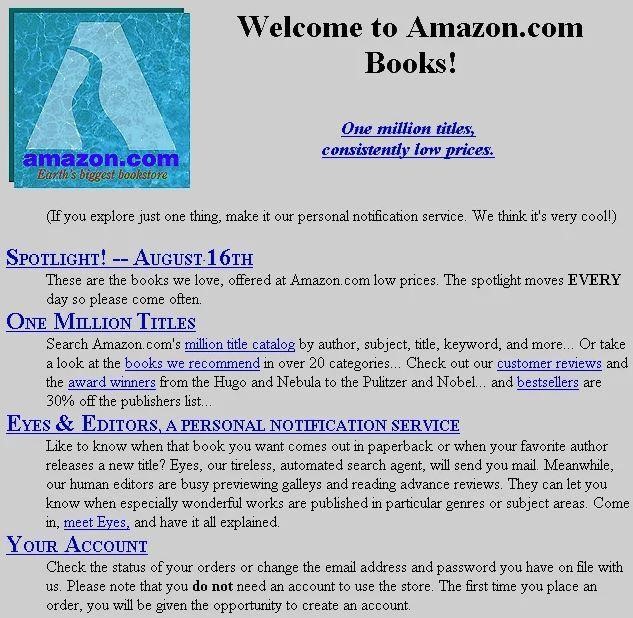
Amazon.com first release. Users could buy books that were listed on the website.
Later, they added multiple products after successfully selling books online. This business strategy helped them to get a deep understanding of whether the idea is workable or not. And to receive customer feedback and iterate to improve their product & supply chain operations.
Why is MVP development important for startups and small businesses?
Undoubtedly, startups and small businesses have innovative ideas in their kitty. They can easily create solutions. But to become successful, you need investments, and investors require:
- Data that proves your idea will be successful in a vast market.
- The demand for the new product will keep increasing in the market.
- Your customers trust that your product is solving a core problem
MVP benefits your data points for all the above-stated points, which leads to making your pitch firmer and more robust. The data you collect from your MVP will become the base of a product that is 10x better than the existing products and solutions in the market.
What are the purpose & benefits of MVP in startups and small businesses?
The MVP aims to test your idea’s potential before investing in complete product development, discover what makes sense to your potential customers, and launch the product as soon as possible.
MVPs are created to collect validation data points about new products.
- Validate Ideas: An MVP provides a real-world test for your business idea, allowing you to validate assumptions, identify potential flaws, and make necessary adjustments before committing significant resources to full-fledged product development.
- Enhances customer satisfaction: involvement of customers from the beginning has an advantage. This will help you incorporate their feedback. You can create a better product that meets their needs and expectations, leading to higher customer satisfaction.
- Risk Mitigation, Cut Costs, and Saved Resources: By using MVP, you can validate your idea through user feedback collection. This requires minimal time, capital, and resource investment and provides a clear picture of whether the product will work or not.
- Building a Functioning Solution: An MVP is a functioning solution with limited features that allow you to generate revenue, attract early adopters, and establish a market presence.
- Quicker Time to Market and Competitive Edge: The product launch will be faster than the usual development with MVP. You have already tested the product using the MVP version and are confident about the results. This will reduce competition and increase the chance of success.
- Allows for Gradual Product Development: The MVP model gives you the benefit of using an iterative approach to product development. Based on the feedback, you can analyze the features and add new ones or rectify the older ones.
- Feedback Analysis and Data-Based Decisions: The feedback and usage data gathered from the MVP can provide valuable insights, allowing you to make data-driven decisions about future product enhancements and business strategies.
Building an MVP is a strategic approach that allows startups and small businesses to efficiently test their ideas, validate their assumptions, and iteratively develop their products while minimizing risks, conserving resources, and gaining valuable insights from real users.
How does launching the MVP early impact the success of your new business idea?
The average required time to build a minimal viable product is three to nine months, depending on the complexity of the problem you are solving. Launching your MVP as soon as possible allows you to gather feedback, refine the final product, and understand the customer demand. When the launch takes 12 to 24 months, it will not only delay the validation of your understanding of the market and customer, but it will also impact your motivational levels, increase cost,s and create additional challenges for the launch. Planning your MVP timeline carefully to minimize delays and potential losses.
What are the goals of the MVP?
An MVP is intended to:
- Test the market demand for the new product that you will develop.
- Validate your assumptions about the problems you are solving for customers.
- Your product’s concept and how it’s solving customer problems.
- Refine the product vision and enhance it further so that it’s a simple, lovable, and complete product.
Each of these goals serves a specific purpose in the development process:
– Test the market demand for your idea: Launching an MVP helps gauge sufficient interest and demand for your product concept before investing heavily in development.
– Verify your product’s concept: It allows you to validate your product’s core functionality and features, ensuring that it resonates with your target audience and solves their problems.
– Refine the product vision: Feedback from early users helps you understand what aspects of the product need improvement, allowing you to refine and enhance your product vision and strategy.
– Choose the future direction of your product: Insights gained from the MVP phase guide future development, helping you prioritize features, make informed decisions, and align with market needs and user preferences.
What should an MVP contain?
Think of an MVP as the first version of a simple, lovable, and complete product. It should have all the basic functionalities without unnecessary complexity, and its experience goes far beyond what customers use today.
- The MVP should highlight to customers what sets your product apart and how it addresses specific needs or problems in a new or improved way.
- MVP will be your data collection tool to get feedback for improvements.
- For customers, it is valuable evaluator to know your approach better and provide the best feedback for improvement.
The concept of building the MVP was introduced in 2001, when there was little competition for software products. Today, customers are overwhelmed with choices, and if you approach building your product that is barely functional and is not at least 3x to 10x better, the chances of it getting shortlisted by your potential customer for evaluation are far less.
What needs to be done before building MVP?
Before launching a business, you should do market research to understand the demand of your market. Suppose you know the market already and have the insights that you have gained after working for many years in the industry. In that case, you can create an excellent, simple, lovable, complete product. Find the answers to the following questions:
- What are the problems customers are facing, and which issues still need to be solved?
- What will be the demands of your product in your target audience?
- What are the general market trends in the industry? Don’t rely much on the reports generated by the consultants or big consulting firms.
- Who is your competition? And what are their revenue trends from the last five years? And how will you differentiate your product from them?
- How much is the customer willing to pay? How much are customers already paying to use the competitor’s product?
- What is the cost of serving the customer?
- How will you promote your product and reach potential customers?
After answering the above questions, you will better understand the market, customers, and competition. Now is the time to identify the personas who will use your product, define the user journeys, create the design, and define the MVP roadmap.
Many first-time entrepreneurs spend far less time on research, discovery, and design and directly think of hiring a developer to build the MVP, which leads to a tech product that is not working or not aligned with the customer’s core needs.
Planning Your MVP
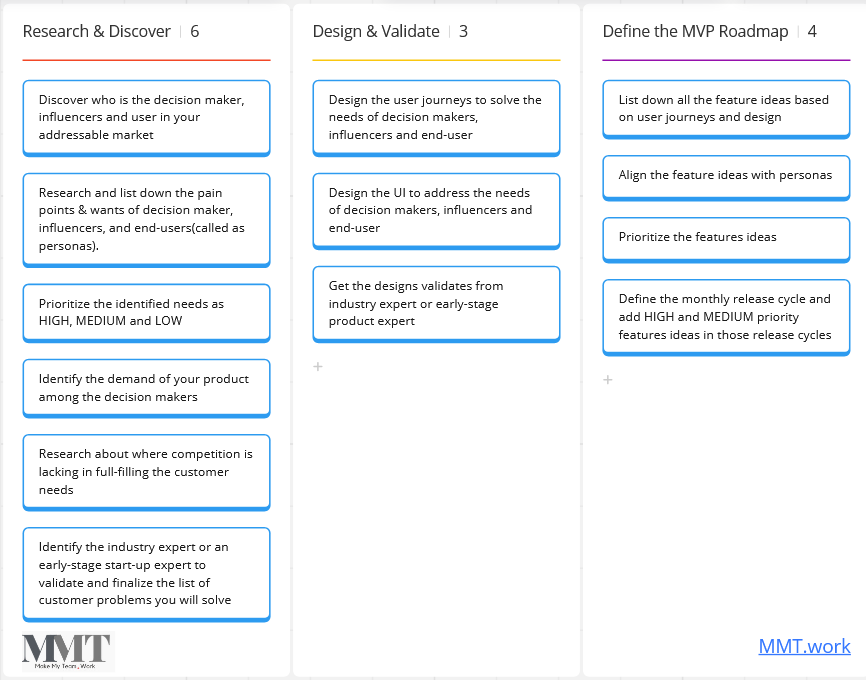
Before you start building your MVP, you need to plan the MVP-building roadmap. After getting pregnant with your startup idea, it’s time to do research, discover, and design, which will lead to building the roadmap for your MVP. Planning is the first trimester of building your business, so don’t rush and take things slowly.
The four-step process to planning to MVP includes
- Research & identify the decision-makers, influencers and users in your target market
- Design user journeys and User Interface
- Define the MVP roadmap
How do I build an MVP?
Many founders and businesses share stories of investing time and money in building the MVP but ending up with software that is not usable by their customers. This problem is especially faced by founders and businesses where tech skills are missing, and small digital agencies take advantage of them.
The following things need to be taken care of before you start building if you want to build your MVP on time and within budget:
- Spend time doing market research, understanding your customer and their pain points
- Create the user journeys and designs
- Define the feature ideas and MVP roadmap based on addressing the most crucial customer needs/problems.
- Write down the specs
- Identify the technical roles required to build your MVP
- I always prefer hiring people with 0-to-1 product-building experience over those with software-building experience.
Before you kick off your product-building cycle, make sure that someone has taken the project manager role and is accountable for delivering things on time and within budget. During the first two months, ask your product builders to give a demo of whatever is developed.
Testing and Iterating Your MVP Benefits
Once your MVP is out, customers will be lined up to buy it. I am joking 🙂; that never happens. The MVP is your first step towards making sure that customers start taking you seriously. They might not be paying customers, but have agreed to use your product and provide you with feedback. Based on the feedback, you will start getting input from different customers.
At this time, you should identify the typical pattern among all the feedback you have received and quickly iterate and improve your product. Incorporating this feedback will continue with other items in your MVP backlog that you have not targeted in the initial launch.
But remember that you should avoid getting caught in a feature trap where a customer says that if you develop this feature, they will buy your product.
How many types of MVPs are there?
There are two major types of MVP:
- Low-fidelity MVPs: These are produced quickly and inexpensively, and they often entail creating a modest prototype with basic but complete wireframes. You can use this as a testing tool to get customer demand signals and feedback. This will verify your idea and determine whether it fulfills the market’s needs. This will save you time and money, which you will invest in a complete product.
- High-Fidelity MVP: These are more developed prototypes with better functionality and design. They are based on a functioning prototype. They are simpler versions of the finished product, focusing on the design and the user experience. These are time-consuming and costly compared to low-fidelity MVPs. Still, they also give realistic and better results and help refine the decision.
Start by creating the low-fidelity MVP, which will enable you to start having conversations with the customer. You can even start selling it to potential customers with low-fidelity MVPs. Once you have some validation about the customer’s interest, begin building the high-fidelity MVP.
Challenges and Pitfalls
Common Mistakes
- Do not ignore user feedback; analyze it carefully.
- Try to implement only the selecting and critical feedback that you will receive. List the important ones and incorporate them.
- Building an MVP is about converting imperfect ideas into digital workflows and solutions customers are happy to pay for. Take your time in launching, and keep analyzing and iterating.
- While iterating, pay attention to time and cost, and do all this as cost-effectively as possible.
There is no perfect recipe for buildingan MVP; if someone is coming to you and claiming one, run away from that place. Mistakes are bound to happen, but keep analyzing which mistakes will have a higher cost and will delay your journey, and try to ignore them. This may impact negatively on your MVP benefit.
Frequently asked questions about Minimal Viable Product(MVP)
What comes after MVP in business?
After MVP comes the next improved version of MVP, which helps you to make your potential customers pay for your product.
What does MVP stand for in a startup?
MVP stands for Minimum Viable Product.
How do you build a successful MVP?
Building a successful MVP requires a deep understanding of the market, the problem you want to solve, and how and where you can find an early customer to try out your product. The team consists of skillful experts and product builders who can create a successful initial tech product that solves the identified problem without requiring extensive coding.
Are MVPs only for startups?
MVP as a concept be long applied to all kinds of products out there, irrespective of the size and domain of the business.
Do you need an MVP to get funding?
While it’s not necessary, overall VC sentiment across the globe is changing towards building profitable businesses. You will be in a better place to raise fund, if you have MVPs and few potential paying customers who are using your product and getting value out of it.
How do I create an MVP for my business?
Steps to create MVP:
Define the problem
Know the target customers.
Research about the competition and market demand.
Create a user journey map
Develop MVP roadmap.
Design the MVP
Develop & test MVP by dividing the MVP roadmap into monthly release cycles.
Get the feedback, analyze, and iterate.
Building MVP is relatively easy today if you have hired the right product-building team and when you have created the right culture of innovation, speed, and bonhomie in the team.
What are the characteristics of MVP?
The characteristics of MVP are:
Focus on core features.
Rapid development and launch
Clear User Feedback Mechanism
Focus on learning and iteration
Market validation and fit
A good MVP enables you to validate the market demand, get deep customer insights, and helps you understand what will the customer pay for and what is just good enough.
What are the benefits of MVP in agile?
The MVP is essential to agile development since the process relies heavily on verifying and iterating products in response to user feedback.
Is MVP Agile or Lean?
MVP is based on Lean methodology
What is the alternative to MVP?
Simple, Lovable, and Complete (SLC) is another term used for MVP, but there is no specific alternative to MVP.
How is MVP connected to the lean startup methodology?
It is a core concept of the Lean startup methodology. According to Eric Ries, an MVP is a new product that enables a team to gather as much data and validation about customer problems as possible with the least amount of work.






[…] Consistently checking these boxes ensures that you not only validate your product idea, but de-risk your startup business. […]
[…] practices can enhance the efficiency of agile and iterative MVP development. They […]