
The concept of a Minimal Viable Product (MVP), coined in 2001, is the most common but, simultaneously, the most misunderstood buzzword in the startup world. Stacy(not a real name) has worked hard over the last 15 years in various companies and finally became an HR head in a leading FMCG company. But in her head, she always dreamed about starting her tech startup one day.
Being a people leader, she always understood the importance of coaching and how that can help unlock the employees’ potential. Her idea was to create a global coaching platform to help company employees, especially managers, become better managers.
Though Stacy has insights on how to solve the problem of coaching people, being from a non-technology background, she needed to figure out how to approach building a tech product that can enable employees to get coaching from experts worldwide.
Unless she finds a cofounder from a tech product and technology background who has experience building and scaling products, Stacy needs to understand the concept of a minimal viable product. A minimum viable product (MVP) is the first version of a product that helps you to test and validate your hypotheses, which includes but is not limited to
- Are you solving the right problem?
- Are you targeting the right audience?
- How soon can you enable the customer to release the value from the usage of your product. ?
- And will your target audience pay for it?
What is the meaning of MVP?
“A minimum viable product is the simplest version of a product with minimal features that sets you on the path to understand, validate and iterate on the potential of your idea.”
Understanding MVPs: Importance and Benefits
Most startups die after 36 to 48 months. Your startup will survive after 36 to 48 months if you correctly approach the development of minimal viable products. And when things move in the right way, you will generate revenue that will set you on the path of building a profitable business and company.
The building blocks of a great company are good revenue, great margin, and lower cost. MVPs done the right way set the foundation for achieving them. And here is how MVP sets you on this path:
- MVP sets you on the path of developing the product that delivers the desired value to early customers.
- MVP, done right, delivers only those features that actually solve the customer’s problem rather than developing too many features, leading to a lot of technical and functional debt.
- MVP done right sets you on the path of lower operational and people cost
- MVP, done in the correct approach, sets you on a path to scale your product quickly.
- MVP done right sets you on the path to achieving the product-market fit.
- Lastly, you build a product that will be 10x better than
Approach MVP as the foundation of building your version 0.1 of the product that will help you to bring initial revenue from the early adopters and give you confidence that you are solving the right problem.
How to Identify Core Features for an MVP
The process of identifying the core features that will go inside the MVP starts with identifying the customer problems, needs, and desires. It’s not easy to identify the actual problem because, most of the time, the founders get carried away with what they want to improve in this world compared to the exact problems that customers want them to solve.
You have an added advantage of a founder-market fit, if you have worked over the years in the industry and domain where you want to build your new tech business and product. However, managing your ego, existing beliefs, ability to view the world as-is and managing your biases will be your biggest challenge.
Start talking to people in the industry and domain if you don’t have working experience in the domain where you are building the tech product. Go outside the building and start talking to your potential customers and your potential users. In addition to that, start with studying your competition, where they lack, their annual reports, and their employee feedback to get a deeper understanding of the domain.
Jot down the list of all customer needs and pain points and prioritize them. Once you have the customer problem and needs identified, start creating the user journey maps. A journey map is a visualization of the users’ process to accomplish a goal. And then create a list of features that will help you achieve those journey maps.
Once the feature list is ready, create the UI designs and the roadmap to build the MVP. To achieve all this, you need an awesome team of a product manager, UI/UX designer and if possible an early stage-startup expert. It’s not a one-person job.
MVPs types for your idea
The type of MVP that you need depends on the kind of problem that you are solving and the workflows within your target audience.
Developing MVP using a no-code, low-code platform: Many no-code, low-code platforms today can help you build your MVP. Once you master the no-code, low-code platform, developing the app is easy and economical as you do not need to hire people to build the product. The downside of leveraging the no-code low-code platform is that you need to master the no-code low-code platform yourself or hire a person who knows how to use that platform to build an MVP. Scalability, customization, and achieving custom workflow using no-code and low-code become problematic after a while.
Developing MVP using an existing platform: Platforms like Shopify are the best place to start if you want to build an e-commerce business. Platforms like Mighty Networks, Kajabi, or Meetup will help you, if you want to build a community based business. And platforms like marketplacer.com and sharetribe might help you, if you want to develop a marketplace-based business. These platforms will give you a good starting point for you to build your MVP.
Developing MVP from the ground up: This option makes sense when your idea is somewhat unique, and/or the workflows within your product will be complex, and/or you have B2B enterprise-level customers, or you want to give your customers a specific UI/UX experience. Developing the MVP from group up will be difficult, especially if you need to learn how to code yourself. Knowing how to code might be an advantage, but do note that developing a product is altogether a different ballgame than building software. The upside of building a product from the ground up is your ability to customize and scale it the way you want.
Many first-time founders, especially those coming from non-tech backgrounds, lack an understanding of which particular approach will work better for them. It is better to ask for help and advice before you start your journey of building your product.
Step-by-Step process for building an MVP
Building a startup needs a lot of grit and perseverance. There is this school of thought that “build fast and fail fast”, though I disagree with it; the unsaid part is that you should learn fast and iterate fast. The major phases involved in achieving your MVP involve
- Phase1: Research, Discover and Design
- Phase 2: Build your MVP
- Phase 3: Iterate and enhance your product
Phase 1: Research, Discover and Design
It is well-known wisdom that a problem well-stated is a problem half-solved. Many businesses and founders rush toward building the product without spending time doing the required research, discovery, and design. This phase involves
- Clearly defining the problem that you want to solve and the customer needs you want to address, Validating if the problem is worth solving or not, and validating those customer needs,
- Defining the user journeys, optimizing them, and prioritizing which user journeys you want to automate and which ones you don’t or should not automate right now
- Defining the features that will help you achieve those user journeys and customer needs
- Design the UI and UX to achieve the defined user journeys.
- MVP roadmap
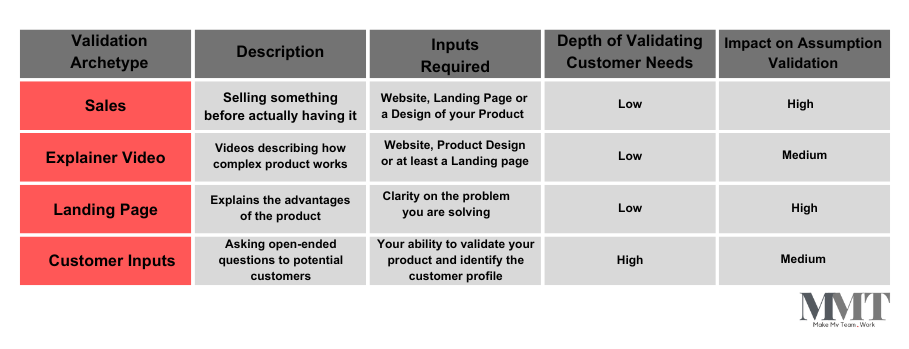
Here are a few ways to further enhance your understanding of customer needs and your idea’s potential.
Phase 2: Build your MVP
Building MVP needs user journeys, UI/UX designs, MVP Roadmap, and the team to help you build the product. Budget is the most important concern. And if you can code it yourself, go for it. Otherwise, find the technical cofounder or people who can help you build the MVP. Divide the entire MVP roadmap into the 3-week delivery and 1-week cool-off period. This means that product feature ideas will be delivered every three weeks.
In the last week of the month, the team fixes the defects and bugs, followed by a demo of the functionality developed. People and process are both crucial aspects when developing the MVP. Only get those people in the team who have experience building a 0 to 1 product earlier. The process is important because otherwise, it will take nine months to two years to build your MVP, and you spend a lot of money just on building.
Phase 3: Iterate and enhance your product
Once the MVP is built, the founder must spend most of their time creating awareness in the market, reaching out to potential customers, and selling the product. Developing the MVP and selling it both are part of checking the potential of your idea. From now on, it will take anywhere from 24 to 36 months(sometimes longer) before you reach a stage where you can understand if your business is a viable business or not. At this stage, make sure you spend as much less money as you can and iterate fast to improve your product.
The founders have to wear many hats and should seek help and advice from appropriate people during each phase. The biggest mistake first-time founders make is either not seeking help & advice or assuming that they know all.
How Do You Set Up a Team to Build Your Minimum Viable Product?
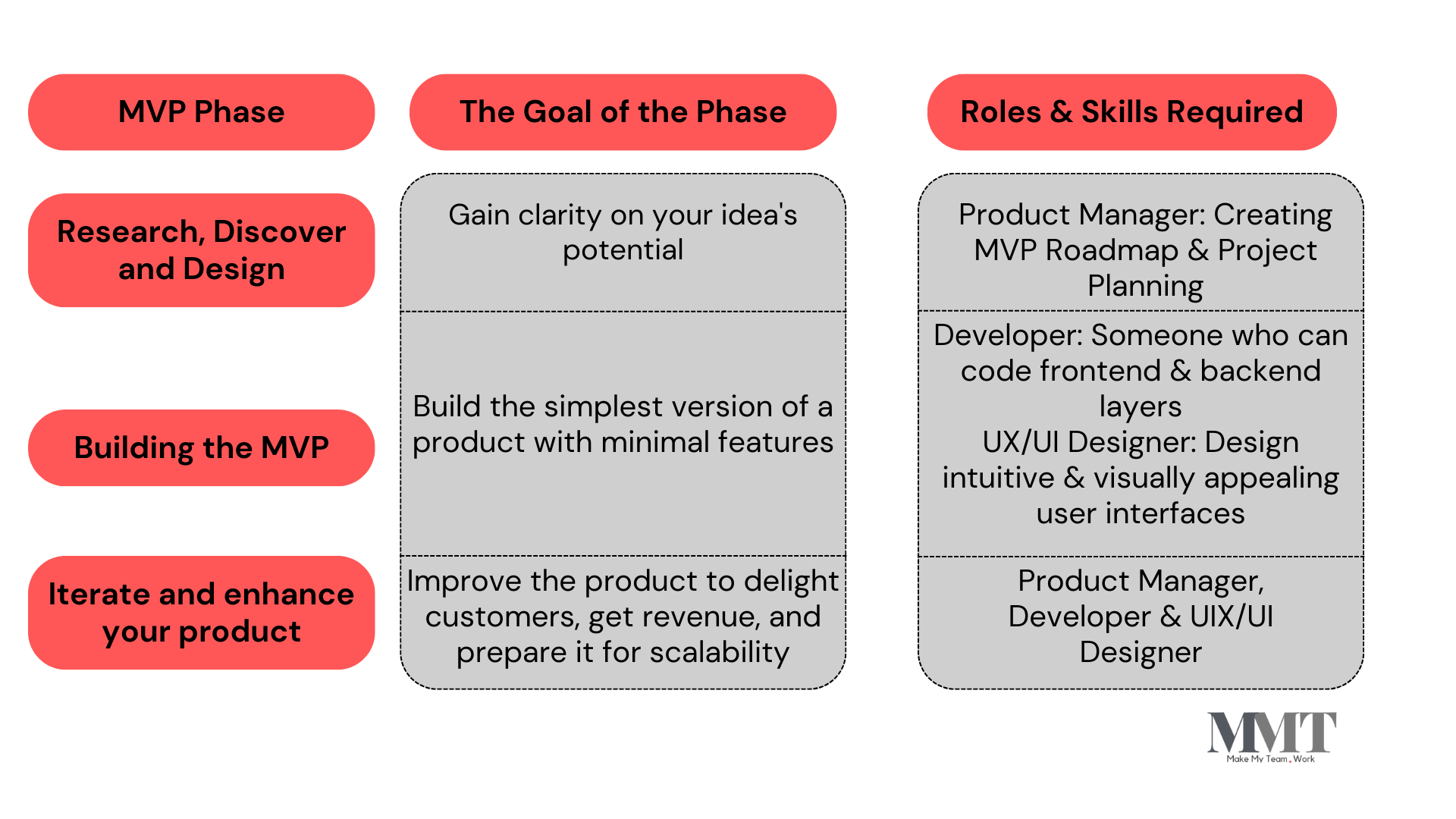
You need people with different skills in different phases of MVP development. Here is the breakdown of the skills required in different phases of building an MVP:
What are the Tools to Build an MVP
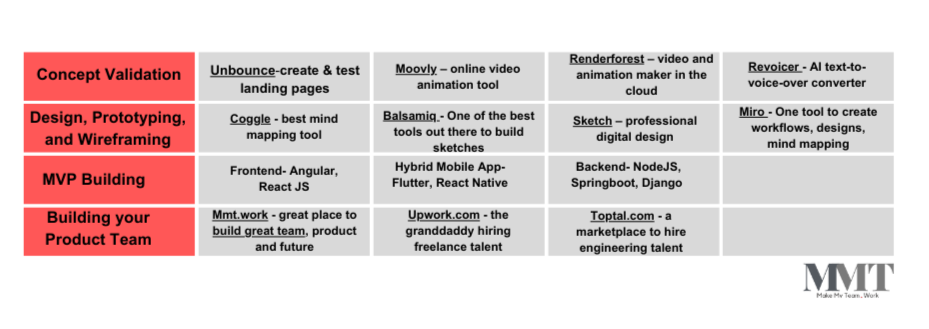
Case Studies and Examples of the Successful Minimum Viable Product(MVP)?
MVP Case Study 1: Uber
How the design looked like during the initial phase


Their initial targeted customers and how they acquired them
Local tech community in San Francisco. Uber approached them by sponsoring local tech events and giving free rides.
How they onboarded the users
Initially, the founders themselves used it; it was invited only, and to gain access, you had to send an email to the founders. Later, they opened an app where users could sign up.
Features introduced in MVP
- Book the cab and give feedback to the driver.
Features introduced later
- Live-tracking of drivers
- Fare splitting
- Automatic credit card payments
- Fare estimates
MVP Case Study 2: Salesforce
How the design looked like during the initial phase


Their initial targeted customers and how they acquired them
Marc Benioff, one of Salesforce’s founders, confessed that it was more like asking for a favour—not pitching. Salesforce was one of the first companies where software was operated just by using a browser, so imagine how hard it would be for someone to decide to replace an existing way of using on-premise software with SaaS-based software. The first few enterprise customers used the software for free.
Features introduced in MVP
- Contact management
- Opportunities
- Accounts
- Reports
Features introduced later
- Process builder
- Sales path
- Omni-Channel
- Predictive data
How to build a successful MVP?
There is no defined recipe that can act as guidelines for building and launching the MVP. And if somebody is claiming that they can give you one, show them the door or run away as fast as you can from that place. But the most common principles to follow when building MVP are:
- Understand the market in which you will play the game and, in parallel, find your team with whom you will build your dream. Once you have narrowed down the problem, you want to fix it in this world.
- Start by deeply understanding the problem your customer faces without letting your bias come in between. The art of identifying the problem starts with cultivating the right view, i.e., seeing the world as it really is, not as we believe it to be or want it to be.
- After you have identified and nailed down all the customer pain points and problems, prioritize those needs and
- The first version of the product should solve the customers’ top priority problems at least three times better than the existing alternative.
- Before you build your MVP, identify your strengths and the roles needed in your 0 to 1 journey of building the product and business. Do not compromise on the quality of talent; do not try to do everything on your own.
- Focus on giving your customer a delightful end-to-end experience on day 1. And it’s okay if the way in which you give that experience is not fully tech-enabled.
- Test the quality of your product before you launch your first version.
*Tip for first-time founders: Building a successful MVP is not complex; if you are able to manage your own bias and, as a founding team, able to see things the way they are, that’s the starting point!
How Much Does an MVP Cost
The cost of developing any product depends on the complexity of the problem you are solving, the team you need to solve that problem and the location of those people. It can cost you anywhere from $40k to $200K for a product with low to average complexity. The most common roles required to develop a product are
- Product Manager
- System architect
- Full-stack product developer
- Product designer
- DevOps Engineer
- Quality assurance engineer
- Might be a project manager
One person can play multiple roles; for example, the product manager can play the role of the project manager. The QA role might not be required if the developer develops quality code. If the developer is senior enough, she can play the role of system architect and DevOps, too.
As a founder from a non-tech background, you need a technical cofounder who can play multiple of the above-stated roles and help you hire freelancers/contractors or team members who can play other roles where she lacks expertise.
Quality Assurance Testing when building MVP
- Early error detection
- Long-term cost savings
- Proper security protocols
- Improved User Experience
- Increased stakeholder confidence
The famous quote “build fast and fail fast” has led many people to assume that it’s okay to launch a sub-par product. That statement might have been true when the industry was moving from the waterfall model of software development to an agile way of developing software. But it’s not relevant in today’s context when most industries have intense competition, and the product should be at least 3X to 10X better.
Early detection of errors in the product not only improves the quality of the product but is also helpful for long-term cost savings. The major types of errors include
- Functional errors prevent customers from gaining the desired value from the product and cause them to lose confidence, which is imperative for generating initial revenue.
- Technical error leads to scalability issues and increased cost and, again, may lead to loss of user and customer confidence.
- Security-related issues, if not addressed, can lead to your data getting hacked, or if you are targeting enterprise customers, you may even lose the business.
- UX/UI-related issues, which are mostly ignored, should be fixed to give customers delightful experiences.
Founders should play the role of QA, if possible. As founders, if you cannot allocate time to test the product, hire a QA engineer who can do that job, especially when you are outsourcing your product development. And during your build phase, just allocate 2 to 3 weeks to find the bugs and 2 to 3 weeks to fix them. During this time, don’t develop any new features.
How to Launch after MVP is developed
Building and launching the MVP should be just one of the milestones of the overall GTM. Once built, the go-live activities should include
- Update your website with more product details, and update the screenshots of the products.
- Start sharing details about the product on your blog. Don’t be afraid to share what’s unique and how your product solves the customer problem.
- Invite the beta users who have agreed to use your product. Start offering your product for free as the journey to validate the customer problem and needs and the potential of your idea has just started.
- And finally, start selling; revenue is the biggest validator.
Talk to experienced founders, and they will tell you that the actual job starts after you have built your MVP. While celebrating the completion of MVP development is a must, as it’s good to celebrate small wins in the startup journey, don’t make it a deal.
How can larger established businesses benefit from the MVP approach to developing new products?
From time to time, many businesses take the initiative to develop a new product
- For a new business initiative
- Enhance internal operations,
- Optimize supply chain
However, moving things faster becomes a challenge because of the sheer size of the business and the fact that most employees are focused on solving business-as-usual problems. Often, we have seen that most of the New Product Development(NPD) initiatives get delayed, the cost exceeds the actual budget allocated, and the people allocated to the NPD initiatives are not the right fit.
While people in larger businesses have started adopting startup lingo and principles, unless the execution mindset is adopted, NPD initiatives will continue to be delayed or fail to produce the desired outcomes.
When the MVP approach to product development is adopted, which includes identifying the right people for the job and the right process, larger enterprises start seeing more success in their NPD initiatives.
Advantages of the MVP approach to product development
If done right, the MVP approach of building a product leads to
- Early realization of the revenue.
- Customer delight will help you spread the word about your product.
- Reduced cost as the focus is on developing only those features that solve the most important customer needs
MVP (Minimum Viable Product) approach for building the product is now well known, but where people fail is to do it in the right way because they are not able to find the right team & talent to do the job.
Challenges and Common Mistakes in MVP Development
The common reasons why new businesses and products fail have been known for at least the last 10 years. But what hasn’t changed or increased is the success rate of new businesses.

If you take MVP development as the process to increase your chances of success, here are the common mistakes that you should avoid :
- The biggest enemy of fledgling business success is getting carried away by your biases and falling into the trap of proving yourself right.
- You will not carefully understand the market in which you will play, the demand for your to-be-built product from potential customers, or the needs of the customers. It needs proper research, patience, and a lot of talking to all the people in the ecosystem.
- You are not talking to enough customers to validate your assumptions. Ideally, you should speak to at least 10 to 50 potential customers.
- Not hiring the right team, product, and tech lead. Ideally, you should have someone who can play the role of CPTL( Chief Product and Tech Lead) and work with you to refine your idea and build the product along with other team members.
- Not following the proper process when designing the product, setting the product architecture, building the MVP roadmap and developing the MVP.
- Not following the agile way of building the design and developing the product. The product manager/project manager should ensure that the team remains focused on delivering the MVP roadmap.
- Not getting the product demo every week during the process.
- Do not focus on the quality of the MVP developed.
Tip for the first-time founder is to find someone who can act as a sounding board and help you to remain focused, help you to manage your emotions and help you build a product that is not feature-rich.
MVP vs Full Product Development
Over the years, the narrative of MVP communicated over the internet has been that it’s okay to build a scrappy product and that it’s okay if customers struggle to get a basic value out of it.
The MVP approach of product building was promoted, suggested, and adopted because before Agile and MVP as concepts became popular, the product was developed by following the waterfall way of system development, in which a full end-to-end product was developed after the customer’s requirements were understood and documented. The biggest drawback of full product development was that, by the time the product came out, the requirements & expectations of the customers had changed. Thus, it was wise for the products to be released sooner, in 3 to 6 months, so that we could validate our assumptions faster.
However, in the last ten years, many markets have consolidated, and customers already have too many choices.
So, it’s certainly not advisable to create a full-scale product, but the goal of the MVP should be to build a Simple, Lovable, and Complete (SLC) product. In this complex world, it’s expensive to find simple things that do the job and do it in a way that customers love using. And the features that are offered, at least those, are complete in themselves.
“Products that do less but are loved are far more successful than products which have many features but do not solve the customers core problem.”
How do we evolve beyond MVPs, and what comes after MVPs?
Once the MVP is out and all critical bugs are resolved, give a gap of at least 2 to 6 months before you develop any new feature, even at the cost of the potential customer saying that he will come back after developing these ten things, and he will buy.
Keep evolving the core features you have developed. You will reach this state only after investing time in market research, customer validation, and designing the MVP roadmap and user journeys.
After you have met 10 to 50 customers, start improving your product and prioritizing again only those features that enhance customer delight by solving their most pressing problems. At the same time, keep simplifying your product, even at the cost of removing those features that you think will no longer be required by the customer.
Once the MVP is out, it’s also time to improve the product’s security, reduce the technical debt, and prepare for product scalability.
Future of MVP Development
Undoubtedly, the emergence of API and machine learning tools will further improve the future of MVP development. But what will remain up to you as a founder is your ability to gauge market demand and customer needs and how you validate those needs.
- AI will help you generate the first version of your market research report. At the time of this writing, this tool was doing a good job.
- AI can help you to generate the wireframes; check this
- AI can help you in creating the scope of work and user stories. Use tools like Read.ai when discussing the product and what should and should not be developed. Read.ai will create a summary that you can use.
- AI tools like Co-pilot can help you with coding and enhance the quality of the code you write by generating test cases.
Generative AI tools like OpenAI and Gemini might help you with generating a message that you will send to your potential customer with whom you want to talk, but it’s you who has to go out of the building and meet the potential customer and ask open-ended questions to help you better understand the problem she faces in her daily life and current challenges she faces in addressing those problems.
Common FAQ when developing MVP
How to make a good MVP?
Avoid jumping directly to developing the product.
Sending more time on Doing market research and understanding the demand for the product,
Customer discovery and validation of the customer problem that will generate revenue.
MVP roadmap and design should be put in place before you develop.
What is the lifecycle of MVP?
The lifecycle of the MVP includes
Identifying the customer problems you want to solve
Validating the customer’s problems
Prioritizing those problems
Identifying all the personas/users who will be using your product
Creating the user journey maps
Creating the UI sketches & designs
Creating the MVP roadmap
Delivering the MVP roadmap.
What makes an MVP?
A simple, lovable, and complete product that solves the customer’s core problems and meets their needs.
In which stage is an MVP created?
After you finish the market research, understand the customer needs and wants and validate those needs. To summarize, when you have started seeing that your idea has potential.





[…] Product and Technical consultant (FCPTO) can help you convert your vision and mission into an MVP roadmap, which, once built out, will help your customers get value out of your product and help you […]
[…] a Minimum Viable Product (MVP) is a creative process, and you need people in your team with a high creativity quotient and good […]