
A minimum viable product (MVP) is a minimalist version of a product that incorporates some basic features to solve a specific problem for your target audience. The MVP development approach enables startups to quickly enter the market through the validation of a product idea and the establishment of its market fit.
A minimum viable product is the solution to satisfy a pain point for your target market. When you own a startup, you want to get your product to the market and assess the reception as fast as possible. These facilitate this and allow you to gather insightful feedback from early adopters. Minimum viable products are iteratively refined into polished products that attract customers and potential investors. Ultimately, this is the gateway to innovation, presenting you with a fast means of market entry to learn with real interactions and iterative improvement of your product.
Importance of Minimum Viable Product for Startups
Developing and bringing a new product to the market is risky because you’re unsure about how the consumer will react to it. Having a great idea is no guarantee of success. So, it’s necessary to follow an approach that will consume fewer resources. This is where they come in. They take less time and investment compared to developing a full-fledged product. They also enable iteration based on the feedback received, thus making it the most advisable approach for a startup.
Reducing Time to Market
These products incorporate a few features necessary to make your product usable. The average time taken to develop such a solution is between three to four months, which is shorter compared to building a full-fledged product. This approach allows you to release your product to the market as soon as possible and gather user feedback. User feedback is used in iterative development, making your product more appealing and user-friendly.
Testing Product-Market Fit Early
The starting point in creating this product is the identification of a problem that needs a solution. When you identify a problem, you draft a hypothesis (which is an assumption) on how your product can be used to solve this problem. You can then develop your solution with features that could potentially solve the problem.
Your product is then released to the market to test its viability. That minimal launch is intended to help you understand whether your product is answering every need and expectation of the end user.
Attracting Investors with a Working Prototype
A minimum viable product is the most suitable way to get investors interested in your product. Having a great idea is simply not enough to convince investors that it is viable. They need a demonstration to indicate the potential of your product and prove their investment will not go to waste.
The MVP approach allows you to prove your concept by gathering feedback, iterating, and validating your idea. The process helps you determine the viability of your product and validate the product-market fit. Your product also gains traction, proving its ability to generate revenue. This aspect proves your product’s financial viability, building investor’s confidence in its ability to return on their investment.
How does MVP Development Facilitate Quicker Market Entry for Startups?
In the startup world, getting your product to the market as early as possible is key to success. This approach will help your startup gain a strategic edge to enter the market early. You also engage your product idea and test it with real users early in the development cycle.
Thus, you gather insights about market needs and user preferences early and iterate your product based on real-world feedback, which aids in releasing something with customer value to the market early. Let us further analyze how product development facilitates quicker market entry for startups:
Rapid Validation of Business Ideas
It only incorporates the core features of a product. These features are functional and directly address the problem you aim to solve. This product is not a perfect product, meaning it has a lot of room for improvement made through iterations.
They allow you to quickly release your product to the market and validate it by focusing on a few functional features. After release, you gather customer insights quickly, which helps you determine the viability of your product.
Efficient Use of Resources
This solution focuses on the core value proposition of your product. The best approach allows you to direct resources to developing a few functional features. For example, it needs fewer developers as opposed to a full-fledged product, saving you on labor costs.
The validation process also helps you learn from customers and make iterations based on real user feedback quickly. This process saves money because the changes made to your product directly address customer needs and help you avoid wasting it on processes that do not serve their interests.
Faster Adaptation to Market Needs
These products embody the agile methodology, which allows them to integrate customer feedback quickly and adapt to changing market conditions. Startups gather feedback and iterate fast based on real user feedback. This enhances the product’s viability in the market within a short period.
Early Visibility and Brand Building
The product approach is important in helping you build your brand visibility early. What early adopters get attracted to is the value proposition of your product. Adding their feedback makes them feel important, thus increasing customer retention. Early adopters are critical in building your brand since they can recommend your product to other users based on their experience. Another likely side effect of positive early adopter reviews is that more people will want to try your product, further increasing the exposure it gets.
Competitive Advantage through Early Entry
Developing a solution against a fully-fledged product fastens entry into the market. Early entry into the market means that you get to collect customer feedback and iterate to suit the needs of the users quickly enough. It gives you the ability to enhance the value that you offer consumers, thus creating their brand loyalty. An increase in brand loyalty boosts your customer base, making your brand more visible.
An increase in your customer base means an increase in your product’s market share, giving you a competitive advantage over other startups offering the same or relatively similar products.

Common Challenges and Solutions in Minimum Viable Product
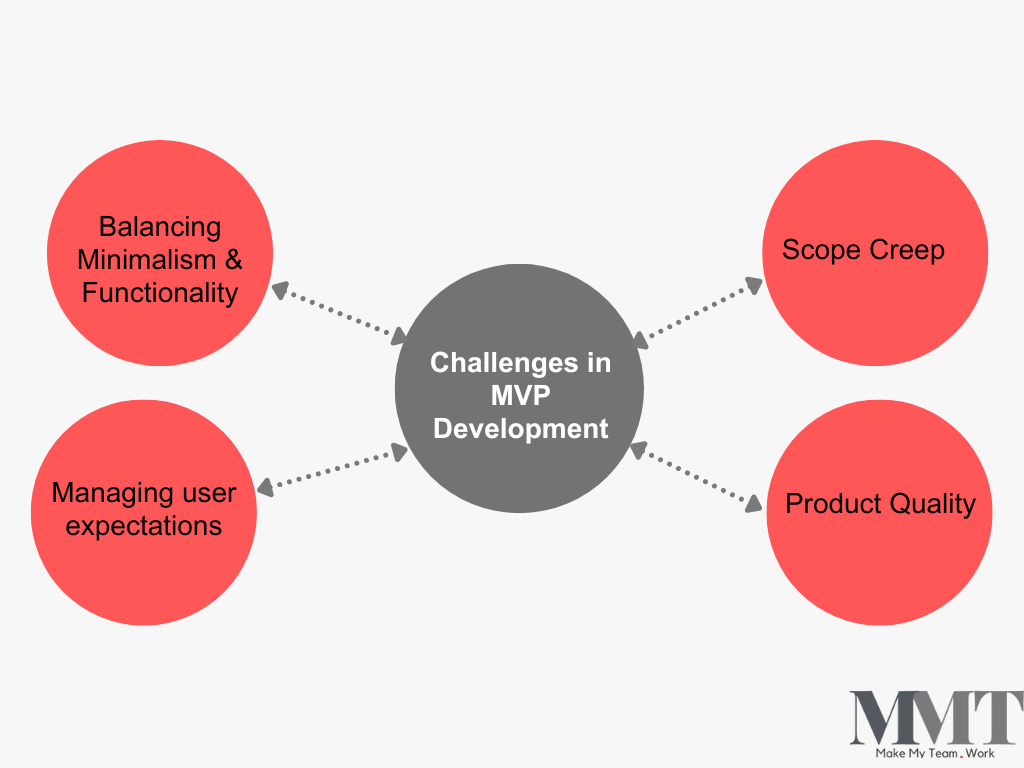
The journey of product development will attract various challenges for any startup. Every challenge you encounter requires a strategic solution to overcome it. Addressing challenges allows your startup to refine its approach and improve the possibility of a successful market introduction. Let us examine some possible challenges and solutions encountered in the product development journey:
Balancing Minimalism and Functionality
This product only prioritizes the core features that offer value to target consumers. The definition seems simple enough, but it is challenging to determine which features to include or exclude while maintaining the functionality of your product. The best way to address this challenge is to establish the primary goal of your ideaP and the problem it aims to solve.
Subsequently, integrate features that directly solve this problem. User feedback also helps you determine which features should be a priority. The iteration process is based on user feedback and allows you to add or remove features while ensuring that your product is still functional.
Managing User Expectations
Your MVP needs to be user-centric, as they will, after all, be the ones using your product continuously. In building a user-centric product, you will need to gather feedback from users. This does not mean including every recommendation given by users in your product. You need to filter feedback and analyze it to find recurring recommendations or complaints.
Such assessments help you to gauge what is to be implemented. You should also communicate with the users and assure them that you work day in and day out on improvements to give the best value to them.
Scope Creep
Scope creep occurs when the deliverables of your project increase compared to the ones set in the initial project scope. Picture having set goals and milestones before commencing the project. A month into development, the goals increase.
Adding deliverables is necessary at times, but you should ensure that it does not derail the project plan. You should focus on attaining the initial goals of your project, and if you have any extra deliverables, add them to future sprints or pivot your product.
Ensuring Quality in a Minimal Product
An MVP usually has a minimal number of features but this should not degrade the quality of your product. You will experience challenges as you try to offer the best value for your consumers. You should know the important features that provide the solution to the problem you mean to solve by using your MVP, knowing that those features have to be objective-oriented. Your product will have to be quality in its minimum form in order to prove to early adopters that it is worthy of their time and money.
Tools and Resources for MVP Development
Product development requires proper tools and resources for it to be developed and launched successfully. These tools and resources will make the design process, building, and testing your MVP easier. You require proper tools and resources to grow your product idea from conceptual to launch. Various tools used in MVP creation include:
Prototyping Tools
Prototyping tools allow you to visualize, test, and refine your MVP. They also facilitate the creation of interactive wireframes and mockups that you can experiment on before your MVP goes into development. Here are five examples of prototyping tools you can use for your project:
- Figma, which has design and collaboration features to design an entire workflow and facilitate the creation of high-fidelity prototypes. FigJam, its whiteboard tool allows your team to share product ideas through features such as sketching, commenting and voice notes.
- Sketch, which facilitates the creation of interactive designs and shows how your product would work in real life.
- InVision Studio, which is a design tool with animation features.
- Webflow, which allows the creation of live websites.
- Axure RP, which allows users to create realistic and interactive prototypes without having to code
You should choose your prototyping tool based on your budget and the desired outcome of your project.
Development Frameworks
Development frameworks are essential in building your product and bringing your ideas into reality. They grant the ability to rapidly and effectively develop applications through writing code.
Development frameworks can be either front-end or back-end. The front-end frameworks will be used by your development team to construct the user’s interaction side, usually referred to as UI, by integrating components of HTML, CSS, and JavaScript. Conversely, backend frameworks pay attention to the server side of your product. Examples of backend frameworks include Django, Laravel, Next.js, and Ruby on Rails.
You need to choose your MVP development framework based on your project needs and requirements and their functionality, such as speed, performance, and scalability.
User Feedback Tools
Iterations made to your MVP are based on user feedback. You need to choose the right user feedback tool, which will help you gain proper insight into effective iteration. Examples include Typeform, SurveyMonkey, Feedbackify, and UserVoice. This helps collect, interpret, and analyze feedback, which is integrated into your MVP for better results in terms of user experience.
Project Management Tools
Project management tools like Trello, Asana, Jira, and Wrike are important to help you in efficiently manage the workflow of your MVP. They help you in breaking down your project into milestones and task delegation and in tracking its progress with the team. The project management tools enable you to visualize the development process of MVP and keep yourself on track for timely completion.
What are the Risks Associated with Product Development?
The MVP approach is preferred when developing software products because it takes a short time and mitigates many risks associated with developing a full-fledged product. The approach is suitable but still associated with some risks:
- Inadequate market research leads to poorly informed decisions. You should analyze the scope of your product’s market, competitors and customers and use the insights gathered to make decisions related to your MVP.
- Misinterpreting user feedback and data, which leads to misguided conclusions. To avoid this, you should review feedback carefully and understand the voice of your customer. You should also take advantage of user feedback tools to gather and analyze data from your customers.
- Underestimating the cost of developing your MVP, leading to delays. You should map out and visualize your project to make it easier to determine the cost of every aspect of your MVP. You should also include a budget for unexpected changes to avoid stalling your project in case it needs you to take a different direction.
When planning for your product development process, you should also anticipate possible risks and challenges and have an actionable plan to address them.
How do I Measure the Success of My MVP?
Metrics and KPIs can be deployed to gain insight into the performance of your MVP versus desired goals. Some of the metrics and KPIs that are widely used in describing the performance of your MVP include:
Revenue, retention rate, bounce rate, the number of active users, user complaints versus positive reviews, the time spent using your product and referral rate. Your metrics and KPIs will vary depending on the nature of the product and what it aims to achieve.
How Long Does it Take to Develop an MVP?
MVP development takes approximately three to four months. It all depends on the kind of MVP, the features that are required for functionality, your team size, and experience, alongside expertise within your team.
While all these factors directly relate to the development timeline, it is important that your MVP is built within the shortest time possible.







[…] Market procurement is the fuel to your startup rocket. A strong illustration of a business opportunity is important in a pitch deck because it proves: […]