

Work models have undergone significant shifts over the past decade. Companies moved from office-bound teams to remote collaboration and global hiring. Freelance platforms grew as businesses searched for flexible talent and faster execution. Short-term contracts, or fractional work, became common during rapid digital expansion.
This shift led to a new structure. The move from freelance to fractional reflects a demand for deeper involvement and consistent outcomes. Businesses still want flexibility, yet they also need continuity, context, and accountability. Fractional roles answer that need by blending commitment with adaptability.
Companies are now rethinking short gigs. One-off tasks rarely support long-term goals or complex execution. Ongoing fractional roles provide stability, knowledge retention, and strategic alignment while preserving cost control. This evolution marks a more mature approach to modern work.
The Early Days: Freelance and Gig-Based Work

Freelance and gig-based work gained traction as digital tools lowered hiring barriers. Platforms made it easy to source talent for design, development, marketing, and content. Companies used freelancers to solve immediate problems without long commitments. This model reduced commitment and costs but often lacked continuity and long-term ownership.
What Sparked the Shift Toward Fractional Work?
As companies scaled faster, work grew more complex. One-off tasks no longer solve ongoing operational challenges. Businesses needed experienced talent that could stay engaged without full-time overhead. Fractional jobs emerged as a response to these evolving demands due to the following:
- Rising Complexity of Products: Modern products require coordination across design, engineering, data, and strategy. Fractional roles provide consistent oversight across moving parts.
- Demand for Senior Expertise: Growing teams need experienced leaders, not just task executors. Fractional models give access to senior talent without full-time costs.
- Remote Work Normalisation: Distributed teams became standard across industries. Fractional work fits naturally into remote-first operating models.
- Budget Discipline and Cost Control: Companies seek predictable spending during growth phases. Fractional roles offer structure without heavy payroll commitments.
- Need for Continuity and Accountability: Short gigs often lack ownership. Fractional contributors stay involved long enough to drive measurable outcomes.
Fractional work reflects a more deliberate way of building teams. It combines flexibility with responsibility and supports sustainable growth. This shift signals a smarter approach to modern talent engagement.
Understanding Fractional Jobs Today
This work model provides ongoing access to specialised talent without full-time commitments. Professionals contribute on a defined schedule while staying embedded in core workflows. This structure supports consistency, context, and long-term impact.
Modern fractional roles extend beyond execution. Fractional leaders guide strategy, manage teams, and support decision-making. Their involvement brings experience and stability during growth phases.
Companies use fractional work to stay agile. Teams expand or contract based on real needs rather than fixed roles. This approach balances flexibility with accountability and supports focused execution.
Fractional Roles vs. Gig Work vs. Traditional Consulting
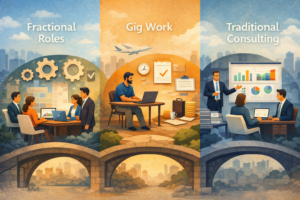
Fractional roles sit between short-term gigs and traditional consulting. They offer consistent involvement without full-time commitment. This balance supports execution and strategic alignment over time.
Gig work focuses on isolated tasks. Freelancers complete defined deliverables and move on quickly. This model works for simple needs but often lacks continuity and ownership.
Traditional consulting provides high-level guidance through structured engagements. Consultants advise, review, and recommend actions. Execution usually stays with internal teams, which can slow progress.
Fractional roles combine strengths from both models. Fractional professionals stay engaged long enough to understand context and deliver outcomes. They contribute hands-on while guiding decisions with practical experience.
As companies scale, this middle ground becomes valuable. Fractional work delivers expertise, accountability, and flexibility without excess complexity.
Case Study 1: Basecamp — From Freelance Collaboration to Long-Term Fractional Contribution
Basecamp began in 1999 as a small web design consultancy called 37signals, founded by Jason Fried and Carlos Segura. The team built websites for clients while experimenting with internal tools to manage projects.
One of those tools solved a recurring problem. Client communication felt scattered, slow, and confusing. That internal solution became Basecamp.
The product launched publicly in 2004. Unlike many startups of the era, Basecamp did not pursue rapid headcount growth. The company stayed intentionally small and profitable.
From the beginning, the founders focused on clarity, calm workflows, and sustainable pace. This philosophy shaped how they built both the product and the team.
Early development happened alongside client work. Revenue from consulting funded product progress. This structure required flexibility. The company relied on external collaborators for design, writing, and specialised work while keeping a lean internal core.
How Basecamp Used Flexible Talent to Scale
Basecamp’s growth followed a clear pattern. The team stayed small while work expanded. Instead of hiring aggressively, they leaned on external contributors for defined needs. Over time, several of these contributors became recurring collaborators rather than one-off freelancers.
- Freelance Specialists for Defined Needs: Designers, illustrators, and writers supported specific projects. These contributors worked independently with clear scopes. This reduced overhead while maintaining creative quality.
- Long-Term External Collaboration: Some contributors worked with Basecamp for years. Relationships deepened through repeated engagement. This created continuity without full-time employment.
- Small Core Team with High Leverage: Basecamp maintained a deliberately small internal team. Decisions stayed focused, and communication remained simple. External talent expanded capacity without bloating structure.
- Clear Ownership and Documentation: Work was guided through written communication and documentation. Contributors understood the context without constant meetings. This allowed external collaborators to operate with autonomy.
- Leadership Stability Without Layered Management: Founders remained closely involved in product direction. External contributors supported execution, not hierarchy. The model reduced complexity while sustaining output.
This approach allowed Basecamp to ship consistently while avoiding the chaos often tied to fast scaling. The company grew revenue, users, and influence without adopting traditional hiring playbooks.
Outcomes and Long-Term Impact
Basecamp became known for its strong product identity and calm company culture. It reached millions of users worldwide while remaining profitable. The team published books, launched new products, and maintained long-term independence. Their operating model challenged assumptions about growth and hiring.
Basecamp’s use of recurring external contributors shows an early version of what many now call fractional work. Talent was engaged with continuity, trust, and accountability, yet without full-time contracts. This balance supported speed, focus, and sustainability.
MMT helps modern companies adopt similar structures with more clarity and scale. Businesses gain access to fractional leaders and specialised talent who stay engaged over time. This approach delivers continuity and execution without forcing companies into rigid hiring decisions.
Case Study 2: Polywork — From Early Network Vision to Evolving Collaboration Platform
Polywork launched in 2020 with a clear mission: shift professional networking away from rigid job titles and toward a platform that reflects the multifaceted nature of modern careers. The founders saw that professionals no longer wanted a singular description of their work.
The timing was right. Remote work was on the rise, and digital platforms were reshaping expectations about professional engagement. Polywork’s platform offered users a way to showcase everything they did beyond a 9-to-5, from speaking on podcasts to collaborating on side projects and finding beta testers for new ideas.
This vision resonated with investors. In 2022, Polywork secured $28 million in Series B funding led by major backers, including Nat Friedman and Andreessen Horowitz, bringing total financing to more than $44 million.
Development Focus and Product Evolution
Polywork’s core product centers on enabling professionals to create rich, modular profiles that reflect their many interests and accomplishments. These profiles allow users to share achievements, announce opportunities for collaboration, and connect with others based on real work they want to do, not just the jobs they hold.
The early phases of product development focused on solving key user pain points:
- Capturing full professional identity: Traditional networks emphasize job titles and single roles. Polywork’s design allows professionals to present their varied engagements and aspirations without constraints.
- Facilitating collaboration: Users can find others open to specific opportunities, whether speaking, mentoring, or building projects together.
- Supporting dynamic networking: The platform encourages connections that extend beyond typical employment models, embracing side projects and passion work.
These product priorities reflect a broader shift in how work itself is evolving, where individuals pursue multiple interests and companies seek partners who can contribute in flexible ways.
Scaling and Talent Strategy in Context
While Polywork’s documented history does not specifically detail the use of fractional engineering leadership, its mission and rapid growth before it ran out of runway aligned with broader trends in flexible talent strategies.
As tech companies build platforms that rely on rapid iteration, modular work, and cross-disciplinary collaboration, they often benefit from blended teams composed of internal staff and specialised external contributors.
This blend of expertise helps maintain momentum during growth phases without overwhelming core teams. Companies facing similar challenges have found that engaging specialised leaders on a fractional basis can shape architecture, inform design decisions, and strengthen product systems without long-term overhead.
Lessons for SMBs
Polywork carved a niche in the digital professional landscape by enabling users to express their full range of contributions. It carved a niche in the digital professional landscape. Its trajectory highlights several insights relevant to talent strategy:
- Innovation often arises at the intersection of evolving work models and technology.
- Platforms that embrace flexible contribution formats can resonate deeply with modern professionals.
- Scaling such platforms may benefit from talent strategies that blend internal focus with targeted external expertise.
MMT helps companies build platforms for modern work by providing access to fractional engineering leaders and specialised talent. This support allows teams to scale product development at minimal cost and quality expertise without expending their runway.
When Should Companies Consider Making the Shift from Freelance to Fractional Work?

The shift from freelance to fractional often begins quietly. Projects start overlapping, decisions repeat, and the same problems resurface each month. Teams realise that short engagements no longer match the pace of their ambitions. Fractional contracts step in when momentum matters more than transactions.
Companies should consider the shift when work becomes continuous rather than task-based. Repeated freelance handoffs often slow progress and weaken accountability. Fractional roles suit teams managing ongoing development, strategy, or operations. This model supports consistency while keeping flexibility intact.
Conclusion
Work no longer fits inside rigid roles or short transactions. Companies need talent models that evolve with pace, complexity, and ambition. The shift toward this module reflects a smarter balance between flexibility and ownership. It supports momentum without sacrificing focus or continuity.
Contact us to get a free fractional fit audit and see how fractional talent can support your next stage of growth.
FAQs on the Evolution of Fractional Work
How are fractional contracts different from traditional freelance work?
Freelance work focuses on short tasks with a clear end date. Fractional job involves ongoing contribution and a deeper context. The relationship is continuous rather than transactional. This leads to stronger ownership and better outcomes.
Which roles work best in a fractional model?
Leadership, strategy, engineering, design, and operations fit well. These roles benefit from continuity without full-time presence. Fractional contributors guide decisions while staying hands-on. The model works best where expertise drives momentum.
Is fractional hiring suitable for early-stage startups?
Early-stage teams often gain the most value from fractional roles. Founders access senior experience without heavy payroll commitments. This support helps avoid early mistakes and speeds execution. It also preserves flexibility during growth.
How do companies manage fractional team members effectively?
Clear goals, documentation, and ownership matter most. Fractional teams integrate into existing workflows and meetings. Strong alignment replaces constant supervision. The focus stays on outcomes rather than hours.