


There was a time when success meant clocking in early and leaving late. The longer the hours, the higher the badge of honour. But that version of work started to crack. People began asking tougher questions about balance, fulfillment, and ownership of their time. The answer evolved quietly into what we now call fractional work.
Fractional work is the modern way of contributing part-time across multiple projects or companies, allowing professionals to offer specialised expertise without committing to a single full-time role. It’s a system built on flexibility and mutual benefit. Businesses gain access to top talent on demand, while workers design careers that match their skills, interests, and lifestyles.
Fractional work is the architecture of a new workforce. To understand where it’s headed, you have to see where it began, and why now is the perfect time to take part in it.
Roots in Academia: The Genesis of Fractional Models
The story of fractional work didn’t start in tech companies or startups. Itt began quietly in universities. Long before “fractional” became a business buzzword, academic institutions were already experimenting with flexible employment models to balance expertise, budgets, and teaching needs.
In academia, fractional appointments allowed scholars to divide their time between research, teaching, and consulting. Professors often held part-time roles across multiple institutions, contributing their knowledge where it was most needed.
This structure gave universities access to high-level expertise without the cost of full-time positions, while giving academics the freedom to pursue research or projects outside a single campus.
It was an early form of shared talent; an exchange of knowledge that crossed borders long before remote work became mainstream. Universities operated like ecosystems of borrowed brilliance, where one expert could teach in London, advise in Singapore, and collaborate with peers in New York, all within a single academic year.
These fractional arrangements showed that value didn’t have to come from permanence. They proved that expertise could be distributed, time could be divided, and productivity could thrive without traditional employment structures. The academic model became a blueprint for what would later define modern fractional work: flexibility, multi-engagement, and mutual benefit.
Early Business Adoption: The Rise of the Fractional Executive

As the idea of flexible expertise left the halls of academia, it found its first serious home in the business world. Companies began to see that not every problem needed a full-time executive. Some just needed the right mind for the right moment. This realization gave rise to a new kind of leader: the fractional executive.
The Early Adopters: The Fractional CFO (2000s)
In the early 2000s, startups and small to mid-sized companies faced a familiar challenge: complex financial needs without the budget for a full-time Chief Financial Officer. Enter the fractional CFO, a seasoned professional who could guide financial strategy a few days a week or during critical growth phases. They brought expertise once reserved for large corporations to businesses still finding their footing.
The model worked beautifully. A company could access decades of financial wisdom without the cost of a full-time salary. Fractional CFOs became the bridge between startup agility and corporate stability, helping young companies scale responsibly while managing risk. This marked the first major shift from traditional employment toward fractional leadership.
The Great Recession Catalyst (2008)
Then came the 2008 financial crisis, a defining moment for the modern workforce. When budgets tightened and layoffs swept through industries, businesses had to rethink how they accessed talent. Hiring full-time executives became a luxury few could afford. The fractional model wasn’t just practical; it was survival.
Fractional executives—CFOs, COOs, CMOs—stepped in as flexible, cost-effective solutions. They offered strategic expertise without long-term commitments, allowing companies to rebuild with leaner, smarter structures. What started as an emergency measure soon became a strategic advantage.
The Pandemic Acceleration (2020-Present)
When the world shut down in 2020, remote work went from optional to essential overnight. Companies learned to operate without physical offices, and professionals discovered the freedom of designing their own work lives. The idea of a fractional career moved from niche to mainstream.
Suddenly, executives who once lived on planes and in boardrooms began managing teams remotely. Businesses realized they could tap into global talent pools and hire top specialists on a fractional basis—CFOs, CTOs, CMOs, even entire remote leadership teams. The pandemic didn’t just accelerate fractional work; it normalized it.

Today, fractional executives are no longer stopgaps; they are strategic partners. They bring outside perspectives, specialized expertise, and flexibility that full-time roles can’t always offer. What began as a quiet financial experiment has evolved into a global movement redefining leadership itself.
The rise of the fractional executive marked a turning point. It proved that experience could be shared, leadership could be flexible, and organizations could thrive without rigid hierarchies. It set the stage for a broader transformation—one where the future of work would be measured not by hours spent, but by value delivered.
The Fractional Ecosystem Today: A Mainstream Strategy
Fractional work is no longer an experiment or a cost-cutting measure. It has become a deliberate business strategy embraced by startups, scale-ups, and even Fortune 500 companies. What once looked like a temporary fix for small businesses has turned into a movement reshaping how organizations access leadership, talent, and innovation.
The Expansion of Roles
The first wave of fractional executives may have started with the CFO, but the model has now spread across the entire C-suite. Companies today bring in fractional CMOs to lead marketing transformations, CTOs to oversee digital architecture, CHROs to build agile people strategies, and growth leads to drive revenue expansion. These professionals operate like precision tools, stepping in when expertise matters most, scaling their involvement up or down as business needs shift.
Fractional teams don’t just fill gaps; they bring momentum. They plug into existing structures, elevate performance, and exit gracefully when the mission is complete. The approach has redefined what it means to “hire,” replacing permanence with purpose.
The Digital Infrastructure
The rise of modern collaboration tools has made this ecosystem possible. Platforms(mmt article) like Slack, Zoom, Asana, and Notion have erased the boundaries that once separated offices from living rooms. Communication flows across time zones, project boards track every milestone, and knowledge lives in shared digital spaces. Managing distributed, part-time teams no longer feels fragmented; it feels fluid.
Technology turned fractional work from a logistical challenge into an operational advantage. It allowed companies to tap into global expertise as effortlessly as sending a message or scheduling a call.
The Marketplace Revolution
As demand grew, specialized platforms emerged to connect companies with vetted fractional talent. Marketplaces and firms now curate networks of executives and specialists ready to step into leadership roles at a moment’s notice. Instead of spending months on recruitment, businesses can now access fractional leaders in days, matched by skill, experience, and industry focus.
This professionalization of the fractional market has given it structure and credibility. These platforms have become the new talent brokers, bridging opportunity with expertise.
Investor and Market Validation

The financial world has taken notice. Venture capital firms and private equity investors increasingly advocate for fractional teams within their portfolio companies. They see the value in deploying fractional leaders during critical growth phases or restructuring periods. The numbers support it as well. Companies using fractional executives often scale faster, spend less, and make better strategic decisions.
What began as a flexible employment alternative has matured into a full-fledged ecosystem with its own infrastructure, talent pipelines, and market validation. Fractional work has moved from the fringes of freelancing into the mainstream of modern business strategy.
Today, being fractional means being precisely where your expertise creates the most impact.
Why You Should Get Involved in Fractional Work
Fractional work is reshaping how people think about success, freedom, and value. Whether you’re a business leader or a professional, this model opens doors that the traditional workforce never could.
For Professionals:
Fractional work gives you control over your time, energy, and direction. Instead of tying yourself to one company, you can design a career that reflects your strengths and interests. You choose the projects, industries, and clients that align with your expertise. It’s not about working less; it’s about working smarter and doing more of what actually matters.
This structure rewards skill, not tenure. A fractional professional builds networks, partnerships, and reputations that span multiple organizations. The variety keeps your work dynamic, while the autonomy keeps it deeply personal.
For Businesses:
For companies, fractional work solves one of the biggest challenges in modern business: access to talent. Instead of hiring full-time executives for roles that don’t require constant attention, businesses can bring in specialized leaders to solve specific problems or drive focused initiatives.
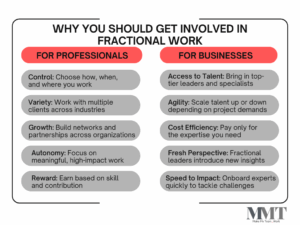
Fractional executives deliver senior-level expertise at a fraction of the cost, scaling their involvement based on business needs. This model gives startups access to world-class leadership without draining their budgets, and it gives established companies agility when facing growth or transition.
Fractional teams bring fresh eyes, fast impact, and flexible engagement, all without the long-term financial commitment of traditional hiring.
The beauty of fractional work lies in its balance. Professionals gain independence without losing stability, and businesses gain expertise without adding complexity. Both sides operate on trust, outcomes, and collaboration rather than rigid contracts and fixed schedules.
It’s the modern handshake between autonomy and accountability.
Fractional work represents more than a shift in how people earn. It’s a redefinition of how they contribute. Getting involved means stepping into a system built on flexibility, choice, and mutual growth. Whether you’re leading a company or building a career, this is the future of work that rewards impact over hours and innovation over routine.
The Future Trajectory of Fractional Work
Fractional work is he foundation of a new employment era. The shift that began quietly in academia and matured in boardrooms is now spreading across every sector, powered by technology, changing values, and a global appetite for autonomy.
The future workforce will look less like a pyramid and more like a network. Instead of rigid hierarchies, companies will operate through flexible ecosystems where talent flows in and out as needed. Projects will dictate teams.
A business might have a fractional CMO leading a campaign, a fractional data scientist optimising systems, and a fractional HR leader shaping culture, all collaborating seamlessly from different corners of the world.
Technology will keep expanding these possibilities. Artificial intelligence will make it easier to match talent with projects in real time, while digital platforms will act as talent marketplaces, connecting professionals and companies with precision. Smart systems will track outcomes, predict hiring needs, and manage cross-border compliance, turning the logistics of fractional work into a streamlined process rather than an administrative maze.
For professionals, this evolution will redefine career paths. Instead of following a single trajectory toward retirement, people will build multi-threaded careers, moving fluidly between consulting, entrepreneurship, and collaboration. Reputation, results, and relationships will replace résumés as the new currency of credibility.
For companies, fractional hiring will become part of the strategic core. It will no longer be a temporary fix for growth but a permanent model for agility. Businesses that embrace fractional structures will innovate faster, scale leaner, and stay adaptable in unpredictable markets.
The future of work will belong to those who value expertise over permanence, collaboration over control, and outcomes over hours. Fractional work represents that balance, a future where flexibility and excellence no longer compete but coexist.
Conclusion

Fractional work began as an experiment in flexibility, but it has grown into a defining feature of the modern economy. What started in academia, evolved through the financial crisis, and accelerated during the pandemic has now become a global standard for how people collaborate and create value.
This model has proven that success doesn’t have to rely on permanence. Expertise can move freely, projects can thrive without borders, and people can build meaningful careers on their own terms. It’s a system that rewards results, not attendance, and opens space for talent to reach its full potential.
Fractional work is the blueprint of what’s already happening. Those who recognize its power early will help shape the next chapter of work, one that values connection, creativity, and contribution above everything else.
You’ve read how fractional work is transforming business, now experience it. MMT.work helps companies access vetted, cost-effective fractional professionals worldwide, backed by full compliance and seamless management.
FAQs on Fractional Work
What exactly is fractional work?
Fractional work is a modern employment model where professionals contribute their expertise to multiple companies or projects on a part-time or contract basis. Instead of being tied to a single employer, fractional professionals divide their time according to business needs, offering high-level skills in finance, marketing, technology, operations, and more. It gives companies access to specialized talent without the cost of full-time hiring and allows professionals to shape flexible, impact-driven careers.
How is fractional work different from freelancing?
While freelancing often focuses on completing specific short-term tasks or projects, fractional work involves taking on an ongoing strategic role within a company. A freelancer might design a campaign or build a website, while a fractional professional, like a CMO or CFO, helps shape long-term goals, manage teams, and drive results over time. Fractional roles carry deeper involvement and accountability, blending the flexibility of freelance work with the leadership and commitment of an executive position.
What’s the difference between a fractional executive and a consultant?
A consultant provides expert advice and recommendations, often from an external, advisory position. A fractional executive, on the other hand, steps inside the organization to lead and execute strategy as part of the team. They take ownership of outcomes rather than simply offering guidance. Consultants tell companies what to do; fractional executives help them get it done. This hands-on involvement is what makes the fractional model so powerful for businesses seeking both strategy and execution.
How do I find and hire the right fractional executive for my business?
Finding the right fractional executive starts with clarity; define the problem you need solved and the expertise required to address it. From there, explore specialized marketplaces and talent platforms that vet and match fractional leaders based on industry, skill set, and experience.
Many firms now focus exclusively on placing fractional executives, making the process faster and more reliable. During selection, prioritize alignment with your company’s goals, culture, and communication style. The right match isn’t just about credentials; it’s about shared vision and the ability to deliver measurable impact from day one.
How do companies choose between full-time vs fractional roles?
Companies base the decision on scope, scale, and strategy. Full-time roles make sense when the work demands continuous attention, deep team management, or long-term operational oversight. Fractional roles fit best when a company needs high-level expertise for a specific phase, such as scaling, restructuring, or launching a new product, but not on a daily basis.
Many businesses now blend both models, using fractional executives to guide strategy while full-time teams handle execution. The goal is to match commitment level with business need, ensuring every role adds focused value.
How many hours do fractional roles typically require?
Fractional roles are designed for flexibility, so the time commitment depends on the company’s needs and the scope of work. Most fractional executives dedicate anywhere from 10 to 25 hours a week to a single client, though some may engage for shorter, high-intensity projects or split their time across multiple organizations. The key is impact over hours. Fractional professionals focus on strategic results rather than filling a traditional workweek.









[…] groundbreaking contributions across various sectors, including healthcare, technology, fintech, fractional work, and health and wellness. They have not only transformed their respective industries but have also […]
[…] a few days a week. Maintaining open and transparent communication becomes crucial to managing the fractional work team effectively if you use this work model. When working with a distributed team, […]
[…] The History of Fractional Work and Why You Should Get Involved […]