
Agile methodology enhances the process of MVP development and helps to empower you to build a better quality product within a timeline of three to five months. In the agile framework, you break down the entire MVP development into manageable phases to ease continuous collaboration and improvement.
Agile technique emphasizes using an iterative looping process to deliver working software. Before the agile way of software development, software development followed the waterfall way of software development, under which customers would get the working software after nine months to two years, which consumed a lot of resources and took a long time.
When you are building a Minimal Viable Product, applying the agile, iterative process leads to better incorporation of customer needs and market understanding, which eventually leads to a better overall product.
How Does Agile Methodology Enhance MVP Development?
Agile framework enhances MVP development by using an iterative approach that emphasizes the delivery of functional increments of the product. The approach allows you to swiftly validate your product idea by incorporating user feedback early and frequently.
Iterative and Incremental Development
Agile methodology allows you to combine iterative and incremental methodologies to deliver a high-quality MVP fast. Incremental delivery ensures that every subsequent version of a product is more functional and user-centric than the previous one.
Iterative development involves incorporating repeated cycles to improve your product until you meet its optimal value. Your team delivers work frequently rather than doing it all at once.
The process also subjects your MVP to a feedback loop that allows you to gather data from users, iterate, test, and re-release it. It is continuous until your product attains a level where it offers maximum value to your target customer and users of the product.

Agile: Iterative Incremental Delivery
Customer Feedback Integration
Iterative development is a significant part of your MVP development approach because it involves integrating feedback from your consumers in a continuous loop. MVPs gather customer feedback through surveys, interviews, online reviews, and focused group discussions.
It is essential to note that you do not only use the first input you receive from your consumers; rather, you gather feedback from different customers and users, analyze and incorporate it, and then release an updated version. You do the same thing over and over, releasing newer versions until you have the optimal product.
Flexibility and Adaptability
Once you release your MVP to early adopters, their feedback provides insight into what they actually need from your product. User feedback can require you to pivot your MVP, changing the requirements of your approach. An MVP in agile is flexible and quickly adapts to new requirements.
This allows a responsive and user-focused development process that aligns with the needs of your target audience. The digital age is fast-paced due to evolving market needs that demand constant innovation. Agility is key in making sure your MVP adapts to dynamic market needs.
Agility makes your MVP flexible by ensuring fast delivery of quality software that responds to market needs in short developmental cycles. Adaptability ensures that your product maintains its relevancy in relation to changing market trends. This also gives it a competitive advantage because any changes are delivered within the shortest time possible.
Faster Time-to-Market
Agile techniques such as Scrum and Kanban enable the fast delivery of working products. Scrum emphasizes iterative development and delivery, while Kanban involves visual representation of workflows to enhance efficiency. Scrum involves dividing tasks into sprints that should be completed within a specified duration, often 2-4 weeks. Kanban ensures continuous and efficient workflow to facilitate fast and timely task completion.
These two techniques enable the fast delivery of working software products. The foundational framework of agile is the rapid development of software products through Scrum and Kanban techniques. These techniques allow you to build and release your MVP to the market quickly. Releasing a product allows you to test its viability in the market. You also gather feedback from early adopters and use it for iterative development based on real-world data.
Risk Management
Agile methodologies allow you to breakdown tasks into phases known as sprints. A sprint is a specified period of time in which tasks should be complete and reviewed. Sprint Review and Sprint Retrospective are significant components of Sprint that allow you to identify and mitigate risks.
Under Sprint Reviews, your team presents the work done, which is then inspected and necessary feedback is offered. Sprint Retrospective allows you to determine what went well and areas of improvement. Agile practices such as incremental delivery and continuous integration and delivery (CI/CD) reduce development risks. When you incorporate incremental delivery, your team delivers work frequently in bits as opposed to doing everything at once.
Each increment represents a portion of your entire project. Incremental delivery simplifies tasks for your team and enhances efficient software delivery. Continuous integration and delivery involve integrating, testing, and frequently delivering code. Your team also runs automated tests to resolve any errors in code and ensure the delivery of quality software.
Step-by-Step Process of Agile MVP Development
Agile MVP development is essential to ensure you deliver a quality product quickly. It also ensures that you respond to any changes in the market fast and maximize the value of your product. Let us look at the step-by-step process of developing an MVP in Agile:
Initial Planning, Research, and Discovery
The first step you should take in MVP development is thorough market research and customer discovery. Market research enables you to gather data that supports or disproves your assumption. It also gives you a clear understanding of your customer base, competitors and market trends. After conducting adequate research, you should proceed to the initial planning of your MVP. The process involves defining the scope of your MVP and your goals and identifying core features to attain these goals.

Image by Startup Stock Photos via Pixabay
Defining User Stories and Backlog Creation
Next, you need to define user stories and your product’s backlog. User stories provide an explanation of software features from the end-user’s perspective. User stories give your development team the context of the product. Why are they building it? What does the product aim to achieve?
How do you achieve it? User stories should be clear and concise to enable efficient product development. Backlog creation, on the other hand, involves the work assigned, which will be done in the near future. Backlog gives your team an overview of what is needed to bring a product to life and what needs to be improved down the line.
Sprint Planning and Execution
Sprint planning is the third step of agile MVP development, and it involves defining the work to be delivered in each sprint. In sprint planning, you:
- Break down your project into phases known as sprints, also called as cycles. Each sprint or cycle can be anywhere from 2 weeks to 6 weeks. The preference here is define as 4 weeks cycle so that its not too long or too short.
- Outline user stories that will be part of each sprint. Here, the efforts required to develop each user story should match the working bandwidth of the product developers.
- Document the user stories in a way that gives clarity to the product developer on how the system will behave once the user story is developed.
- Assign the user stories to the product developers; what should each team member do for every sprint?
- Complete the development within 3 weeks and dedicate last week to bug fixing and demos.
- Deploy the working code in production and move to the next sprint.
Sprint planning and execution requires discipline and commitment from the entire team. You should conduct regular checkups to ensure your team is performing their tasks efficiently.
Continuous Testing and Quality Assurance
Continuous testing allows you to identify risks early in the development process and refine your product early. Continuous testing occurs during the entire delivery pipeline and ensures that the final product is functional and of high quality. Initially, you can manually test the application in each sprint, but later, you move towards automating the testing and integrating it within your CI/CD pipeline, which means that the code will test the written code and tell you if it’s working fine or not.
Gathering and Implementing Feedback
Gathering and implementing feedback goes hand in hand with continuous testing and quality assurance. You should gather data from your target audience as early and often as possible. Your MVP is subject to a continuous feedback loop that involves gathering, analyzing, and implementing feedback into your iterative processes.
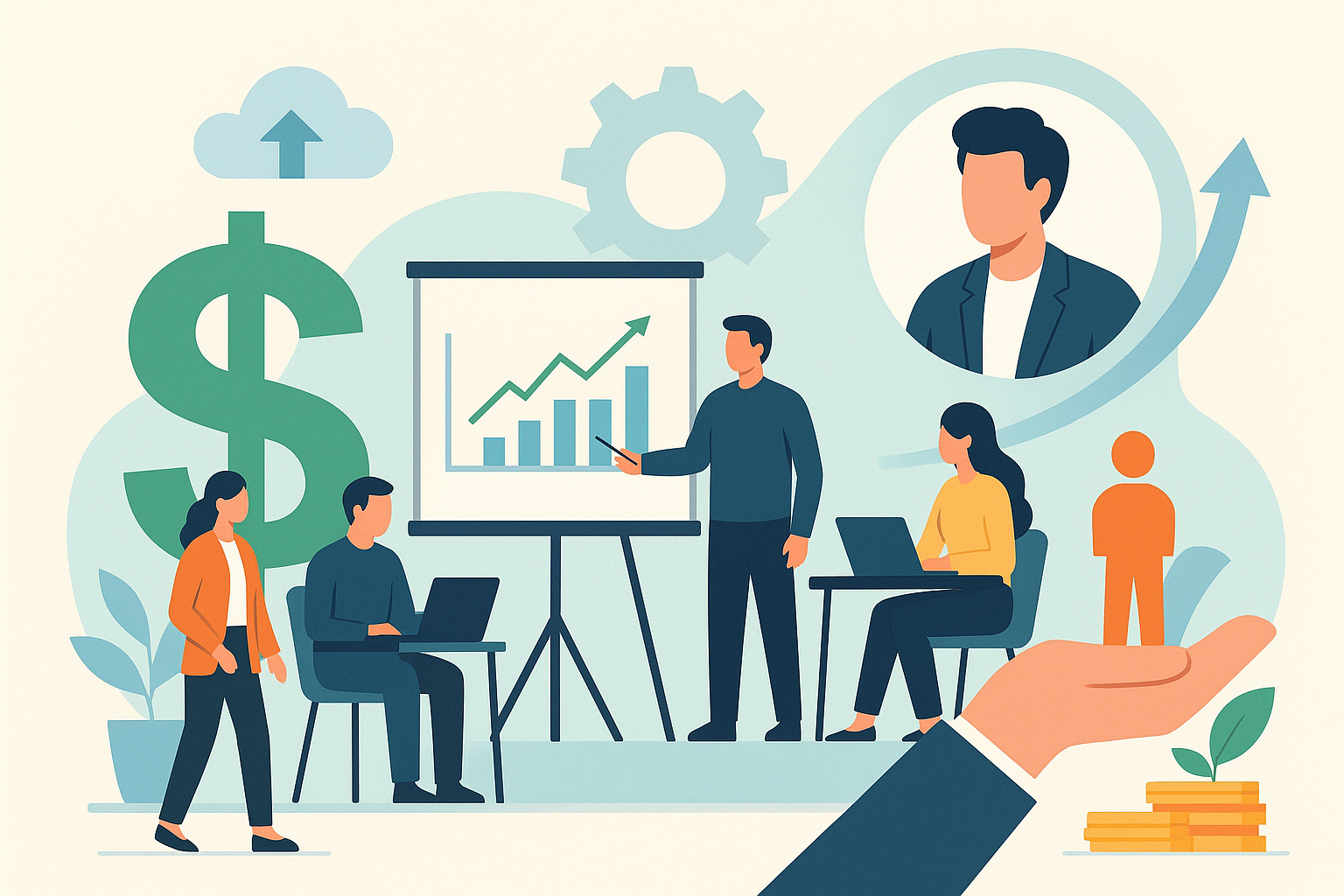
Image by Gerd Altmann via Pixabay
Iteration and Improvement
Iteration and improvement are continuous cycles in your MVP development process. They involve learning and refining your product to meet the needs of your target consumers. Iterative development is based on feedback received from early adopters, which is used to modify your product to enhance its performance.
Final MVP Launch
After your MVP undergoes the processes discussed above, you are now to execute the final launch. The final launch enables you to make your product available to the general public and your target consumers. In your final launch, you should consider the following:
- Marketing: How will you reach your target consumers? What are the most suitable platforms to market your product?
- Metrics: How do you measure the success of your launch? What metrics determine the success of your product?
- User onboarding: How will you get more people to use your product?
- Post-launch support: How will you fix any issues with your product to increase customer value?
The final launch allows your refined product to enter the market. However, you will still need to incorporate post-launch activities to ensure the continuous success of your product.
Case Study: How Spotify used Agile for its MVP Development
Spotify was founded in 2006 by Daniel Ek and Martin Lorentzon. It is a perfect example of agile methodology in action. Its MVP was called Spotify AB and only had one function: allowing you to stream music without downloading it. The MVP was developed and released to beta testers within four months. Beta testers were music bloggers in Sweden. They played a crucial role in spreading the word about the new product. The company iterated as the number of users increased.
New features added to the product included creating playlists, streaming music offline, and sharing songs with other users. The changes were integrated based on the feedback gathered from consumers. Today, it has many more features, such as podcasts, recommendations based on user preferences, audiobooks and video services.
Lessons learned from Spotify’s MVP
Today, Spotify has more than 600 million users. However, it went through the general MVP development processes we have discussed. Here are some key takeaways from Spotify’s journey:
- Focus on the core functionality of your product. Users could only stream music from Spotify’s MVP. Other features such as creating playlists were incorporated later after gathering user feedback.
- Do not take too long to develop your MVP. Spotify’s MVP took four months to develop.
- Ensure your product offers customer value. Despite being a minimal product, Spotify’s early adopters were pleased and spread the word about it.
- Gather feedback and iterate. Spotify used the feedback gathered from its audience to add new features that increased the app’s usability.
- Subject your MVP to a continuous Development and Iterative Cycle. Spotify added features that increased its usability. However, as a full-fledged product, it still undergoes changes. For example, its video feature was added in 2024.
Spotify’s journey shows that MVPs do not become a success overnight. Rather, your product undergoes an extensive development and iterative cycle that prioritizes consumer needs to become successful.
Common Challenges and Solutions in Agile MVP Development
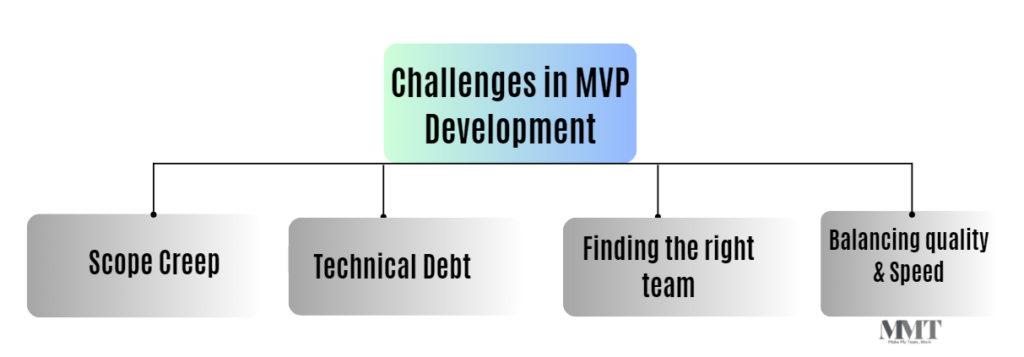
Agile in MVP development is a highly effective technique that allows you to develop your product, test and validate it fast. However, it attracts some challenges:
- Scope creep: The requirements of your project increase over time based on feedback from consumers.
Solution: Ask the right questions to gain relevant and insightful feedback. Prioritize the most pressing demands from your users.
- Balancing quality and speed: The continuous agile MVP development cycle requires you to balance quality and speed, which is challenging for some teams.
Solution: Use short and flexible iterative development cycles that allow you to respond rapidly to change.
- Finding the right team: Some companies experience challenges acquiring a team that aligns with its goals and vision.
Solution: Conduct interviews and let your team know what you expect of them. Allow them to air their concerns and address them.
- Technical debt: Some companies accrue technical debt due to iterative development. The feedback from consumers might require you to change more than expected.
Solution: Build a clear roadmap that visualizes your project and allows you to allocate resources efficiently. Also, budget for unexpected costs.
While the MVP journey attracts some challenges, it is also transformative. Integrating the recommended solutions ensures that your journey is value-centric with rewarding outcomes.
What is the Difference Between Agile and Traditional Project Management in MVP Development?
Agile project management is a flexible approach that breaks down a project into phases with simpler tasks. The model allows continuous collaboration and improvement within each phase. Traditional project management is structured and uses a step-by-step approach. Proceeding to one phase requires the completion of the preceding one.
How Do You Measure the Success of an MVP Developed Using Agile?
The success of an MVP is measured using metrics that align with the project’s goals. Common metrics used to measure the success of an MVP include user engagement, conversion rates, churn rates, and retention rates.
What Roles Are Essential in an Agile Team for MVP Development?
Product owner, Scrum Master, Designers and the Development Team are essential in an agile team for MVP development. A product owner is in charge of the MVP’s vision and goals. A scrum master guides the team in the agile development process. A designer is in charge of prototyping your product while the development team builds your MVP’s software.