
Budgeting effectively for Minimum Viable Product (MVP) projects is essential to the success of startups. Effectively budgeting for your MVP project is a non-negotiable and critical to its success. The budget for developing MVPs differs depending on the type of product and what it requires.
Complex products require a higher budget because many resources are necessary to make them functional. You need to evaluate your idea carefully, determine the type of MVP that aligns with it, and build a clear roadmap for it to have a budget that aligns with what it requires. Effective MVP budgeting ensures the seamless development of your MVP from formulation to launch.
Why is Budgeting Important for MVP Projects?
Proper budgeting ensures effective resource allocation and minimizes risks. Setting clear-cut financial boundaries and monitoring expenditures will help one make informed decisions while avoiding common pitfalls or ensuring efficiency. MVP delivery needs proper budgeting, which impacts the effective set-up foundation during further development and scaling.
Importance of effective budgeting in MVP development
An effective and realistic budget is a non-negotiable in MVP development. Many segments of your MVP will need financial resources. They include market research, design, development, testing, marketing, hosting, and other unexpected costs.
You need a practical budget that aligns with your MVP’s goals, objectives, and vision. Poor budget planning can lead you to spend more than what is necessary, which can cripple your project.
What are the Steps to Budget Effectively for MVP Projects?
Businesses use MVPs to test and validate their ideas while integrating their core features that will solve core problems for the customers. MVPs are meant to use the minimum possible resources. Let us look at five steps to undertake to budget for your MVP project effectively:
- Conduct comprehensive research on your potential market. Market research helps understand the demand of your product, how the problem is getting solved right now and how competition is solving those solves for your customers. All this will lead to better understanding the scope of work and complexities of your project. It also helps identify the opportunities and issues that will potentially arise during your MVP’s development.
- Establish your project goals and objectives. It is essential to understand exactly what your project aims to achieve. The main aim here is to develop a minimum lovable product that helps you get a seat on the table with customers to have a conversation and sets you on the path to get initial revenue. This understanding will help you establish the budget that will help you achieve your desired goals and objectives.
- Clearly identify and define the components of your MVP. The -1 to 0 journey of the MVP will have a website, UI designs that look like a working product, and a sales pitch deck. The 0 to 1 journey of your MVP will have a product that enables you to be considered along with the competitor. Thus, the common components of the -1 to 1 journey of building MVP include:
- Building a landing page
- UI designs
- Customer feedback
- A pitch deck, concept video, etc
- An official email
- A minimum lovable product that gives you a seat on the table along with the competitor
- Iterating and improving the product as you learn more about customers, their problems, gaps in competitor products, etc.
The components of your MVP should appeal to customers and give you a chance to compete with other products in the same industry.
- Budget for unexpected costs. Once you commence building your MVP, you wish for everything to go as expected. However, this is not always the case because you will encounter some hiccups along the way. An example is working with a product developer who abandons the project before completion or you hire someone not skilled enough to build the initial product. You will obviously have to find a new one, which attracts new costs for your project. Many other situations and scenarios like this will come up along the way. It is essential to have a list of some costs that will potentially arise in your MVP’s journey and effectively budget for them.
- Identify available resources. Evaluate your resources and weigh them against your budget plan. Are the resources available sufficient to develop your project?
A clear roadmap of your budget is essential to the success of your project. Avoid making assumptions about your budget because it will lead to the failure of your MVP.
Image by Gerd Altmann via Pixabay
Estimating Costs and Allocating Resources Wisely
Whether you are a startup or an established company, budgeting for an MVP is essential. Running out of financial resources is one of the primary reasons many startups fail. It also affects allocated budgets in established companies. Here’s how you can estimate the costs of your project:
- Define the kind of product you want to create. Different products attract different costs.
- Identify the features of your project, including development and non-development costs.
- Conduct research on all the features and estimate the budget for each.
- Budget for unexpected costs.
- Allocate resources to all your features. You should assign resources to different parts of your project. Resource allocation involves identifying which features need the highest budget, which can take budget cuts, and the estimates for unexpected budgets.
Estimating costs and allocating your resources efficiently is essential for the success of your project.
Image by Gerd Altmann via Pixabay
Analyzing competitors’ MVPs
Understanding competitors helps you gain market insights essential for developing your MVP. The following strategy will help you analyze your competitors’ MVPs efficiently:
- Determine your competition, that is, companies in an industry similar to yours, and serve your ideal customer profile(ICP).
- Examine their content through their websites, social media channels, and case studies.
- Conduct a competitive analysis using either of these frameworks: SWOT, PESTLE, and Porter’s five forces.
- A competitive analysis helps you identify the strengths, weaknesses, and other factors related to your competitors. You can pivot based on their strengths and also identify the unique value proposition your company offers from their weakness.
Analyzing your competitors helps you understand how to position your product effectively in the market.
Identifying core features and functionalities of an MVP
Understanding the core features and functionalities of your MVP is crucial. You should identify your target audience, examine their problems, needs, and wants and how your product offers a solution to those problems, needs and wants.
Subsequently, you should identify the core features to incorporate into your product to achieve this solution. You also need a clear and effective MVP roadmap to ensure your product get delivered on time with required functionality and reaches your target audience.
Methods for Prioritizing Features
Proper product building that enables you to be considered by customers requires feature prioritization. The following techniques are used in feature prioritization during MVP development:
- MoSCoW Method. The method is used to prioritize tasks based on their outcomes and return on investment (ROI). The term MoSCoW stands for must have, should have, could have, and will not have. The technique involves prioritizing tasks with the highest ROI.
- ABCDE Method. This method allows you to rank your tasks from the most to least urgent and essential. You then prioritize the most urgent and important tasks.
- Chunking. This method involves breaking down your tasks into smaller, manageable chunks. This leads to the efficiency of accomplishing your project tasks.
- Eisenhower Matrix. It is a time management framework designed to help you prioritize your tasks. It involves dividing your tasks into four quadrants with urgent and non-urgent tasks.
- Eat the Frog. This technique allows you to prioritize the tasks you consider challenging or unpleasant. The reasoning behind this method is that focusing and completing difficult tasks first will enhance productivity. It also makes other tasks simpler than the challenging completed ones.
The technique you will use depends on the type, complexity and scope of your product. You should select a method that makes sense to you, easy to adopt and allows you to get the development done on-time with quality.
Many founders and teams ignore the prioritization leading to too many features getting developed which will lead to you end up spending more money.
What is an MVP Roadmap & Project Plan?
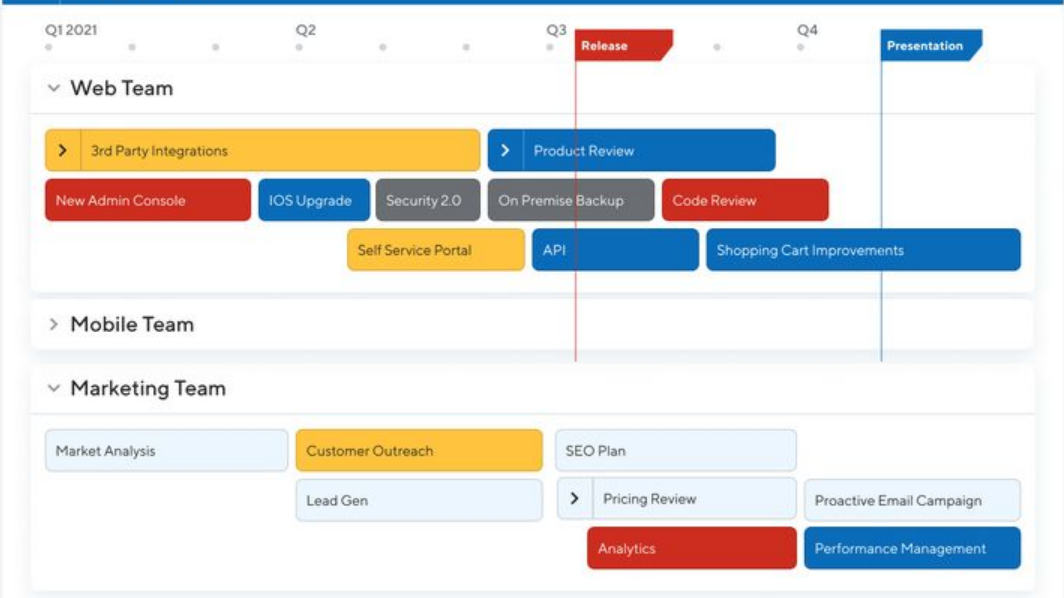
Having a product idea and a vision for it is great at face value. However, you need a plan, from the formulation of your idea to its launch, to bring it to fruition. This plan is the roadmap for your MVP. A roadmap is important because it helps you visualize the processes necessary to make your MVP successful.
It is often detailed with the goals, objectives, strategies, and timelines related to your product’s development processes. A roadmap also helps coordinate activities and actions necessary to bring your MVP to life.
Breaking down feature ideas into user stories, tasks, and milestones
Breaking down your MVP roadmap into user stories and tasks helps divide them into manageable tasks. Every milestone is a sub-project that requires certain user stories to be completed. Here is how you can break down your MVP roadmap into manageable tasks:
- Define the feature ideas of your MVP product, as well as its goals and objectives.
- Prioritize all the feature ideas.
- Divide it into sub-stories and multiple tasks within those stories if the feature is big enough.
- Cluster the logically related feature ideas into milestones.
- Assign the owner of each story if you have multiple product developers in your team.
A breakdown of your MVP plan into user stories and tasks is essential, as it is divided into small, achievable tasks and milestones. Completing every milestone contributes to the completion and success of your main project.
Development costs (in-house vs. outsourcing)
You need people with the right skills for your MVP to succeed, whether you are an established organization or a startup. You can outsource your development team or use your in-house product builders. Below is a chart comparing the costs and benefits of outsourcing against in-house development:
| Outsourcing Product Development | In-house Product Development |
| ● Access to product developers with specialized expertise. ● Independent contractors develop their expertise on their own. You will not incur any training costs. ● No overhead costs. Independent developers are in charge of getting their supplies. ● You can negotiate a fixed amount for the project with independent contractors. | ● Access to internal expertise gained through experience and training. ● Training costs are necessary for the development of your team. ● Overhead costs unrelated to the project, for example, insurance, office supplies and rent. ● A monthly expenditure for salaries, rent and other segments that keep your organization afloat is necessary. |
It is essential to evaluate your available resources to determine whether in-house development or outsourcing is the best alternative for your MVP development.
Marketing and launch costs
Marketing and launch costs are very crucial to your product’s success. After all, how will your product reach your target market? A market budget is important because it helps you align your marketing activities with the goals of your project.
Some marketing expenses incurred when launching MVPs include market research, advertising, search engine optimization (SEO), networking events, and running tests to determine platforms suitable to market your product. You should focus on marketing activities that directly benefit your project and avoid targeting all marketing platforms at once for cost-effectiveness.
Human resources
Human resource management (HRM) is fundamental in organizations, regardless of their size. Startups can incorporate essential human resources (HR) functions without having an entire HR department. Budgeting for human resources is important because it helps identify costs associated with hiring and recruiting.
Some roles you need to budget for in MVP development include product developers and engineers, product designers, writers for your blog, marketing specialists, and project managers. Established companies will often have a budget for salaries and overhead costs. On the other hand, you will estimate costs based on your agreement with independent contractors if you opt to outsource your services.
Financial resources
Securing funding is essential for your MVP’s success. It helps you acquire products and support features that are out of your immediate reach. Different sources of funding for MVP projects include:
- Angel investors who are individuals willing to fund your project during its early development stages. They include cofounders, friends, family, and other acquaintances.
- Bootstrapping by using your own money.
- Venture capital, a form of equity funding from firms built to fund startups and companies with product ideas.
- Bank loans from financial institutions.
Securing funding helps your MVP to allocate resources for all features efficiently and bring your idea to life.
Time management
Time management is an essential resource in the development of your MVP. Time management is also important in budgeting because:
- It helps you optimize resource allocation by establishing the time required for each task.
- It helps you avoid cost overruns from taking a longer time on projects.
- It helps in efficient project planning by building project plans based on the timeline required for each milestone.
Overall, time management helps in budget estimations based on the duration taken to complete different tasks and milestones.
Monitor and Adjust the Budget
Ongoing budget monitoring is essential in MVP development because it helps determine whether ongoing activities align with your budget estimates. Monitoring your budget also gives you a clear overview of whether the remaining finances are sufficient to complete your project.
Monitoring and reviewing your budget is essential in establishing whether it needs adjustment. Adjustment involves realigning your resource allocation plan by identifying which areas need more or less finances.
Common Budgeting Mistakes to Avoid in MVP Projects
Overestimating revenue
A common mistake by founders is extreme optimism and bias towards a product idea, which causes them to have high expectations regarding its success. Overestimating potential revenue affects your anticipated cash flows and profits, making investors lose trust and confidence in your product idea. Five tips on how to make your revenue projections more realistic include:
- Conduct market research and understand existing market conditions.
- Define the scope of your MVP.
- Build financial projections based on your market research and MVP scope.
- Work with experts to create your financial projections.
- Monitor the performance of your MVP regularly and make adjustments on revenue projections if necessary.
Avoiding overestimating revenue and having realistic projects is essential for making informed financial decisions for your company.
Underestimating costs
Underestimating costs arises from a lack of understanding of your project’s size, the real costs for every feature, and how much money is needed to bring it to life. Some underestimated expenses in MVP development are iteration costs, the costs of integrating with third-party systems, and marketing by assuming that one rollout will bring in customers.
Underestimating costs will result in budget overruns, requiring you to seek additional funding. It also slows down the progress of your project –or stops it entirely– while inhibiting the quality of your product. Understanding the size of your project and its requirements is essential for establishing a realistic budget for its development.
Tools and Resources for MVP Projects Budgeting
Budgeting software
Many companies face budgeting issues when developing their MVP projects. Fortunately, we have tools to aid in the financial planning of your project. Examples of budgeting software you should utilize include:
- Budgyt: Organizes and manages your financial data. It also integrates scenario planning to help in budget estimation.
- Scoro: Manages your company’s finances in one system. It also has a forecasting feature.
- Datarails: Has drill-down capabilities to help in forecasting and effective budgeting.
- Mosaic Tech: Consolidates and analyzes your financial data, which aids in streamlining your budget.
- PlanGuru: Integrates cash flow projections to aid in financial planning.
Budgeting software makes it easy to manage your finances and create an efficient budget for your project. Budgeting software differs in pricing and functions. You should select a tool that will meet your project’s needs.
What is the average budget for developing an MVP?
The average cost of developing an MVP is anywhere between $15000-$250,000.
How do I know if my MVP budget is realistic?
Your MVP budget is realistic if the available financial resources adequately cover all features of your project from formulation to launch while accommodating unexpected costs.
What is zero-based budgeting for MVP projects?
Zero-based budgeting (ZBB) involves justifying your MVP expenses for every new financial period, starting from zero rather than working with the previous budget. In MVP development, you will analyze all features and allocate a new budget for them in the new financial period.