
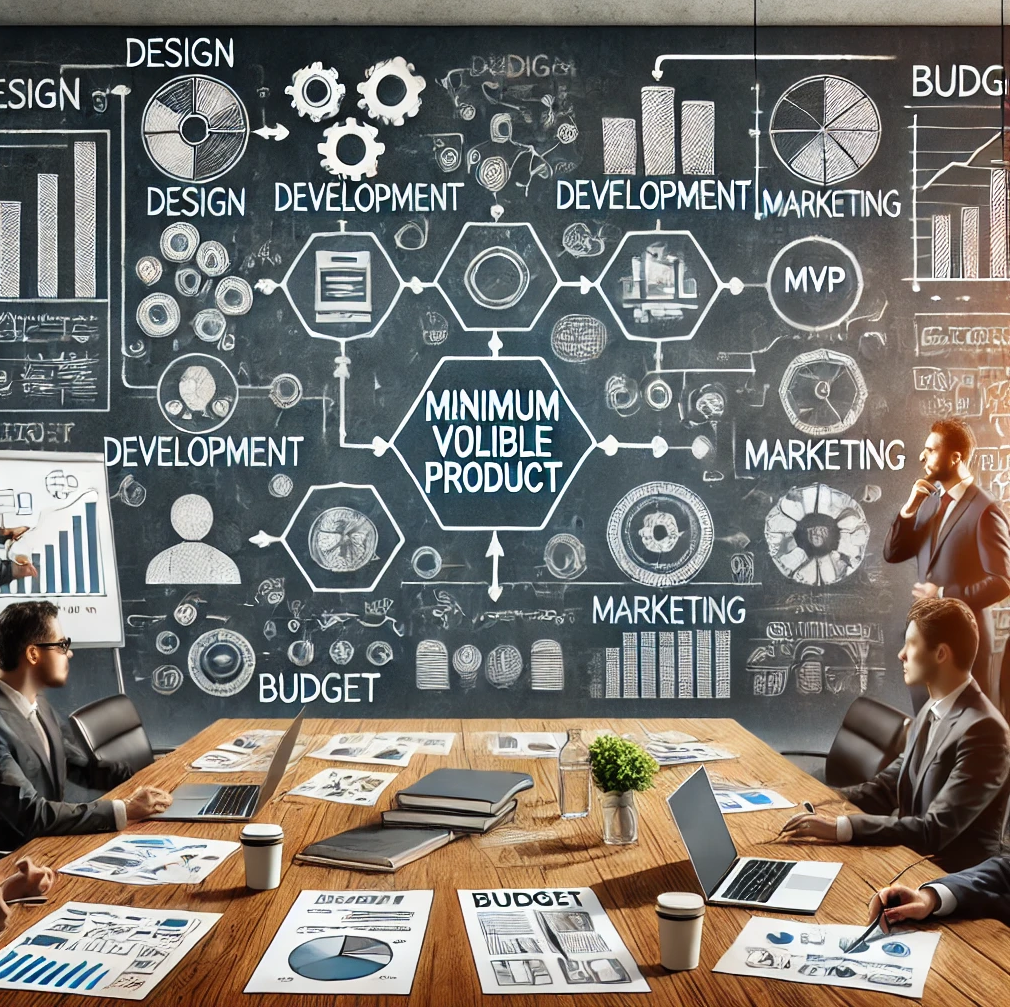
Estimating the cost of developing a Minimum Viable Product (MVP) leads to better budget planning and sets the stage for building a successful product. Factors that should be considered when estimating the cost of MVP development include design, development, marketing, and unexpected expenses.
A clear picture of these costs helps you set realistic expectations for their MVP project and will help you launch a better product faster. It lets you determine which features to prioritize and minimize waste, which is especially crucial for founders and SMBs working on a tight budget.
Why Do You Require Planning the MVP Development Cost?
Adequate planning for MVP development costs helps establish clear financial expectations, laying a foundation for releasing an MVP that is better than the existing competition.
Budget Planning and Resource Allocation
Budgeting for development expenses helps identify the elements of your MVP that require funds, such as design, development, marketing, etc. When budgeting, it is essential to prioritize high-impact areas of the MVP that will deliver customer value and validate your concept. This is especially important for startups due to limited funding. It also ensures your project maintains a lean operation that minimizes waste and maximizes value.
Risk Management
The MVP approach involves experimenting with convert your idea into something tangile whose reception by consumers and performance is usually unpredictable, if product is not developed cotrrectly. Market changes, technological revolutions, and user feedback can cause unforeseen challenges. Some issues are only revealed when early adopters use the product.
Allowing early adopters to engage with the MVP from the outset provides valuable insights that help identify potential issues early in the development process. By gathering feedback and observing user interactions, you can pinpoint problems before they escalate, significantly reducing the risk of encountering numerous challenges that consume your finances later.
Stakeholder Communication
A detailed budget offers stakeholders comprehensive insight into how the financial resources will be allocated. This makes the development process transparent, enhancing their trust. Investors–part of the stakeholders– also become more confident and secure in funding the MVP because they can see that their investment will be well-managed.
Budgeting for MVP development costs helps in the proper allocation of resources, ensuring contingencies for unexpected outcomes, and fostering transparency with stakeholders.
Factors Affecting MVP Development Cost
Understanding development costs is vital to the success of your product because it allows realistic budgeting and proper resource allocation.
Scope of the MVP
A product’s development costs are impacted by its features, functionalities, and complexities. A broad MVP scope will generally attract higher costs since it becomes more complex and takes longer to develop. A narrow and clearly defined scope is suitable for product development because it focuses on the essential features that directly address a problem your target consumers face.
“Building a Minimum Viable Product (MVP) is like packing for a journey. You want to make sure you have everything you need, but overloading your backpack can slow you down and leave you exhausted before you even begin.”–Sergei Zagriychuk.
Development Team
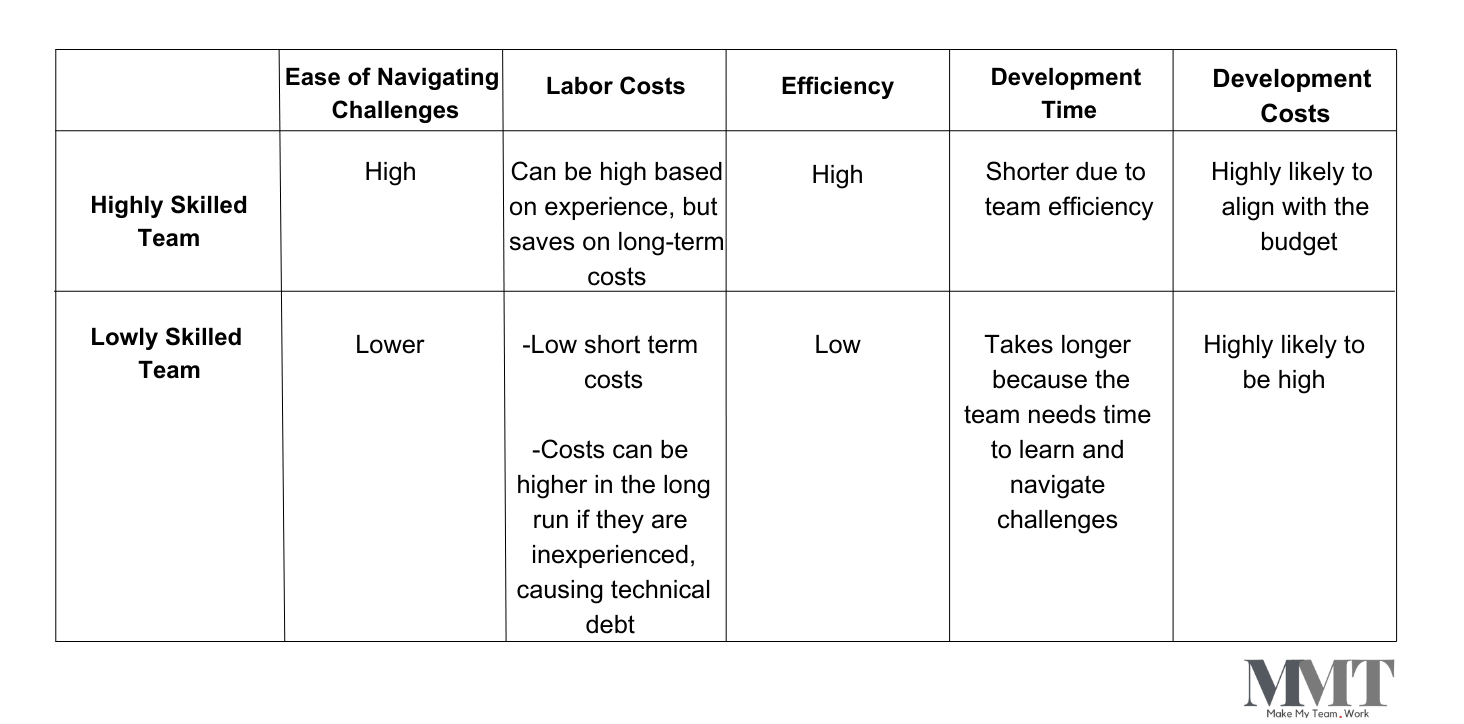
Team composition significantly affects the development costs of an MVP. A highly skilled team is conversant with the best technologies and practices that ensure an efficient development process. This saves costs because the development process is streamlined. A less experienced team might seem like a better alternative, especially if your company has limited financial resources.
However, the team can attract higher costs if not carefully selected. It will take longer for the team to navigate challenges, leading to high labor costs. Also, future scalability is affected if the team is unfamiliar with the right technologies to develop your product, leading to technical debt.
Technology Stack
A technology stack (tech stack) includes programming languages, frameworks, and libraries used to build an MVP. It influences your product’s:
- Scalability,
- Security,
- performance, and
- Maintenance.
A tech stack that cannot handle user growth in the future will attract higher costs due to the need for extensive optimization and additional infrastructure. Additionally, a stack with vulnerabilities will incur costs for securing your system.
Design and User Experience
An intuitive and appealing user interface (UI) and user experience (UX) reduce development costs by streamlining the process. It is common to assume that investing in a properly thought-out UX/UI will attract higher costs. However, you also need to focus on the long-term impact of this investment. A poorly designed UI/UX requires many refinements and reworks, eventually leading to higher costs. On top of that, if users don’t find your product easy to use and attractive, the bounce rate will be high, inhibiting its success.
Geographic Location
You can find the right team and target audience for your product from anywhere in the world. Geographical factors to consider before you develop your MVP include:
- Team Location: Developers from regions with a lower cost of living tend to have lower rates. However, be careful when selecting your development team and prioritize experience and skills.
- Legal considerations: Regions with specific laws related to product development can attract higher taxes and compliance requirements.
- Talent competition: Talent is highly sought after in areas with skilled professionals (e.g., tech hubs). A high demand for their talents leads to higher salaries, making development costs high.
- Time zone differences: Working with teams from different time zones can affect collaboration and communication. This leads to feedback delays, potentially affecting your MVP project’s progress.
Before you start developing your MVP, it is essential to consider the location of your target audience, developers, and where your company is set up.
Time to Market
The essence of using the MVP approach is to build a product with just enough features to solve customers’ pain points and release it to the market early. A faster time to market ensures that your target audience receives and uses your product as early as possible. This reduces development costs because you make iterations based on user feedback rather than assumptions (which require more costly refinements). It also helps you generate revenue quicker, offsetting some development costs.
Maintenance and Support
After the initial MVP launch, maintenance and support ensure the product is functional, secure, and optimized to meet customer expectations. Your product is not perfect upon release and will undergo many refinements based on user feedback and testing. For example, user feedback can require additional features to make the product more appealing to consumers. You need a team to fix bugs and streamline your product after the initial release, which adds to your costs.
By considering these factors, you will clearly grasp the costs associated with developing your product and make an informed decision on allocating resources efficiently.
How Much Does It Cost to Build an MVP?
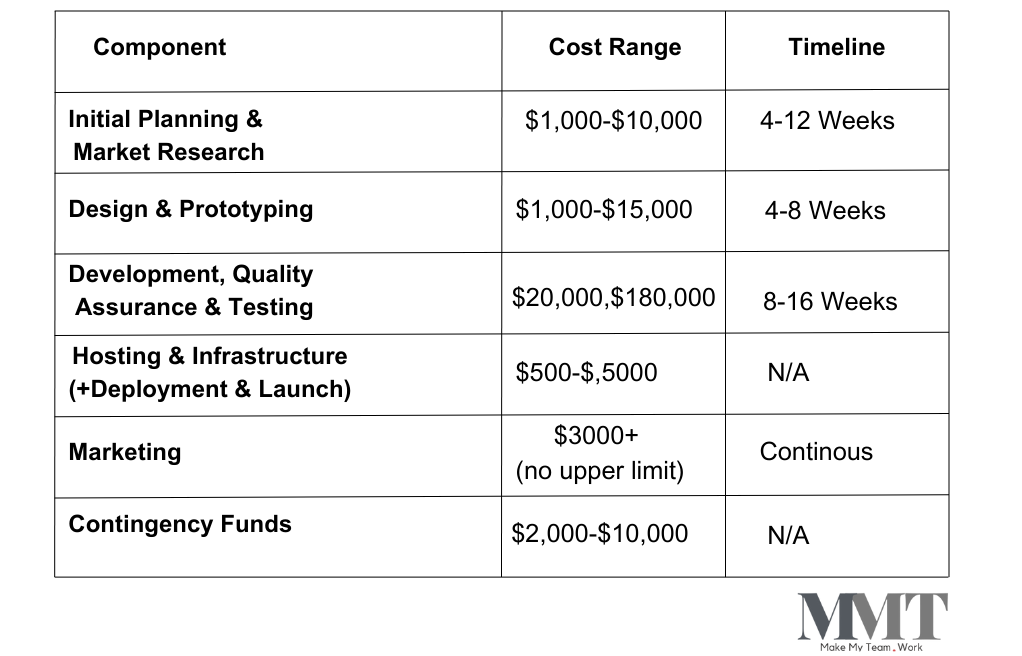
The cost of building an MVP varies depending on the specifics and complexity of the product. Different elements, such as design, development, testing, etc., determine the cost of your MVP project. The development timeline also affects the costs; projects that take longer generally require a higher budget. Below is a detailed breakdown of the cost estimates associated with each MVP component:
Source: Bhaval Patel
Based on the estimates above, the overall cost of developing an MVP ranges from $30,000 to $220,000. It is essential to note that this is just a ballpark figure. The development cost can be more or less depending on the nature of your MVP.
Cost Estimation Methods
Estimating MVP development costs is essential for setting a realistic budget for your project. Depending on the nature of your MVP project, you can use either of the three cost estimation methods:
1. Top-Down/Analogous Estimation–Project managers estimate the cost of developing an MVP without providing detailed information. Rather than estimating individual costs first, the cost is allocated to the entire project. This method relies on historical data from previous similar projects to guide the costs of the new one. An example is whereby a project manager estimates that a specific MVP project will cost $25,000. This method provides a ballpark figure and is more suitable for small MVP projects.
2. Bottom-Up Estimation–The project manager breaks down all the project components and determines the relevant costs, such as labor, hosting, marketing, etc. Subsequently, they aggregate these estimates to arrive at the final cost of developing an MVP. This cost estimation method is suitable for relatively complex MVP projects.
3. Parametric Estimation–The project manager uses statistical data and information to determine the resources needed to complete your MVP project. It relies on quantifiable parameters based on historical data to derive project estimates. For example, they can evaluate the cost of research from a previous MVP project and use these statistics to determine the new cost of research. The costs don’t have to be similar because other factors, such as current market standards, are taken into consideration. This cost estimation method is suitable for highly complex MVP projects and ones that require comprehensive details.
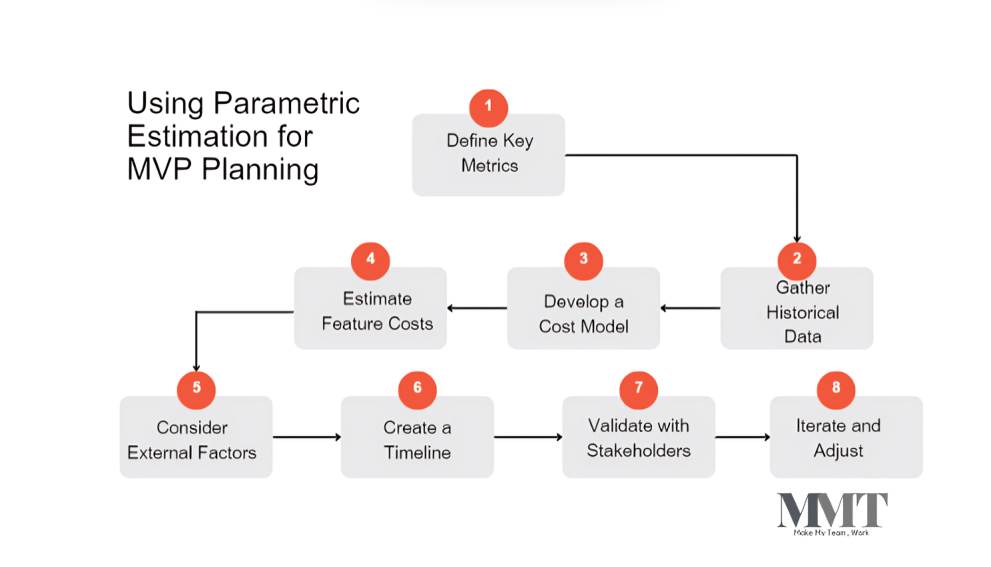
You can use some estimation methods interchangeably, e.g., starting with top-down estimation to set initial expectations and later using bottom-up estimation to develop a comprehensive overview of the MVP project’s financial needs.
Common Mistakes in Estimating MVP Development Cost
Understanding the mistakes startup founders and project managers make when coming up with MVP development costs is key to fostering a reliable estimation process. These mistakes include:
- Underestimating development time due to a lack of detailed planning, leading to budget overruns and team burnout. Eventually, the project stalls because of insufficient funds and high turnover rates.
- Overlooking hidden costs by failing to budget for costs that are not obvious, such as quality assurance, infrastructure, and hosting.
- Failure to budget for iterations due to the belief that you’ll get the product right during initial development. Your product will not be perfect the first, second, or third time around. The development process involves a lot of learning and iterations based on user feedback.
- Failing to budget for non-development costs such as marketing, legal and compliance fees, and customer support.
- Ignoring post-launch expenses that come after the initial product launch. They are critical to the long-term success of your MVP because they help validate the assumptions made in the development phase and refine your product to offer maximum value to consumers. They include iterations, maintenance, bugs, fixes, and performance monitoring.
Proper project planning helps address these challenges by estimating the costs of each component of your MVP. It is also essential to plan for unforeseen expenses and have a contingency fund for them to avoid budget shortfalls.
Tips for Reducing MVP Development Cost
Cost-reduction strategies help minimize waste while maximizing efficiency, leading to a sustainable development process. They include:
- Prioritize essential features that ensure the functionality of your product and solve a pain point for your target audience.
- Adopt agile development practices that allow iterations and ensure you can pivot quickly to changing requirements.
- Use a user-centric approach that prioritizes customer feedback to refine your product features.
- Leverage existing tools and frameworks, such as open-source tools and libraries, to reduce development time and enhance your product’s performance.
- Choose the right tech stack to ensure your product is scalable in the future.
Ensure a balance between cost-effective strategies and quality for a sustainable process that utilizes resources efficiently while delivering a product that meets user needs.
FAQs Related To Estimating The Cost Of MVP Development
What are the additional considerations for MVP development costs?
Additional considerations are expenses that go beyond the core costs of building the MVP itself. In an environment with limited experience, it is easy to forget these costs, which are equally important to the success of a product. Contingency funds, regulatory compliance, ongoing maintenance and support, and quality assurance are additional considerations when planning for MVP development costs.
What are the risks of not properly estimating MVP costs?
Failure to budget efficiently for an MVP will lead to budget overruns and financial strains, eventually forcing you to compromise the quality of your product or halt your project altogether. It is essential to carefully evaluate the costs associated with developing your MVP to avoid stalling the project due to associated risks.
Can I develop an MVP on a tight budget?
You can develop an MVP on a tight budget by focusing on features that deliver the most value to your consumers. However, ensure that your budget is not too limited to compromise the quality of your product.
How do you calculate the cost of MVP development in Agile?
When budgeting for an MVP in agile, it is essential to take into consideration the iterative nature of the methodology. The parametric cost estimation method is suitable for providing detailed costs of an MVP in Agile.