


Strategies for interviewing and vetting developers begin with taking the time to understand the hiring process, as assessing a developer’s skills requires a certain level of technical knowledge.
The process is even more crucial and requires you to invest time in understanding your product and knowing which questions to ask if you’re a non-technical person, such as a product owner or startup founder.
Collaborating with a product manager or recruiter who has technical knowledge is invaluable in guiding the process if you find it challenging to examine these skills.
It’s equally important to assess a candidate’s soft skills and their potential fit within your company culture. Evaluate their emotional intelligence, ability to collaborate, and communication skills, because these attributes play a critical role in ensuring they can work effectively within a team.
Since product development often involves collaboration across various roles, selecting a developer who can work well with others and integrate seamlessly into your team is vital.
Preparing for the Developer Interview
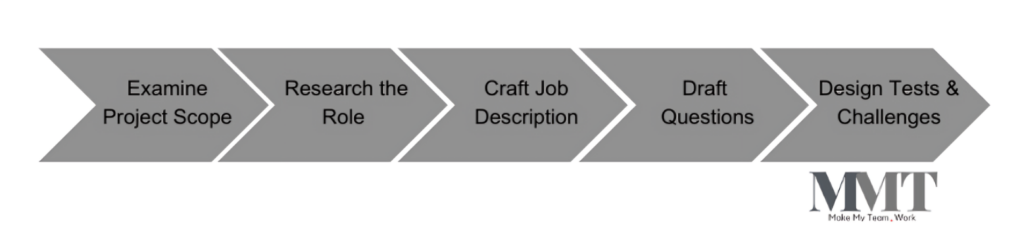
Whether you’re a founder, a product manager, a recruiter or a product owner, preparation before interviewing a developer is crucial. Adequate preparation allows you to create a clear evaluation framework to help you identify your tech product’s best developer. The following are strategies you should undertake to prepare for the developer interview effectively:
- Examine the Project Scope: This helps you understand the requirements of your project in detail and the type of developer needed to build a product.
- Research and Learn about the Role: Understanding the role helps you ask targeted questions. For non-techie clients and product owners, it enables you to familiarize yourself with some technical aspects relevant to the role.
- Craft a Job Description: The job description is tailored to the project scope and includes the specific job title, required technologies, level of expertise, etc.
- Prepare Questions: In an interview, you ask questions to determine the experience, skills and interpersonal capabilities of a developer. You should prepare questions to ask about their background as developers, as well as technical, behavioral, and problem-solving ones.
- Design Tests and Challenges: Coding challenges, personality tests and case scenarios can help you evaluate a developer’s expertise, knowledge and soft skills.
Product owners and clients are less likely to have conducted interviews compared to product managers and recruiters. To prepare for an interview if you fall under this category, practice with others first, e.g., family members, friends and colleagues so you can be well-prepared for the interview.
These preparation mechanisms will enable you to make an informed decision when selecting the ideal candidate for your product development journey.
Crafting an Effective Interview Process
Designing a well-structured interview process is crucial for ensuring a logical and efficient evaluation of a developer’s skills, experience, and cultural fit. It also ensures the interview flows smoothly, with each stage building on the previous one. Here’s how you should plan for an interview process:
- Choose the platform you will use to conduct the interview.
- Determine the duration of each interview–you don’t want the interviews to be too short or too long.
- Structure the questions sequentially. For example, start by asking the developer about themselves, their experience, and technical questions, then examine their soft skills.
- Outline responsibilities and expectations clearly and craft questions tailored to them.
A carefully planned interview process helps maintain consistency, reduce bias, and ensure that each candidate is assessed fairly across the same criteria.
You can also design a post-interview evaluation that helps objectively review the candidate’s strengths, weaknesses, and overall suitability for the role.
Screening Developers: The First Step
When you’re hiring for a developer role, the reality is that you’ll likely receive numerous job applications, many of which do not align with your specific needs. This influx can be overwhelming, making it necessary to have a screening process to filter out applications that do not meet role-specific criteria. Here’s a breakdown of what screening entails:
- Reviewing Resumes/CVs: This helps the recruiter quickly assess whether the candidate has the qualifications, experience, and skills for the role. Candidates not meeting the basic requirements are trimmed out at this point.
- Online Assessments: This involves using online tools, such as HackerRank, TestGorilla, and ThriveMap, to assess candidates’ coding skills, cognitive abilities, and personality.
- Portfolio Reviews: Examining a developer’s actual work allows you to assess the quality, creativity, and complexity of the projects they’ve completed.
- Evaluating References and Reviews: Verifies the information on the resume and helps gain insight into the candidate’s work ethic, performance, and past behavior.
- Phone or Video Screening: After filtering out candidates using the above approaches, you’ll have a few qualified ones left. You can proceed to a phone or video screening interview, which is usually informal and designed to quickly assess whether the candidate meets the basic requirements for the role.
Screening facilitates an efficient interview process by allowing you to allocate enough time to candidates truly suited for the role–you’ll have more productive interviews with 5 qualified candidates than interviewing 50 candidates, some of whom lack the proper qualifications.
Assessing Technical Skills
The technical proficiency of a developer directly influences the quality of product they build. Conducting thorough technical assessments is crucial in evaluating how well a developer is versed in the programming languages, tools, frameworks, and technologies essential for the role. You can assess a developer’s technical skills through the following ways:
- Coding challenges tailored to specific programming languages. You can use platforms such as Leetcode and Codility.
- Presenting coding problems and hypothetical scenarios that mirror real-life technical challenges,
- Giving them pre-written code and asking them to debug it to test their ability to fix errors and optimize code.
By assessing a developer’s expertise in specific technologies relevant to your project, you can make an informed decision about their ability to contribute effectively and deliver high-quality work that aligns with the objectives you have for your product.
Evaluating Past Experience and Projects
You can evaluate the past experience and projects of developers by reviewing their portfolio, which provides tangible evidence of their skills. It serves as concrete proof of the claims made in their resumes. Here’s how you can effectively assess a developer’s portfolio:
- Examine the Code Quality: Is it well-structured and easy to follow?
- Evaluate the User Interface (UI) and User Experience (UX): Do their previous applications look polished and professional? Are they intuitive and easy to navigate?
- Look for Innovation: Check if the developer thinks outside the box and (possibly) uses unconventional approaches to solve problems.
- Learning and Growth: Look for evidence of the developer’s commitment to improving their skills, such as contributions to open-source projects, participation in coding communities, or learning new technologies. A developer actively seeking to learn and evolve is an asset to your team.
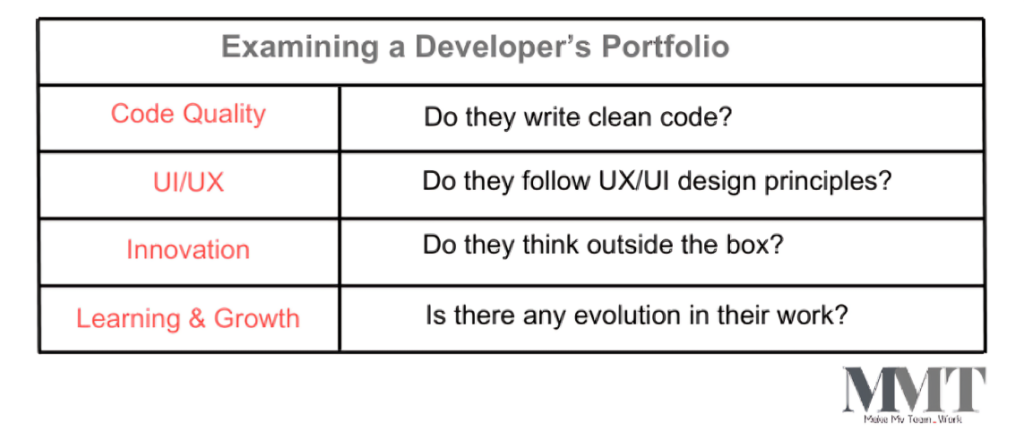
In essence, a portfolio gives you a window into how a developer works, what they’re capable of, and whether their style aligns with your project’s needs, helping you make a more informed hiring decision.
Behavioral and Cultural Fit Interviews
When hiring a developer, it’s important to understand that their technical skills alone don’t determine their suitability for the role. While coding proficiency and problem-solving abilities are fundamental, their soft skills—such as communication, collaboration, and adaptability—play a critical role in how effectively they work within your team.When conducting a behavioral and cultural fit interview:
- Evaluate the developer’s ability to work well with a team–do their qualities complement team dynamics?
- Frame questions around common work scenarios and how they would respond to such situations.
- Observe how they respond to your questions to gain a little perspective on their people skills.
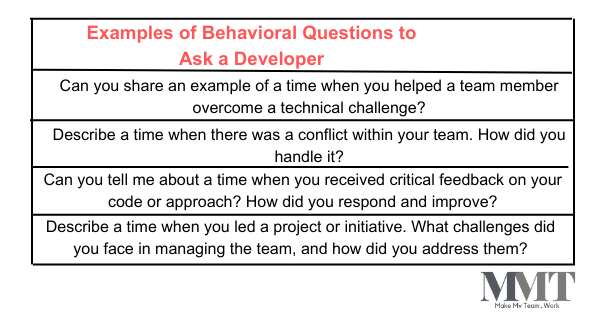
A developer who excels in interpersonal skills, adaptability and teamwork is an invaluable asset that contributes to a positive and productive work environment that aligns with your company’s culture.
The Role of References in Vetting Developers
You can verify a developer’s skills and qualifications by utilizing references, which can be gathered by checking online comments and reviews from previous clients who have worked with them. Checking a developer’s references and reviews is important because:
- It helps you validate their skills and experience,
- Provides insight into their work ethic based on the experiences of other people and,
- It enables you to identify any potential red flags to expect when working with the developer.
You can also speak directly with previous employers or colleagues so they can offer a more personal and detailed perspective, allowing you to confirm whether the developer possesses the skills they claim to have.
Making the Final Decision
After conducting interviews, you can proceed to select the right developer for your product development. However, before making your final decision, it’s essential to thoroughly examine each candidate to ensure they align with your specific needs.
It is equally important to keep your budget in mind and choose a candidate whose compensation expectations align with what you can offer.
Don’t hesitate to bring them back for a final round of interviews to make a more informed and confident decision if you find yourself torn between a couple of strong candidates.
This final step can help you evaluate their fit more deeply, allowing you to choose the best developer to drive the success of your product.
At MMT.work, we’ve already done the hard work of vetting top developers for you. Whether you’re building a new product or scaling your existing idea, our team of skilled professionals is ready to bring your vision to life. Get in touch today and let’s turn your ideas into reality