


The key considerations for success in a mobile app startup include simplicity, touch-friendly design, faster loading times, and accessibility. Every startup should consider these key factors, as they drive user engagement and business growth. A user-centered approach is always the most effective in creating a compelling and competitive product.
This keeps users engaged and interested in using an app, eliminating the need for them to seek better alternatives. Understanding a mobile app’s ecosystem can position the product effectively in the highly competitive landscape.
Understanding the Mobile App Market
Understanding the mobile app market is an essential component of developing a successful app. By analyzing the mobile app market, you look at current trends, consumer behavior, and preferences, and the competitive landscape, which guide you in making decisions crucial to your app’s success.
Current trends in the mobile app market
Rapid technological advancements and a continuous change in user expectations have caused significant shifts in mobile app development. Current trends in mobile app development include;
- Virtual Reality, which immerses users into a digital environment and allows them to interact with objects that appear to be real,
- Augmented Reality by facilitating interactions through physical and digital worlds,
- 5G Technology to improve speed and enhance app efficiency by reducing latency and
- Artificial Intelligence (AI) Integration by making apps smarter. Virtual assistants, chatbots, and app content personalized based on user preferences are examples of how AI is used in mobile apps.
These trends focus on enhancing user experience by ensuring seamless interactions with apps and low latency. It also ensures that consumers have an easy and enjoyable interaction. These are key considerations for any mobile app startup.
Key statistics and data
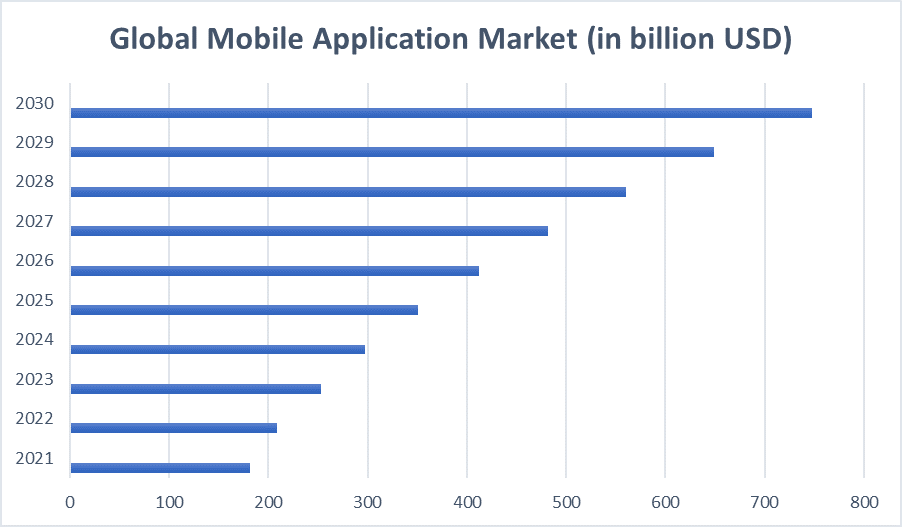
Mobile devices are easy to carry around, making their demand higher than PCs and other gadgets. In 2024, more than 60% of the internet traffic is from mobile devices, a 75% growth from 2015. The global mobile application market was valued at $181.67 billion in 2021, $208.5 billion in 2022, and $252.89 billion in 2023. The expected compound annual growth rate (CAGR) of the global mobile application market is 14.3% between 2024 and 2030. The statistics show that the demand for mobile applications is high and will continue to increase.
Market Segmentation and Target Audience Analysis
Market segmentation involves dividing your wide addressable market into smaller groups with specific characteristics. Groups with the same characteristics respond similarly to specific actions you undertake for your app. You can divide your target audience based on location, age, gender, and income levels. Dividing your target market into smaller groups allows you to meet the specific needs of each segment of a diverse clientele. An example is a clothing e-commerce app with different action buttons for luxurious and affordable outfits.
A deep understanding of the mobile app market is essential for creating a successful app. By examining market trends, user preferences, and competitive dynamics, developers can make informed choices that align with current demands and opportunities. This knowledge not only aids in customizing the app to better satisfy user needs but also strategically positions it within the marketplace.
Identifying Your Niche
Choosing a profitable niche is one of the most important considerations to make for an app and business. Before developing the new product, you should do a market analysis to determine customers’ needs and gaps left behind by existing solutions from competitors. You should also identify the best monetization models to apply, as well as the overall ROI of the niche. Moreover, you should think about the long-term growth potential of your niche by examining whether your application will meet growing consumer needs and adapt to new technologies.
Defining Your Unique Value Proposition (UVP)
A Unique Value Proposition (UVP) is a concise statement that answers the question of what your app specifically provides for its users that your competitors do not. It defines what your app does and why your target consumers should choose it over the many similar apps in the market. A compelling UVP:
- Is clear and concise: Your target audience should easily understand the unique benefits offered by your app. For example, Uber’s UVP is “Tap the App, Get a Ride.”
- Give a small description of your app: Its features and the value it offers your target audience.
- Is user-centric: The UVP should appeal to your target audience and offer a specific solution to their problem. For example, Uber’s UVP appeals to users by stating, “Uber is the smartest way to get around.”
- Differentiates itself from other apps: What makes it unique compared to the products used by competitors? For example, Uber uses this in its UVP, “One tap and a car comes directly to you. Your driver knows exactly where to go, and the payment is completely cashless.”
A UVP is a principle that guides the development of your app. It is used to determine features, design, and how the user will interact with the application to ensure that all its aspects correlate to the core value you are committing to provide.
Choosing the Right Development Approach
There are certain things that you need to consider while deciding upon the precise development model of the mobile application, whether native, hybrid, or cross-platform development:
- Native development: Built from the ground up to be executed on a specific platform(usually iOS or Android), and it is used via app-specific programming languages. For iOS, you would write code with Swift or Objective-C using Xcode; for Androids, it will be Kotlin or Java using Android Studio. A native development creates an app that is optimal in performance and usability as the developer builds apps for the specific platform by leveraging its standard toolsets and languages. However, it is costly and consumes a lot of development time.
- Hybrid Development: Involves creating a single application to be deployed and executed on multiple platforms. This means an application works on iOS and Android devices. The app utilizes several development technologies inside a native container, for instance, HTML, CSS, and JavaScript. The most common frameworks used in hybrid app development are Ionic, Phonegap & Apache Cordova. This hybrid approach to building applications for mobile devices saves time and cost because it develops different web technologies in one native shell. However, it may be dragged down by performance concerns and a low consumer experience. For instance, one X user explained that they prefer Apple Music to Spotify because of the difference in sound quality. That is because Apple Music is a native application for iOS users only. Spotify, on the other hand, is a multi-platform hybrid application.

- Cross-platform: It utilizes frameworks that allow the developer to write a single codebase and deploy it on multiple platforms with few or no changes. Some of the usual cross-platform frameworks include React Native, Flutter, and Xamarin. You cut costs arising from development and maintenance through the development approach.
When choosing a development approach, balance the performance, cost, and effectiveness of development for your mobile application.
Apps that require high performance and user experience will cost you more time and financial resources. Be prepared to trade off high performance and user experience if you want quick development that consumes fewer resources. Evaluate each choice in light of how they satisfy your long-term objectives and ensure the approach you take meets what you want your app to achieve.
Selecting the Right Technology Stack
Choosing the right technology stack for your mobile app is a crucial decision that affects its performance, scalability, and development efficiency. The technology stack includes the tools, languages, and frameworks used to create and maintain the app, making it vital to select the right combination to meet both current and future needs.
Overview of popular tech stacks for mobile app development
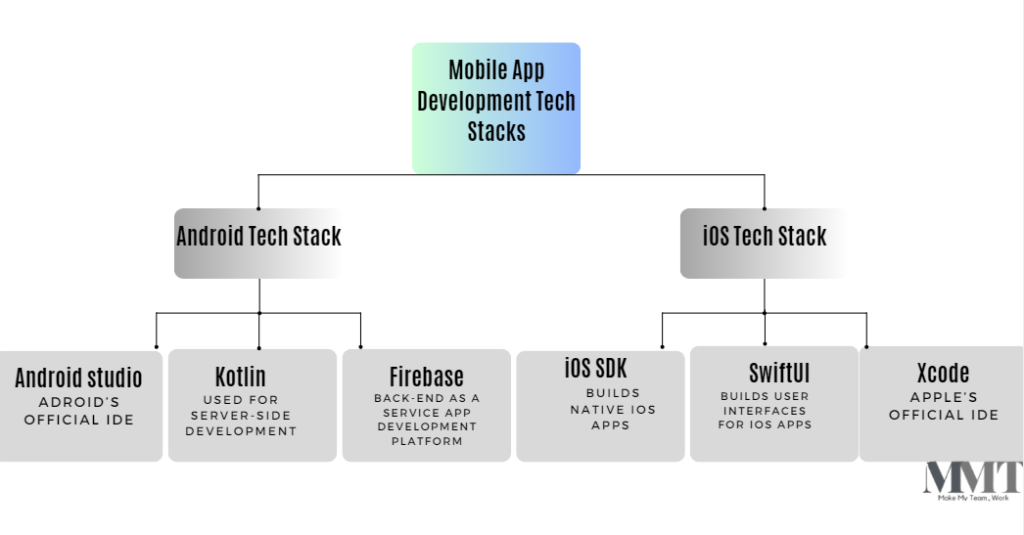
Android and iOS hold the largest market share in mobile operating systems worldwide, with 70.71% and 28.56% respectively. Other operating systems, such as Windows and KaiOS, account for less than 1% of the total market share. Therefore, the tech stack you select will mostly cater to Android and iOS devices.
Criteria for selecting the right technology
You should consider your application’s current and anticipated demands and use it to guide you in selecting the technologies to develop it. Parameters to guide you in selecting the right stack include:
- The framework’s maturity is based on its maintenance, scalability, security, and performance.
- The cost of development,
- The framework’s compatibility and ease of integration with other tools and platforms, and
- Your team’s expertise and ease of learning and adapting to new technologies associated with the frameworks.
Assessing your app’s current and future needs is essential for selecting a tech stack that allows your product to grow as its demand increases.
Future-proofing your technology choices
When you develop an application, you obviously want it to succeed by attracting many users. As more people start using your product, you will have to scale it horizontally and vertically. You should build a product that comfortably accommodates more users and handles large data volumes while meeting its performance requirements as it grows.
The technology stack you select influences everything from the app’s functionality and user experience to its capacity to incorporate new features and respond to market demands. You can ensure a strong and successful app development process by thoroughly assessing the available technologies and aligning them with your project requirements and objectives.
Building a Skilled Team
Building a skilled team for mobile development is crucial for creating a successful app. Bringing together individuals with diverse expertise ensures that every aspect of the development process is addressed, from design and coding to testing and marketing.
Key roles in a mobile development startup
The involvement of a development team is very important in bringing your mobile application into reality and making something that the end-users will find valuable. Every member of the development team adds a unique set of skills that are directed at attending to various aspects during the development process. In the development of your mobile application, you will mostly deal with:
- A project manager is responsible for overseeing, managing timelines, and coordinating between team members.
- App developers, who are specialists and deal with writing and maintaining the app code.
- Designers who work out the user interface and user experience of the app to make sure that it’s friendly and aesthetically appealing to users.
- QA testers who debug the app for it not to have any problems with respect to performance or usability.
These experts work together for the proper integration of not just the technical and design aspects but also the user experience of the app. At the same time, their comprehensive knowledge is vital for gaining efficiency in the development process and ensuring the delivery of a quality product.
How to hire the right talent
Hiring the right talent for mobile development first requires clearly defining your project needs and seeking out individuals with relevant skills and experience. In addition to technical competencies, look for people with problem-solving capabilities and a deep understanding of mobile applications and their development process. Look at their previous projects, references, and testimonials from people and companies who have worked with them before to ensure they are a good fit.
Tips for building a collaborative and efficient team
To build an efficient team, it is important to foster open communication and ensure you share your vision with the team so they understand what you expect from the mobile app. Every team member should understand the objective of the project.
You can attain this through regular updates and by addressing any misunderstandings that come up along the way. Create a respectful culture where every person is taken seriously and listened to in case they have concerns. You should also utilize collaboration tools that help simplify your workflows and keep your project on track. The more supportive of an environment you continue to develop, the better the teamwork will be, and it will help to move the development process along positively.
The ideal team combination brings together professionals with expert knowledge of mobile technologies and app development, user experience principles, and current market trends. Collaboration and communication among the team are the key driving factors to ensure your team achieves its goals for your mobile app. A talented team is crucial in building a high-quality mobile app that appeals to user needs while gaining a competitive advantage over other products in the market.
Importance of a Minimum Viable Product in Mobile App Development
Using an MVP in mobile application development allows you to enter the market with a simple version of your application that has just the core features to test the viability of the application in the market. This concept allows early gathering of user feedback, testing assumptions, and making informed decisions about further development.
The key focus of an MVP is on basic functionalities, which reduces costs and development time while helping discover issues early in development. MVPs use an iterative process that minimizes risk and ensures that subsequent refinements cater to user needs. This enables you to create a user-centric app that will attract more consumers.
Ensuring User-Centric Design
A user-centric design is paramount to a mobile application’s success because it satisfies users’ needs and exceeds their expectations. Conduct extensive user research to develop deep insights into user preferences, points of pain, and behavior in your target audience to create a product that attracts consumers. Let this insight guide the design process in creating intuitive interfaces and seamless interactions that align with user needs.
Regular testing and feedback from users are also essential in validating your design and making adjustments by relying on insights from users who have interacted with your product. Simplicity and ease of use should also be a priority to ensure users do not lose interest when interacting with your app. Keeping users at the center of the design process enhances engagement, satisfaction, and overall success of your mobile app.
Implementing Agile Development in Mobile App Development
Agile development emphasizes flexibility and iteration and is the foundation for mobile app development. It prioritizes collaboration, customer feedback, and continuous improvement until the product achieves its optimal value.
Agile breaks the project into manageable units called sprints, with each sprint resulting in a functional part of the software application. This approach allows for regular product reassessment and adjustments based on user feedback and needs. Agile practices also highlight the importance of team collaboration and alignment through continuous communication and effective project management.
Focusing on Security and Privacy
Prioritizing the security and privacy concerns within mobile application development secures sensitive user data and maintains the trust of your consumers by protecting their information. Strong security practices should be implemented when developing your app to prevent data security breaches and unauthorized access. Adhering to privacy standards, on the other hand, protects you from legal issues that emphasize respecting your consumers’ rights.
Key security considerations for mobile app startups
Safety in mobile application development should be a priority to ensure the protection of data against vulnerabilities and maintain the trust of your users. Ensuring security requires attention to areas of design and functionality through:
- Data Encryption by encrypting sensitive data at rest and during transmission to prevent breaches and unauthorized access.
- User Privacy by implementing policies and procedures related to user privacy in line with data protection regulations so that users are better informed about how their personal data is used and protected.
- Secure Coding Practices to protect the code against vulnerabilities like cross-site scripting and SQL injections.
- Authentication and Authorization using strong authentication methods, like multi-factor authentication, with proper authorization controls to restrict unauthorized access.
- API Security through authentication and authorization mechanisms can be used to restrict unauthorized access to APIs and further breaches.
- Regular updates, along with its dependencies, are needed to protect against vulnerabilities.
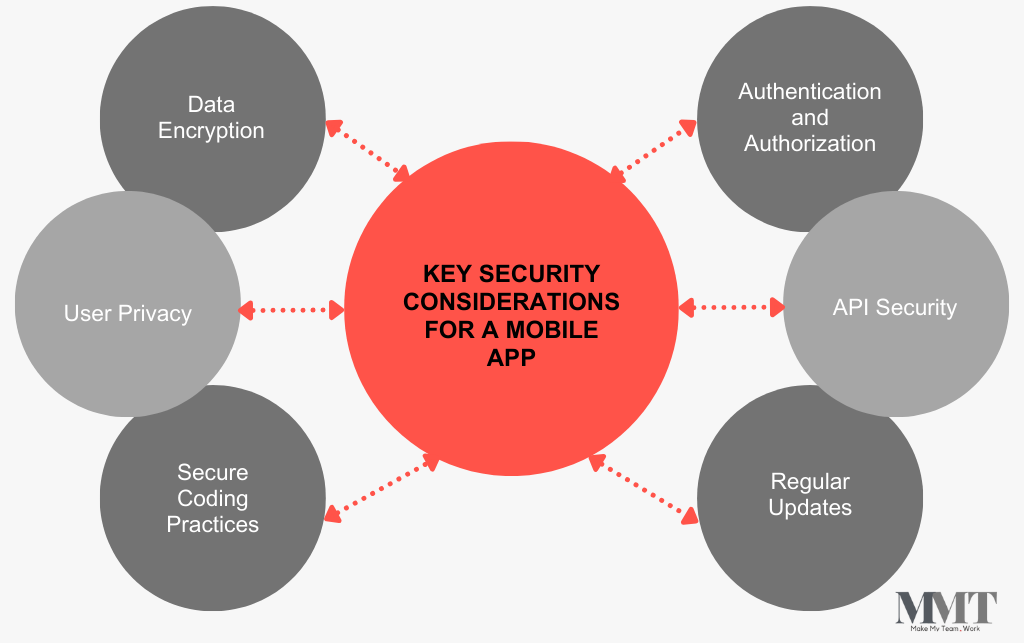
These practices integrate strong security features from the very start of mobile app development, thus protecting sensitive information from unauthorized access. Proper security measures also ensure the application complies with data protection, therefore contributing to user satisfaction, trust, and long-term success.
Compliance with regulations
Mobile application developers must adhere to regulatory compliance like GDPR and CCPA, which help gain the confidence of users and ensure legal compliance. According to these regulations, collection, storage, and user information use are based on consent and transparency, with the protection of data bound by strict guidelines. The regulations include:
- Strong data management practices.
- Explicit consent by the user for data collection.
- Clearly communicated privacy policies.
- Rights exercisable by users in relation to their personal information.
Compliance will not only help you avoid legal penalties but also strengthen the credibility and reliability of the app in the eyes of users.
The security of your mobile app cannot be compromised since it protects against unauthorized access, data breaches, and other vulnerabilities. Strict adherence to privacy policies ensures that regulations are not violated and that users’ information is not compromised. You should keep this in mind from initial development because it will save you costs arising from security incidents and enhance users’ trust in your product, which builds a good reputation for your app.
Marketing and Promotion Strategies
A proper mobile app marketing strategy enhances visibility and attracts users to your app, allowing you to create brand awareness. Even the best-designed apps become the victim of insignificance if their marketing approach is not well-defined because they fail to reach the right audience. A strong marketing approach also leverages the right channels to reach your target audience, for example;
- App Store Optimization (ASO) is crucial in improving the visibility and ranking of an app within an app store through relevant keywords and compelling descriptions.
- Social networks like Facebook, Instagram, and Twitter provide an opportunity to connect with users, share updates, and build buzz around your product.
- Influencer partnerships by leveraging influencers in your niche help promote your app to build reach by leveraging the following of popular figures.
- Paid advertising, including search ads and display ads on various platforms, can be facilitated through Google Ads, among other social media.
- Content marketing creates awareness and valuable information about your app through blogs or video content.
- Email marketing nurtures leads and retains users through updates and personalized messages. Proper use of the channels ensures visibility for your app, attracts users, and helps grow your app.
Strategic marketing involves conducting market research, creating a UPI, and selecting the right channels to reach your audience. A strong marketing approach will engage users and ensure the app adapts to changing needs and market demands. It also utilizes efficient mobile app marketing channels to reach and communicate with your audience.
Measuring Success and KPIs
Measuring the success of any mobile app development is necessary to understand how an application performs in the market and precisely pinpoint where an improvement is needed. KPIs for mobile apps include;
- User Acquisition: The number of downloads or installations.
- Cost Per Acquisition: The total cost of acquiring every user.
- Daily Active Users: Users who interact with the application daily.
- Monthly Active Users: The number of users who interact with the application monthly.
- User Retention: the strength of the application in maintaining user interaction over a specified period.
- The Churn Rate: The number of users who stop using the app within a fixed period.
- Lifetime Value: Estimates the revenue generated in the whole lifetime of a user in an app.
By assessing certain metrics, you will understand how users behave using your app, whether they are engaged or not, and what value they receive from your application. Such insights would be useful during decision-making, optimization of features, and refining marketing strategies toward a better user experience. Performance indicators act as guides to strategic adjustments you should make to ensure long-term success and sustainability of your mobile app in a competitive market.
FAQs
How much capital is required to start a mobile app development startup?
The cost of developing a mobile app differs depending on its complexity. An MVP costs between $5000-$50,000, while medium-complex apps can go up to $100,000. Complex apps cost between $100,000 and $300,000.
What are the biggest challenges faced by mobile app startups?
Mobile app startups frequently face challenges that inhibit their ability to succeed. These include highly competitive markets, limited resources, keeping up with ever-changing regulations, and securing funding. Addressing these challenges requires proper strategic planning, flexibility, and a keen understanding of the market and user needs.