


App development is crucial for startups because it is a vehicle that gives value to target consumers and eventually generates revenue. App development is crucial for startups because consumers often judge the company’s credibility based on the quality of the product(s) they release. As more consumers adopt your app, it enhances your brand’s visibility and recognition, helping your startup acquire customers and eventually establish a strong presence in the market.
Key Benefits of App Development for Startups
App development is the bridge that allows customers to access a service offered by startups. It gives startup companies the following key benefits:
- Increased brand visibility: The experience consumers have interacting with your app influences how they perceive your company. When users have a positive experience with your app, they associate your company with quality and this builds a positive image for your brand.
- Cost efficiency: A carefully planned development process is thorough and involves a lot of testing. Testing allows startups to identify issues with their product earlier on before scaling, helping them avoid costly changes later.
- Data collection and analytics to enhance user experience: App development allows startups to gather valuable insights on consumers, including user behaviors and preferences. In turn, startups personalize the user experience by tailoring the app to meet their needs.
- Scaling your startup: As your app gains more users, it has to scale to accommodate a larger user base. More users offer valuable insights used to refine and improve the app, making it increase its customer value. As the app becomes better, the number of users increases. More users mean more clients for your startup, amplifying its growth.
- Increased sales and revenue: App development opens new revenue streams for your startup, including client subscriptions, in-app purchases, and in-app advertising revenue.

App development is crucial to startups because a software product is the medium through which their business performance takes place. Startups draw in customers based on how well they interact with their apps, from the ease of navigation and user-centric designs to features they find valuable.
The manner in which users interact with your app influences their perception of your brand. App development allows startups to refine their products for the optimal user experience. Therefore, when you develop an app, ensure it’s well-refined and so intuitive that consumers want to use it constantly and associate its quality with your brand.
Types of Apps Startups Can Develop
Startups can build different types of apps, including mobile apps, web apps, progressive web apps (PWAs) and hybrid apps. The kind of app a startup decides to build is guided by its target audience, desired functionality, and available resources.
Mobile apps
These are software applications designed to run specifically on mobile devices such as smartphones, tablets, and, in recent years, smartwatches. Users download these apps from the App Store (iOS devices) and Google Play Store (Android devices). iOS apps are designed to run on Apple devices and are developed using iOS development stacks such as Swift and Objective-C.
On the other hand, Android apps are developed using Android tech stacks such as Kotlin and Java. Mobile apps can run offline on devices without requiring an internet connection.
Web apps
These apps are designed to run on web browsers such as Google Chrome, Mozilla Firefox, and Opera browser. They are primarily developed using standard front-end programming languages such as HTML, CSS, and JavaScript. Web apps run on a remote server and require an internet connection for users to access them.
Progressive Web Apps (PWAs)
PWAs are accessed through web browsers but can also be installed on devices and run independently of the web browser. Think of a PWA as a web browser with offline capabilities. Adobe Creative Suite is an example of a PWA.
Hybrid apps
These are a combination of web and mobile apps. They are developed using standard technologies but wrapped in a native shell, which allows them to be installed on devices. Instagram, X (formerly Twitter), and Facebook are examples of hybrid apps.
The type of app a startup decides to build should be influenced by what they aim to achieve with the app and how users prefer to engage with it.
How Startups Can Analyze Competitor Apps
Competitor analysis helps startups understand the current market and competitive ecosystem. To sufficiently understand your competitors:
- Identify your primary and secondary competitors. Primary competitors offer similar products, while secondary competitors may not have the same product, but they solve the problem as your app indirectly.
- Examine how these apps rank to gauge their popularity. This helps you determine whether your app has potential demand.
- Look at the features incorporated in these apps and identify what they’re missing–gaps you can fill.
- Conduct a SWOT analysis for your app to determine its strengths and weaknesses and to identify opportunities and threats from the competitor analysis.
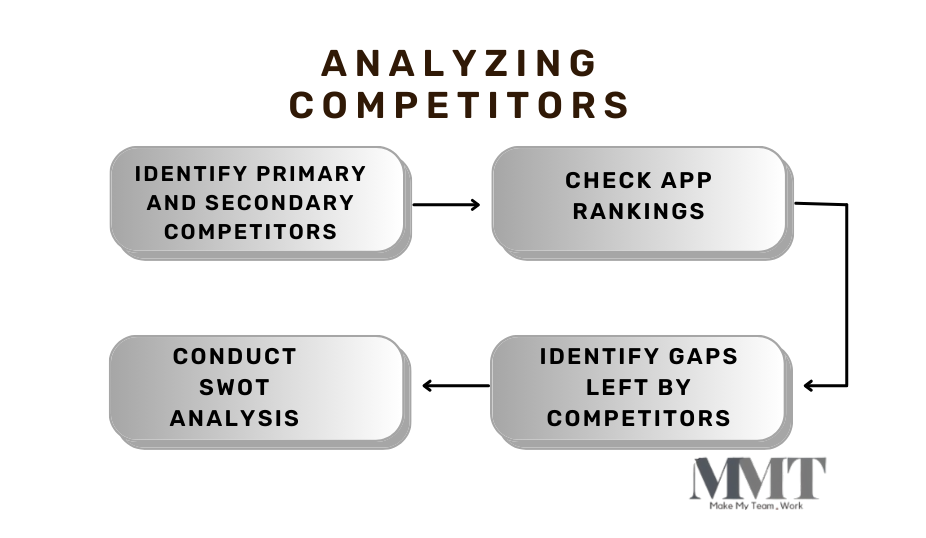
Thoroughly analyzing your competitors helps you gather valuable insights to guide you in developing an app that differentiates itself from others in the market.
Key Considerations in App Development for Startups
Before building an app, it is essential to consider factors that significantly influence its success. These factors ensure you develop an app that resonates with users and gives them optimal value.
Choosing the right development platform and technology stack
Development platforms and technology stacks, if well-selected, lay a strong foundation for your app. These considerations affect the performance of your software product, user experience, security, scalability, and maintenance. When selecting a platform, it is essential to determine whether your priority is user experience or saving on time and costs.
Native app development, which designs native apps to run on one operating system specifically, is more costly and takes longer to develop. However, they offer a better user experience. On the other hand, cross-platform development, which designs hybrid apps, is more suitable if cost efficiency is your priority.
Hybrid apps run on multiple operating systems, such as iOS and Android, from a single code base, making maintenance easy and less costly. For native app development, you need app-specific tech stacks, such as Swift and Objective-C for iOS apps, Kotlin and Java for Android apps, and Dart and Flutter for hybrid apps.
Designing user-friendly interfaces
Startups should prioritize a well-designed and friendly user interface in their apps. The interface should be intuitive to optimize user engagement and satisfaction. User-friendly interfaces are usually simple and appealing and don’t require users to undertake many actions to accomplish tasks.
Quality development process and App Testing
A quality development and testing process leads to a highly functional and well-performing app that meets user needs and expectations. Your app will be free of bugs and reliable for consumers If you execute your development process well, leading to higher adoption rates.
A proper development process adopts an iterative approach, which breaks your project into sprints. This process allows you to continuously test and refine your product based on user feedback until it attains optimal performance.
Effective launch strategies
A proper launch strategy entails a well-planned series of actions and approaches to ensure your app’s maximum impact and success upon launch. These strategies create awareness and build excitement, ensuring that the app makes a difference in the lives of your target audience.
They also ensure that the app starts attracting and retaining users early. Examples of effective launch activities you should incorporate include focused marketing efforts, implementing user feedback, and post-launch activities.
Post-launch maintenance and updates
App development is not just about building and launching an app; it is a continuous process that shapes the app to meet user expectations, technological changes, and market trends. Users can also point out bugs and issues you did not catch during development. User feedback can also lead to the realization of new features that enhance user experience.
Post-launch activities also ensure you update your app constantly to secure it from new vulnerabilities. Post-launch maintenance and updates ensure your app is relevant and competitive by aligning it with industry practices.
When your startup embarks on developing an app, these key considerations are critical to building an app that prioritizes the user.
Common Challenges in App Development and Strategies to Overcome Them
Startups often encounter different challenges that complicate and slow down the development process. Examining possible challenges your startup can face and planning well for them is essential. These challenges include:
- Budget constraints: Occur due to underestimating the project’s complexity, scope and feature creep, and unforeseen technical challenges.
Solution: Thoroughly plan before development, plan for unexpected costs, and monitor your spending during development.
- Scalability: The inability of an app to handle growth, including many users, data volumes, and transactions. This leads to performance issues and can cause your app to crash.
Solution: Use scalable cloud hosting services, which allow you to add or remove servers and resources with minimal physical hardware costs. It is also essential to plan and budget effectively for growth.
- Competition: Many apps offer similar (or relatively similar) solutions and target the same audience. It can be challenging to convince users to choose your app over competitors.
Solution: Conduct market research to understand your competitors’ practices and your target consumers’ preferences. Use focused marketing strategies and gather user feedback to refine your app.
- Performance issues: They influence the responsiveness of an app, for example, many bugs, slow load times, and crashes. These issues frustrate users and eventually cause them to abandon the app.
Solution: Conduct thorough testing through iterative development to fix bugs and enhance your app’s performance.
- Keeping up with technological changes: Technological changes and advancements make apps outdated fast.
Solution: Stay informed on changes relevant to your app and update it periodically.
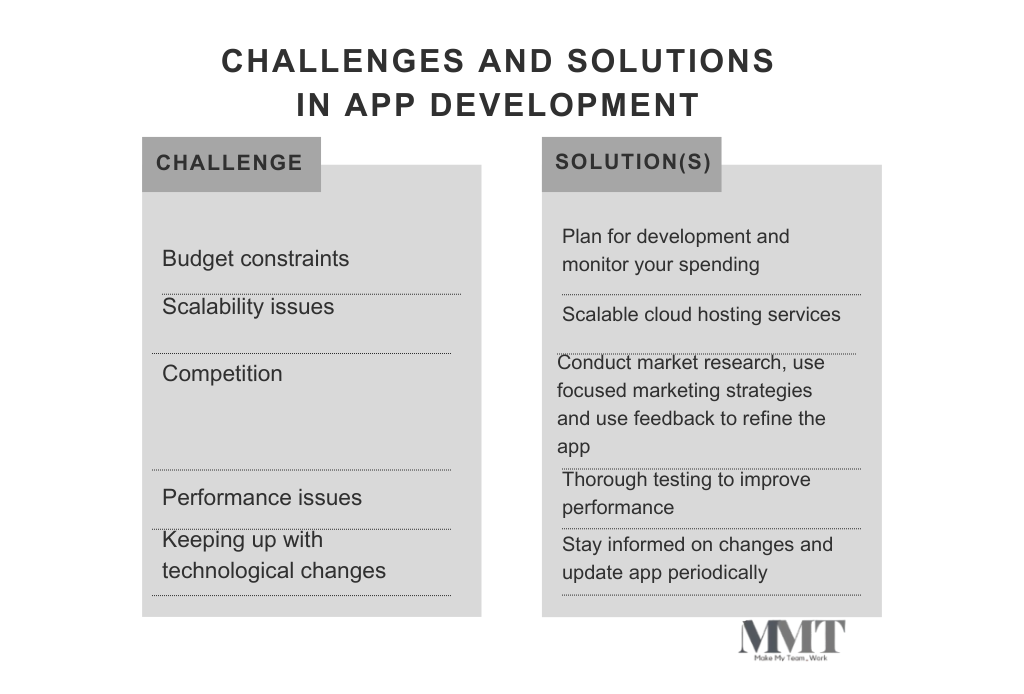
Budget constraints, scalability issues, market competition, performance issues, and keeping up with technological changes are just but a few challenges startups face when developing apps. It is essential to conduct thorough research and identify which problems your startup is likely to encounter. Proper planning helps develop tailored solutions and facilitate a seamless development process.
Choosing the Right App Development Partner
Choosing a development partner involves matching your needs against their skill and capabilities. To identify a suitable development partner, first, take some time to work out the scope of your project. Next, go on to describe the capabilities the development partner should possess.
When you begin your search, interview your potential partner thoroughly about their experience and development process. Also, review their portfolios for your previous work and testimonials from previous clients to know whether they are reliable. Ensuring your development partner’s fees fall within your budget is also essential.
At MMT.work, we connect non-techie founders with a vetted team of developers and product builders, ensuring your app is built to support your startup’s success. Get in touch today and let’s turn your vision into reality.
How long does it take to develop an app?
The time taken to develop an app varies depending on its complexity. On average, simple apps take 2-4 months to develop, medium-complex apps take 4-8 months, and complex apps can take up to a year.
What are the best practices for app marketing?
To reach your target audience, you can market an app through social media advertising, search engine marketing, App Store optimization, referral programs, and email marketing.
What are the key metrics for assessing an app’s success?
Some metrics used to measure an app’s success include the number of downloads, daily and monthly active users, user acquisition costs, session length and frequency, and bounce rates.










[…] App development is a complex process that requires careful planning and strategic execution for a successful outcome. Understanding your needs ensures the development process is guided and focused, and team efforts align towards a shared vision. […]