

The benefits and risks associated with outsourcing developers are easier to understand if you have gone through the process and hired a few yourself. Alternatively, you can learn about outsourcing techs from those who have traveled that path. Small-to-mid-to-big companies outsource their development either due to the high cost of talent or the inability to find the right talent in their region.
Outsourced development teams can optimize operations by improving efficiency and workflows while minimizing resources. However, working with a team of individuals from different regions has its shortcomings. In this article, we will dive more into outsourcing and analyze the benefits and risks associated with the process and possible mitigation measures.
What Is Outsourcing in Software Development?
Outsourcing in software development involves contracting third parties such as specialized development and design firms, freelance developers and designers, and other consultants to undertake an entire project or specific tasks and functions related to your development process. Companies often outsource to reduce costs while maximizing the benefits of a highly skilled team. There are three different outsourcing models:
- Offshoring– Involves migrating your development services to another country. The essence of this practice is to use access to low-cost labor while gaining access to teams with specialized skills and expertise.
- Nearshoring– Companies outsource services from a nearby country, often in the same region.
- Onshoring– Involves outsourcing to locations within your country. It is also referred to as domestic outsourcing. Companies that use these practices target locations with lower labor costs within the same country.
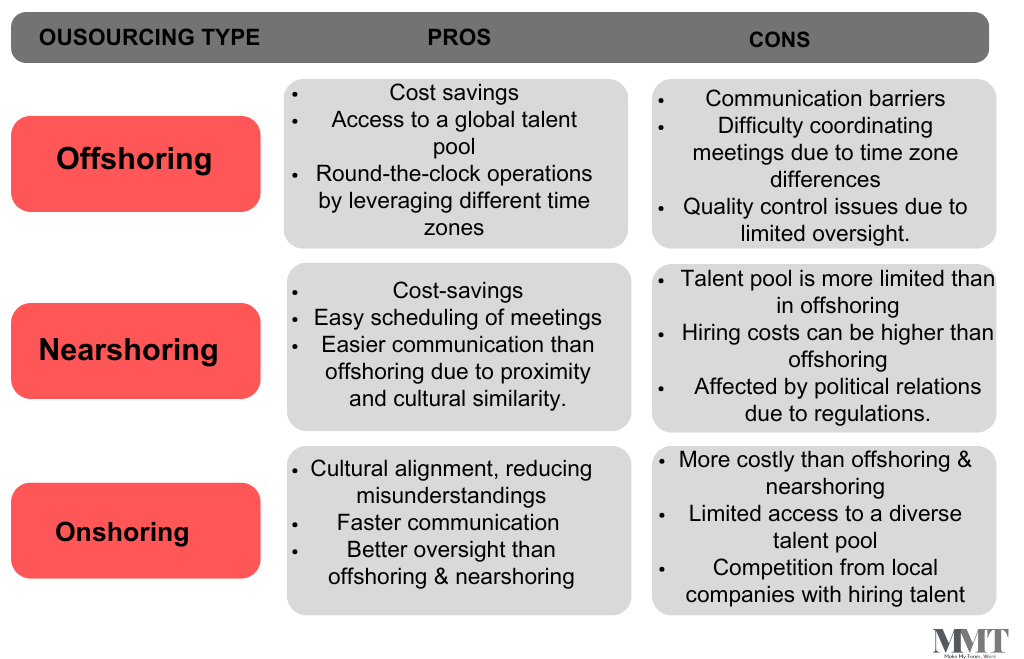
While offshoring, nearshoring, and onshoring each present great benefits, it is important to consider the quality of talent you hire because it is crucial to the successful development of your product.
What Are the Benefits of Outsourcing Developers?
Outsourcing is a practice that companies adopt to optimize their operations and business strategies using external teams. It attracts various benefits associated with cost savings, access to specialized skills, and fast development, which drives innovation.
Cost Reduction
92% of the top companies in Information Technology (IT) outsource their services to minimize costs. Companies also save up to $77,000 annually by outsourcing development services. Outsourcing reduces costs by:
- Lowering labor costs from a diverse talent pool,
- Reduced overhead costs such as rent, insurance, and other costs associated with maintaining an in-house team,
- Fewer HR resources by selecting a qualified partner, eliminating the need for training, and
- Focusing on their core business because the partner is assigned specific responsibilities. An in-house team often juggles multiple responsibilities, diverting it from the company’s strategic initiatives.
When you hire developers with cost savings in mind, it is essential to consider their location because labor costs vary by country. The costs differ based on experience, expertise, tech stack, and current market conditions.
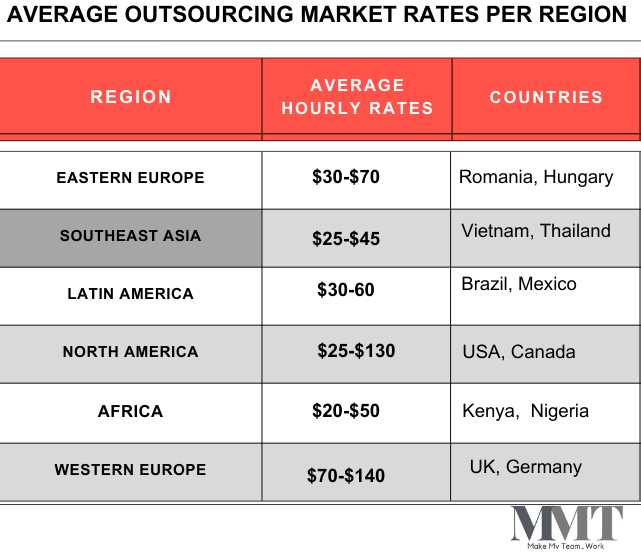
Source: Oksana Tymoshchuk
Faster Time to Market
Outsourcing developers helps companies develop and launch their products faster, giving them a competitive advantage and gaining market share early on. Due to special expertise in the technologies and domains required to build your product, they can start work immediately after getting hired. Experienced development partners also build your product fast by incorporating agile methodologies–essential in product development. Thus, you can release your product to the market fast, gather feedback, respond to customer needs more effectively, and gain a competitive advantage.
Access to the Latest Technology and Expertise
To stay competitive, outsourced specialized firms often train developers to enhance their skills and keep up with the latest technologies and industry practices. It helps them position themselves as valuable assets that deliver high-quality products and solutions to potential clients. Outsourced development partners have:
- Niche skills, since they are experts who specialize in specific technologies and methodologies,
- Industry-specific knowledge because they stay informed to attract different clients and,
- High-quality outputs due to vast experience working on diverse projects.
Outsourcing to specialized firms brings benefits instead of an in-house team, which often requires costly training to enhance skills, familiarize itself with the latest technologies, and understand current market trends.
Risk Mitigation
Leveraging development partners averts the risks associated with product development, such as delayed project delivery timelines, budget overruns, and security issues. Outsourcing helps you mitigate risks because:
- Specialized firms often have enhanced security measures to prevent vulnerabilities and breaches in their clients’ products,
- You can work with fixed-priced contracts, which prevent budget overruns associated with in-house development,
- It prevents overstaffing and allows you to manage resources more efficiently, and
- It facilitates shared responsibilities since team members specialize in different areas, such as frontend development, backend development, UX/UI design, etc.
Working with an outsourced team stabilizes the entire project outcome because the teams are often cross-functional and have overlapping skills. They often work together to solve problems and offer different perspectives to deliver high-quality products promptly, preventing the risk of project delays.
To fully utilize the benefits of outsourced development partners, ensure they are highly skilled and qualified to develop your product. You should look at their portfolios, reviews, and testimonials from former clients to determine whether they are the right team to build your product.
What Are the Risks of Outsourcing Developers?
While outsourcing offers significant benefits to companies, it also attracts risks that should be carefully considered. As you navigate the outsourcing landscape, it is essential to understand these risks and mitigate them for successful project outcomes.
Communication Challenges
Many companies experience communication challenges, which can hinder the progress and success of a project if not addressed promptly. Approximately 20% of companies that use outsourcing partners report communication as their biggest issue in the development process. Communication challenges with outsourcing partners arise from:
- Time zone differences due to the development team being unavailable simultaneously cause delays in exchanging information.
- Language barriers between team members from different regions can lead to misunderstandings. This is especially challenging when some members experience challenges conveying and articulating information.
- A lack of real-time interactions inhibits team members’ ability to familiarize themselves with one another and build cohesion, which fosters a shared understanding of the project’s goals.
Failure to convey and receive information effectively can lead to confusion and hinder your team’s ability to develop a high-quality product that aligns with your vision.
Quality Control Issues
Outsourcing partners should ensure a thorough testing and quality assurance (QA) process because it identifies and removes defects and bugs in a product before it is released to the market. This ensures your product is functional, high-performing, and exceeds the expectations of your target consumers. Quality control issues experienced in product development include:
- Quality lapses because clients (companies) have limited oversight over the outsourced teams. This is especially common if outsourcing partners have their own management systems.
- Inconsistencies in code quality if the outsourced firm has different skills and expertise.
- Limited ability to thoroughly test and debug the product if the outsourcing partner has insufficient access to testing tools and resources.
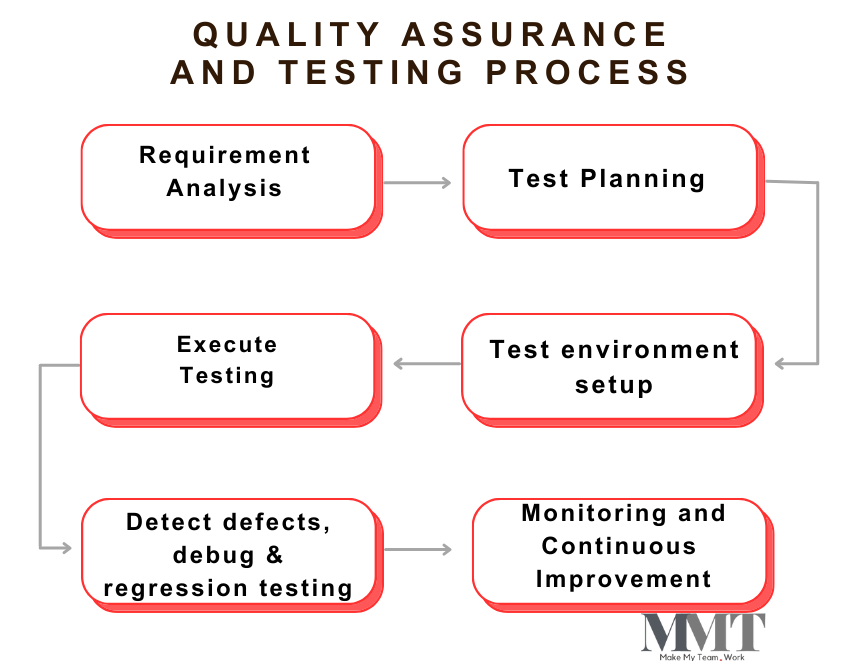
Delivering a subpar product leads to high bounce rates and eventually damages your company’s reputation. To ensure your product is well-refined and exemplary, it is essential to ensure regular progress checks and, if possible, use third parties for quality assessments.
Intellectual Property (IP) Risks
Companies often lack direct control when working with external developers, creating an inherent vulnerability to proprietary ideas. This exposes them to potential intellectual property (IP) risks such as:
- Disputes regarding who owns specific parts of the product –for example, the source code and design elements– in cases where the contract does not specify this.
- Unintended disclosure by development partners when they interact with other clients and in informal settings.
- Unauthorized use and theft of proprietary information.
When you partner with a development partner, ensure you have a contract in place that safeguards you from IP vulnerabilities and protects your product idea from being exposed and infringed upon by third parties.
Hidden Costs
16% of development projects experience invisible costs, leading to a 200% budget overrun. Out of these projects, 70% experience delays. Unexpected costs that arise in outsourcing include:
- Costs that arise from integrating technologies with third-party services, such as payment processing and cloud hosting.
- Testing and quality assurance costs and
- Maintenance and support costs post-development.
Thoroughly vet your outsourcing partners, set a realistic budget, and include detailed contract terms to mitigate these challenges. It is also essential to consider the cost of cloud hosting since it is usually overlooked. Ensure the contract stipulates whether the burden falls on you or them–whether it is included in the initial payment.
Dependency on External Providers
It is common to want a long-term working relationship with the same outsourcing partners because established relationships attract familiarity, which leads to efficiency. However, over-reliance on these external providers attracts various risks:
- Inadequate service levels and low-quality work when outsourced partners believe a client is over-reliant on them.
- Outsourcing partners prioritize other clients’ projects over yours, which affects the quality of your product and causes delays in delivery.
- Limited ability to adapt to project needs related to shifts in the technical directions if the development partner lacks the expertise and skills.
To mitigate the challenges arising from overreliance on external partners, you should maintain control over outsourced projects by establishing a structured communication strategy that ensures regular check-ins and updates. You should also have contingencies to facilitate an efficient transition process if your relationship with the current outsourcing partner does not work out.
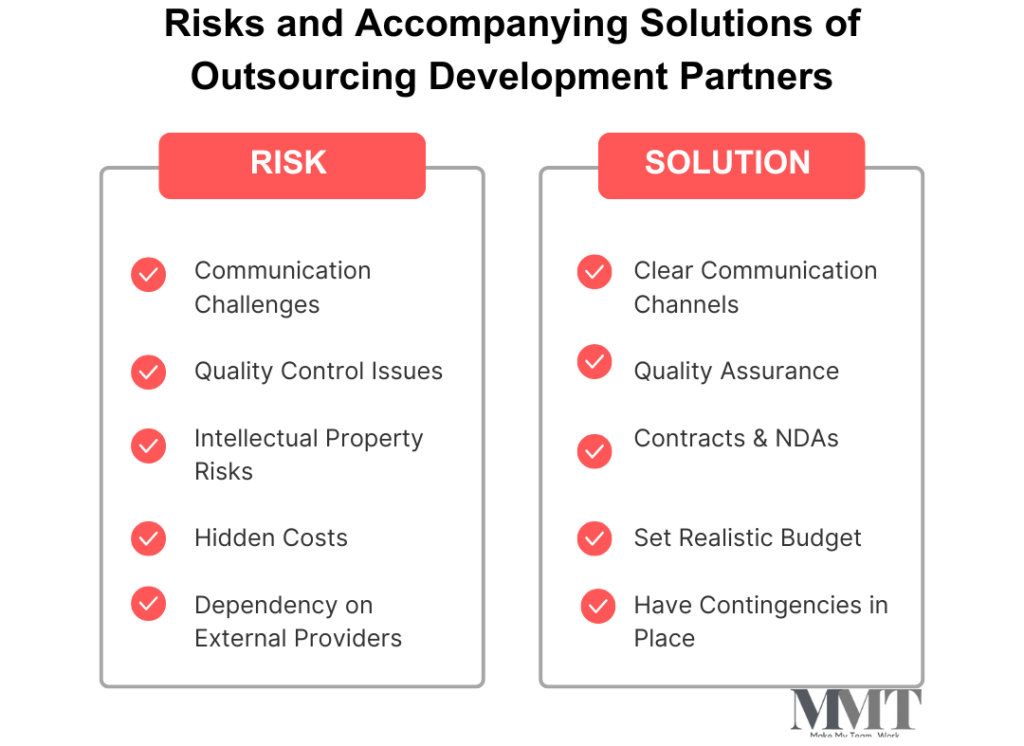
How to Mitigate the Risks Associated with Outsourcing Developers?
When you decide to outsource developers, it is essential to understand the strategies to help you navigate the challenges of working with them. These solutions help improve the workflow and maintain momentum throughout the entire development process, leading to positive project outcomes.
Choosing the Right Outsourcing Partner
The firm or developer(s) you select for your project significantly impact its outcome. The right development partner should have the skills and expertise needed to build your product, align with your goals, and fit into your organizational culture. When selecting an outsourcing partner, you should look at their:
- Technical skills and the ability to handle complex challenges,
- Familiarity and expertise with the technologies needed to develop your product,
- Reviews and testimonials from their former clients,
- How well they understand your project needs, for example, the type of product you want, your target audience, and delivery timeline, and
- Ability to fit well with your company’s culture–including adopting the desired communication styles and adopting your values while aligning with the company’s vision.
Finding the right outsourcing partner builds a strong foundation for a great working relationship, ensuring your project needs are met effectively and efficiently.
Establishing Clear Communication Channels
Open communication is the backbone of the success of your project because it ensures that everyone is aligned with your product vision throughout the development cycle. Best practices for managing communication include:
- Establish clear communication channels suitable for you and the outsourcing partner
- Schedule regular check-ins to review the team’s progress, offer feedback, and address their concerns.
- Establish clear reporting structures to ensure information is communicated to the intended parties and,
- Use project management tools such as Asana, Trello, and Jira to facilitate collaboration and structure your project’s framework.
Streamlining communication with outsourced development partners ensures an efficient and continuous workflow and facilitates a high-quality project outcome.
Setting Clear Expectations and Goals
Your goals and objectives act as a roadmap for your project because they help your team understand what needs to be achieved. This facilitates focused decision-making, as everyone’s actions are synchronized to attain them. You can set clear goals and expectations by:
- Defining the goals and objectives of your project and explaining to the outsourcing partner what you want your product to achieve. Use SMART criteria–Specific, Measurable, Achievable, Relevant, and Time-bound to ensure clearly defined and well-established goals.
- Defining roles and responsibilities clearly so everyone understands what is expected of them.
- Utilize contracts and service level agreements (SLAs) that define your project’s deliverables and timelines and subsequently hold the outsourcing partner accountable.
Well-defined goals and expectations reduce miscommunication and misunderstanding with your outsourced development teams by ensuring everyone is aligned with your project’s vision.
Protecting Intellectual Property
Intellectual property is one of the factors that drive your company’s competitive advantage. Once you safeguard your IP, you prevent others from appropriating your creative ideas without permission. Third parties can access your ideas if your team engages in related informal discussions and if you fail to have a protected documentation process. To protect your IP rights from the onset of development, you should:
- Adopt contracts and explicitly state IP ownership of the product,
- Use non-disclosure agreements (NDAs) to protect confidential information and,
- Encrypt sensitive information –in transit and at rest to limit unauthorized access by third parties.
Having legal measures in place safeguards your IP and unique ideas and offers remedies in case outsourced developers violate the terms of your agreement.
Working with outsourcing partners attracts uncertainties that can impact the overall success of your project. Having safeguards for these uncertainties helps you create a framework that mitigates them quickly and efficiently and ensures you gain the maximum value from outsourcing.
Conclusion
Outsourcing development partners is a resourceful strategy that allows your company to access specialized talent from a diverse talent pool. Whether you have a startup or a well-established company, it is a sufficient approach because it saves you on costs. When you decide to outsource, thoroughly evaluate your potential partners to ensure they have the proper skills to develop your product and fit well within your company’s culture.
FAQs About Outsourcing Developers
How can I ensure the success of my outsourcing project?
Clearly defining your project’s goals and articulating them well to outsourcing partners lays a strong foundation for its success. You should also maintain regular communication and closely monitor the team’s progress throughout the development process.
What are the legal considerations when outsourcing?
When outsourcing, it is essential to comply with local, national, and international laws to prevent legal liabilities and protect your company’s reputation. Other considerations to safeguard yourself include contracts with partners to ensure performance and NDAs to protect your Intellectual Property rights.
How does outsourcing affect my company’s culture?
Outsourcing attracts diverse perspectives, which can cause a significant shift in team dynamics and the company’s culture. These shifts are not always negative for your company. You can utilize them by welcoming new and different viewpoints, facilitating innovative solutions, and leading to better project outcomes.
Can outsourcing developers lead to innovation?
Outsourcing developers leads to innovation due to access to specialized skills and fresh viewpoints, which can be better than the existing solutions. Outsourced partners are also constantly upskilling to remain marketable. This informs them of current industry practices, the latest trends, and new technologies that facilitate innovation.
How do you manage outsourced teams effectively?
You can manage outsourced teams effectively by setting clear expectations from the onset of your project and using project management tools to assign and track their tasks. Open communication is also key to managing these teams because it facilitates transparent discussions and aligns the team with shared goals, streamlining the development process.