


A tech cofounder or Chief Technology Officer (CTO) isn’t just a coder—they are the technical backbone of a startup, the architect of your vision, and strategists who ensure that your software product doesn’t just survive but thrives. A tech cofounder or CTO doesn’t just build products; they build scalable, sustainable tech foundations that set up startups for a solid MVP launch and long-term success.
A strong tech foundation is crucial, but having the right person to lead it is just as important. You need more than just technical execution if you have a game-changing idea—one that could disrupt an industry, solve a massive problem, and make people’s lives easier. You need a strategic partner. A CTO ensures that your tech strategy evolves as your startup grows, while a tech cofounder takes it a step further—shouldering both the technical challenges and the entrepreneurial highs and lows that come with building a company from the ground up.
Tech Co-Founder vs. CTO: What’s the Difference?
When it comes to launching a startup, many founders struggle to figure out who they actually need: a tech cofounder or a CTO. Both play a critical role in turning a startup’s vision into reality. Before you start searching, let’s break down what sets these two roles apart by understanding the differences in their roles and responsibilities:
Tech Co-Founder
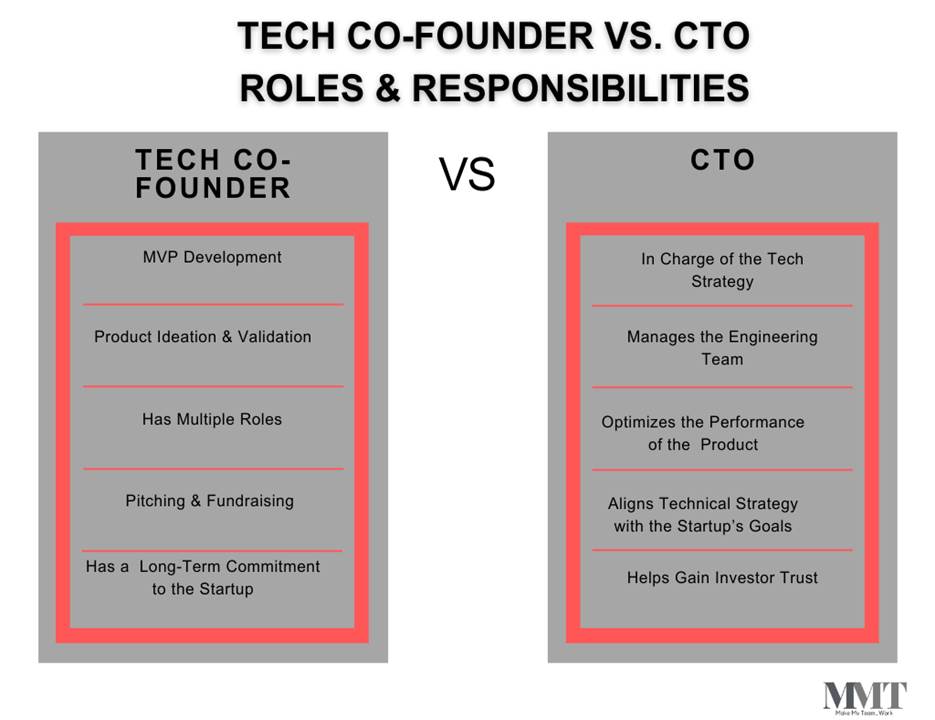
A tech co-founder is not just a regular employee because they play the role of the builder and the co-owner of a startup. They’re a partner who shares the risks, rewards, and relentless challenges of building a startup from scratch. They usually come on board early, often before there’s even a product. Their key responsibilities include:
- Building the First Version (MVP): Writing the initial code and developing the first working product.
- Product Ideation & Validation: Helping shape the product roadmap based on technical feasibility.
- Wearing Multiple Hats: From coding to server maintenance to debugging.
- Fundraising & Pitching: Investors want a solid tech team—cofounders often participate in pitches.
- Long-Term Vision: Committed to the startup’s success, not just as a job but as an owner.
The right one doesn’t just build your product; they build the future of your company with you. They sweat over every line of code, every pivot, and every late-night “what are we even doing?” moment.
Chief Technology Officer
A CTO is a technical strategist who oversees the tech team, such as developers and designers and ensures the tech stack used can support the startup’s long-term growth. Their key responsibilities include:
- Tech Strategy & Scalability: Designing architecture that can scale as the company grows.
- Managing Engineering Teams: Hiring, leading, and mentoring developers.
- Optimising Performance & Cost: Ensuring software, servers, and security are optimised and the cost of people and tools are within the budget.
- Bridging Business & Tech: Aligning technical decisions with business goals.
- Fundraising & Investor Relations: Builds investors’ trust that the tech side is in good hands.
A CTO balances vision with pragmatism, strategy with execution, and code with company growth. In short, they don’t just keep the lights on—they build the infrastructure that keeps your startup moving forward.
Choosing between a tech cofounder and a CTO comes down to the stage your startup is in. Many early-stage startups whose vision is to build a small-to-medium tech business don’t need a CTO, especially when they’re still building their first product, because finances are usually limited. What they usually need is a tech cofounder or a strong tech lead—someone who can write code, build the MVP, and iterate quickly. Sometimes, in some cases, a tech cofounder eventually transitions into the CTO role as the company evolves.
However, a CTO is a better fit for fast-growing startups competing in a big market with existing big players that need the CTO’s technical leadership from day 1.
Benefits of Having a Technical Co-Founder vs. Hiring Developers
When building a tech startup, one of the biggest decisions you’ll face is whether to bring in a technical cofounder or simply hire a developer. Both options have their pros and cons, but choosing the right one depends on your startup’s needs and long-term vision. Before you decide, let’s break down the key benefits of having a technical cofounder versus hiring a developer.
- Long-Term Commitment and Shared Vision: A tech co-founder is a partner in building the company. Hired developers can always seek employment elsewhere, especially if things get tough. A co-founder, on the other hand, will stick it out and actively work to find solutions that make the startup better.
- Strategic Thinking and Technical Leadership: Beyond coding, a technical cofounder plays a strategic role in product development, scalability, and innovation. They understand the bigger picture–how tech choices impact business growth, funding opportunities, and long-term sustainability.
- Cost Effective in the Early Stages: Many early-stage startups can’t afford to pay market rates for top-tier developers. A technical cofounder typically takes equity instead of (or in addition to) a salary, meaning you don’t need to spend large sums upfront to build your product.
- Faster Product Iteration and Problem Solving: With a cofounder, your tech team is driven by passion, not just paychecks. They are more likely to work long hours, iterate quickly, and solve critical technical challenges without waiting for instructions.
- Better Fundraising Opportunities: Investors prefer startups with technical founders. A strong tech cofounder signals to VCs and angel investors that your startup has the technical leadership needed to execute and scale.
A technical co-founder is often the best choice if your startup is in its early stages, lacks funding, and requires strong technical leadership. The co-founder has a real stake in the company’s success, which means their commitment will be long-term.
Can You Succeed Without a Tech Co-Founder?
It is possible for a startup to succeed without a tech co-founder, especially if you have technical knowledge yourself. However, most successful companies today have co-founders because only a few manage to succeed without one. A co-founder is your partner throughout the startup journey, someone to exchange ideas with, tackle challenges alongside, and keep you motivated when things get tough. The right co-founder brings complementary skills, shared vision, and resilience, which can make a significant difference in a startup’s long-term success.
That said, if you’re a non-technical founder struggling to find the right tech co-founder, don’t let that stall your progress. You can kick off by hiring skilled developers and engineers from platforms like MMT.work or Upwork. These platforms give you access to experienced professionals who can build your MVP, iterate on your product, and help you gain traction before you even bring a co-founder on board. While a co-founder brings long-term commitment, a well-assembled tech team can bridge the gap and get your startup moving in the right direction.
Characteristics to Look for in a Tech Co-Founder or CTO
Finding the right technical partner isn’t as simple as posting a job ad or hitting up LinkedIn. It’s a lot like dating—you need to find someone you have chemistry with, someone who shares your vision, and most importantly, someone who matches your passion for the product. Here are the key characteristics to look for when choosing a tech cofounder or CTO:
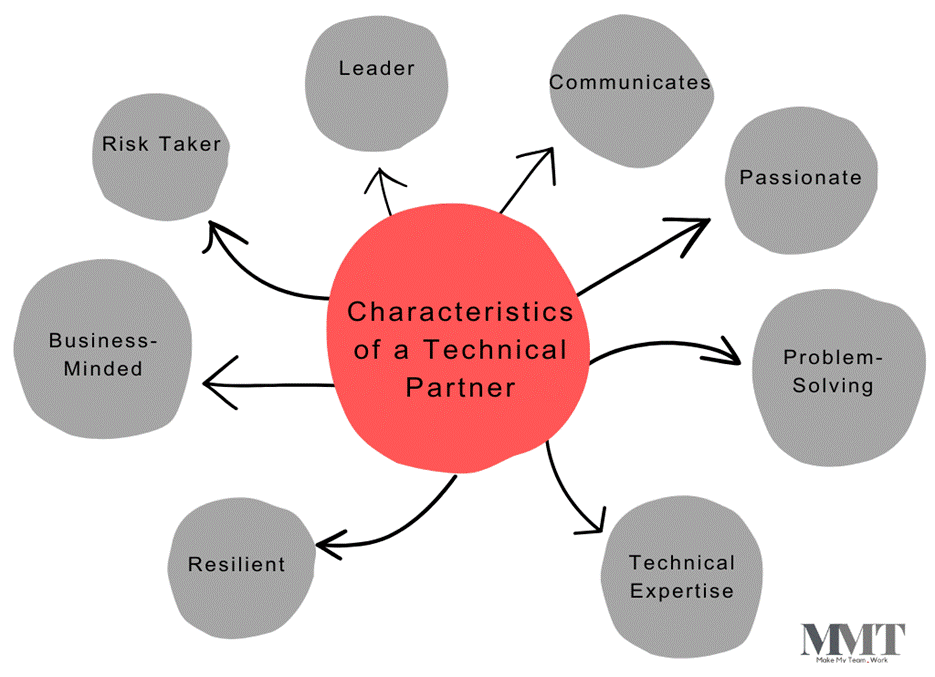
- Technical Expertise that Matches Your Needs: Not all tech leaders are the same. Some specialise in backend infrastructure, others in AI, others in app development and so on. You need someone whose skills align with what your startup is building.
- Strong Problem-Solving Skills: A startup encounters many unexpected challenges. A great tech partner finds solutions, even when under pressure and thinks strategically about technological choices.
- Passion for your Product and Vision: A tech co-founder or CTO is not just another hire but someone who is deeply invested in the success of your startup. It should be someone who believes in the startup’s mission, is willing to go the extra mile and has the drive to stick around when things get tough.
- Ability to Communicate and Collaborate: Miscommunication between business and tech teams can lead to costly mistakes, so your partner needs to bridge that gap effectively. They communicate technical concepts clearly to non-technical team members, investors, and customers. They should also have the ability to communicate with you on any matters related to the startup.
- Leadership and Team-Building Skills: Your first tech hire might be building the product alone, but eventually, they’ll need to hire and manage developers, set engineering best practices, and foster a strong company culture. A CTO, in particular, should be able to scale an engineering team and lead effectively.
- Willingness to Take Risks: Startups are risky, and not everyone is cut out for the uncertainty. The right tech partner embraces challenges, adapts to change, and is willing to experiment to find the best solutions.
- Business-Minded Thinking: Your tech cofounder or CTO isn’t just there to code—they need to understand the bigger picture. How does the technology support business goals? What’s the most cost-effective way to scale? Can the product’s infrastructure handle rapid user growth?
- Resilience and Commitment: Startups aren’t built overnight. There will be long nights, setbacks, and moments of doubt. You need someone who is in it for the long haul, committed to pushing through challenges and constantly iterating to make the product better.
Finding the right tech partner is primarily about alignment because they are central to building the startup’s future (just like you). Partners who share your vision will be willing to go the extra mile to ensure your startup succeeds.
Where and How to Find a Tech Co-Founder or CTO
When looking for a technical partner, it’s essential to put yourself in the right places, engage with the right communities and actively seek them out because the right person won’t just fall into your lap. The following are the best places and strategies to find your ideal tech partner:
- Startup and Founder Communities: Tech founders often hang out in startup communities, sharing ideas, networking, and looking for opportunities. Indie Hackers, YC Cofounder Matching and Reddit forums are some of the best places to start.
- Online Developer Communities: Developers spend a lot of time in online communities where they contribute to discussions, open-source projects, and job boards. GitHub communities, Collectives on Stack Overflow and Reddit Developer Communities are some places to access developers.
- University and Accelerator Networks: Many successful startups have found their tech cofounders through universities and accelerator programs. You can take advantage of alumni networks, computer science clubs and other university programs to find co-founders.
- Startup Events: These events are filled with many talented individuals, and one of them can be your next partner.
- Direct Outreach to Engineers and Developers: You can find a CTO or Co-Founder by reaching out directly to them, especially if you’ve seen their profile or engaged with them before on platforms such as LinkedIn, X (Formerly Twitter), and WellFound, which connects you directly with founders.
Finding the right tech co-founder or CTO takes time, patience and effort. Since you’ll be looking for someone who shares your vision and is willing to build with you, it can take longer than you anticipated. However, it’s essential to avoid rushing this decision while ensuring you put yourself in the right places, engage with the right communities, and, most importantly, be intentional about your outreach.
Attracting a Tech Co-Founder or CTO
Finding the perfect tech partner is only half the battle—the other half is making them want to join you. The best tech talent isn’t just looking for a paycheck; they want to be part of something exciting, meaningful, and worth their time. The following are ways you can position yourself and your startup to attract the right technical partner:
- Have a Compelling Vision: Top tech talent wants to work on exciting, impactful problems –not just another generic app or marketplace. Therefore, you need to sell your vision: Why does your startup matter? How will it change lives or disrupt an industry?
- Build a Prototype or MVP, if Possible (A Simple One): Nothing attracts a great tech partner more than proof of execution. Non-technical co-founders can use no-code tools, wireframes, or even a basic landing page to validate their ideas.
- Tap into the Right Networks: Tech cofounders and CTOs won’t magically appear –you need to go where they are. Attend startup events and join founder communities, hackathons, and tech meetups (both in-person and online).
- Be Someone they want to work with: The best tech talent usually has options. Therefore, you should offer them value that makes them want to work with you.
- Offer More than Just Equity: The best tech leaders want a stake in something meaningful, and equity alone isn’t always enough to convince them to join. You can offer other incentives such as creative freedom, access to networks, a higher stake in the future and a long-term vision that makes them want to stay.
Bringing in a tech cofounder or CTO is a major commitment–for both of you. Startups are unpredictable, and the early days will be filled with long hours, tough decisions, and unexpected challenges. That’s why transparency is key. Be upfront about the risks, the workload, and what the role truly entails. The right person won’t just join because of the potential reward–they’ll join because they believe in the mission and trust that you’re the right partner to build with.
How to Build and Test Compatibility with a Potential Co-Founder
A co-founder is someone you can trust, work with and build a company alongside for years. Clicking with someone over a shared vision is common, but this does not mean that you are compatible. Before making it official, you need to test the working relationship, align on values, and make sure you can handle challenges together. Here’s how to build and test compatibility before committing to a co-founder partnership.
- Start with Deep Conversations: Have discussions about your goals, work ethic, risk tolerance, conflict resolution and personal motivations.
- Work on a Small Project Together: Before fully committing, test the waters with a small project, e.g. a prototype, to see how well you work together.
- Simulate High-Stress Scenarios: You should put your working relationship to the test so you can gauge how each of you will respond in chaotic situations. An example is having a tough discussion on what happens if one of you wants to leave the partnership.
- Define Roles and Responsibilities Clearly: This helps set clear expectations on the role each of you plays so that one partner does not feel unfairly treated in the future.
- Get External Perspectives: Seek input from people who have had tech co-founders before. Ask about what worked well and what did not so you can set up your co-founder relationship for success.

Image by Elevate Digital via Pexels
After finding a co-founder, put everything in writing no matter how well you work together. A Founder’s Agreement sets clear expectations and protects and guides both of you in case your working relationship experiences challenges.
Red Flags to Watch Out for in Potential Tech Co-Founders
Choosing the wrong co-founder can be more damaging than not having one at all. While technical skills are important, the real deal-breakers often come down to mindset, work ethic, and trust. No matter how impressive someone’s resume is, ignoring red flags early on can lead to major problems down the road. The following are warning signs to watch out for:
- Lack of Commitment: A co-founder who is hesitant to join you and visibly expresses their lack of desire will most likely not stick around in the long run.
- Poor Communication: Co-founders who ghost you, barely communicate for days and avoid tough conversations will cause many misunderstandings and delays.
- Skills that Don’t Match their Claims: Some people talk big but don’t deliver. Always test their technical abilities before committing.
- Not Open to Criticism: A co-founder who refuses feedback, always needs to be right, or dismisses others’ ideas will create a toxic work environment.
The right co-founder is reliable, adaptable, and aligned with your vision. Don’t ignore the red flags you see because joining forces with the wrong person can break your startup before it even takes off. It’s always better to keep searching than to fix a bad partnership later.