


A fractional job is like having a slice of top-tier talent without having to buy the whole cake. Fractional roles solve that problem by giving you access to high-level expertise on a part-time or project basis. So, your company gains the strategic muscle of a corporate giant, but with the agility and budget of a startup.
What is Fractional Work?
Fractional work is a modern employment model where highly skilled professionals share their time and expertise across multiple businesses instead of committing to one full-time role. It is exactly what it sounds like; you’re not hiring someone’s entire 40-hour workweek, you’re bringing in a fraction of their time, skills, and expertise. Instead of locking into a full-time salary with benefits and overhead, businesses pay for just the slice they actually need. They are integral members of your leadership team, deeply invested in your long-term success, just on a schedule that makes sense for your current growth stage.
A fractional role could be a CFO who shows up eight hours a week to steer your finances, a CMO who designs your marketing playbook on Mondays, or a tech lead who comes in just long enough to get your product roadmap under control. They’re senior-level professionals working with multiple clients at once, almost like consultants but with a deeper, more hands-on role inside your company.
Fractional workers dive into the deep end with you. For example, a fractional CMO doesn’t just give you a marketing plan and leave. They help execute it, manage the team, and are accountable for the results. A fractional CTO, on the other hand, will architect your system and then guide your developers to build it. Overall, they provide the strategic direction and hands-on leadership you crave, without the full-time commitment.
Are Fractional Jobs Different from Freelance Jobs?

At first glance, fractional and freelance sound like the same thing, but the reality is that they play in different leagues. The confusion is understandable. Both involve hiring external talent. But the difference lies in the nature of the engagement, the level of integration, and the ultimate goal. Think of them as cousins, not siblings.
A freelancer is a specialist you bring in to complete a specific, bounded task. They usually operate on a project-to-project basis. You hire them to design a website, write content, or build an app feature, and once the project is done, so is the relationship. They’re specialists in execution, often juggling many short-term gigs with different clients, and their involvement is usually tactical. The freelancer is a master of their craft, but they operate outside the core machinery of your business.
Fractional professionals, on the other hand, embed themselves into your business in a more strategic role. You don’t hire a fractional CMO to design a single ad campaign; you hire them to run your marketing department. They are integrated into your team, involved in important decisions, and accountable for long-term outcomes.
To understand what you need, you have to look at these aspects:
- Scope of Work (Defined Task vs. Ongoing Function): Freelancers usually focus on delivering a defined output, like designing a logo, writing blog posts, or coding a feature. Their work has a clear start and finish. A fractional hire’s scope is an entire business function. They build systems, shape strategy, and guide execution.
- Time Commitment (Project-Based vs. Embedded Partnership): A freelancer’s engagement is finite. It lasts for the duration of the project. Once the website is launched or the campaign is over, the contract concludes. A fractional executive works on a retainer basis for an ongoing, long-term period. They are a permanent part-time member of your leadership team, often committed for a minimum of several months to a year.
- Responsibility Level (Execution vs. Accountability): Freelancers rarely carry long-term accountability and are responsible for the quality of their work. They execute against a brief you provide. A fractional hire is accountable for business outcomes and is often on the hook for the lead generation numbers. They share the risk and the reward of their function’s performance.
- Integration with the Business (External Vendor vs. Internal Leader): Freelancers usually remain external. They’re service providers who execute and report back. Fractional professionals embed within your team, join leadership meetings, mentor staff, and align with company goals. They’re closer to “in-house” than “outside help.”
- Relationship Duration (Finite Project vs. Long-Term Partnership): Freelance projects can last a week or a few months, but they usually end when the deliverable is complete. Fractional roles tend to be long-term, with ongoing commitments that scale as the business grows.
- Cost Structure (Project Fee vs. Retainer Salary): Freelancers typically charge per project or per task, while fractional professionals often work on a retainer or a recurring schedule, more like a part-time executive contract than a project fee.
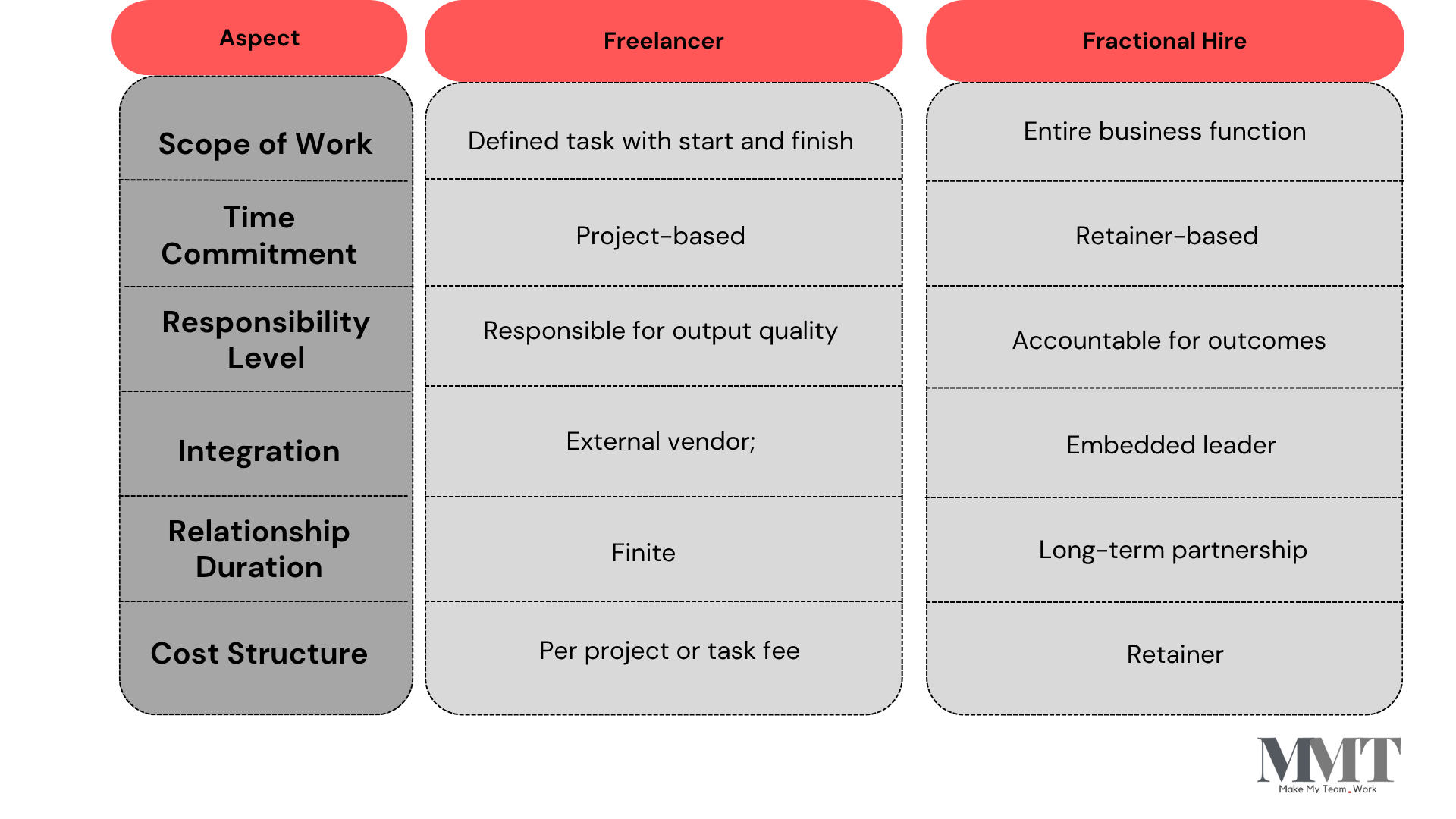
The distinction between fractional workers and freelancers is crucial because it dictates your hiring needs. If you have a defined, finite task, a freelancer is your perfect solution. But if you have a persistent, strategic gap in your leadership team that requires ongoing stewardship, a fractional hire is the smarter, more scalable answer.
Why is Fractional Talent Demand Increasing?
The pull for fractional talent is growing fast. In a world of economic uncertainty and breakneck technological change, businesses are ditching the heavy structure for a more agile, elastic approach. The demand for fractional talent is a fundamental shift in how companies are built to win.
Here are the main drivers:
- Businesses need agility: Market conditions change quickly. Full-time execs come with fixed costs; fractionals let you scale up or pull back leadership investment without being fully locked in.
- Specialized, on-demand expertise is harder to find in full-time pipelines. Tech, marketing, and operations are evolving so fast that having someone who knows the bleeding edge, even for just part of the week, makes a big difference.
- Worker preferences are changing. Senior professionals increasingly prefer autonomy, portfolio careers, and flexible schedules. Fractional roles let them stay sharp, avoid burnout, and contribute to several projects.
- Remote work makes this model viable. Geography is less of a limitation. Businesses in the US, Australia, and Europe can tap into talent anywhere (including other countries) with the right infrastructure.
- Cost savings and risk reduction. You avoid full-time salary + benefits + overhead + risk of bad hire. Fractional roles allow leadership input without full commitment.
In developed economies like the USA, Australia, and Western Europe, the trend is driven by startups and SMBs needing to compete with enterprise-level talent. A tech startup in Berlin can now have a fractional CTO from London and a fractional CMO from Lisbon, assembling a world-class leadership team without any of them needing a visa.
In developing economies, there is a dual effect. Local companies gain access to international fractional experts who bring global best practices. Simultaneously, highly skilled professionals in these regions can offer their services as fractional leaders to companies in developed countries, creating a vibrant export of high-value expertise.
The table below is a quick scan of major hiring platforms to show the demand for fractional hires:
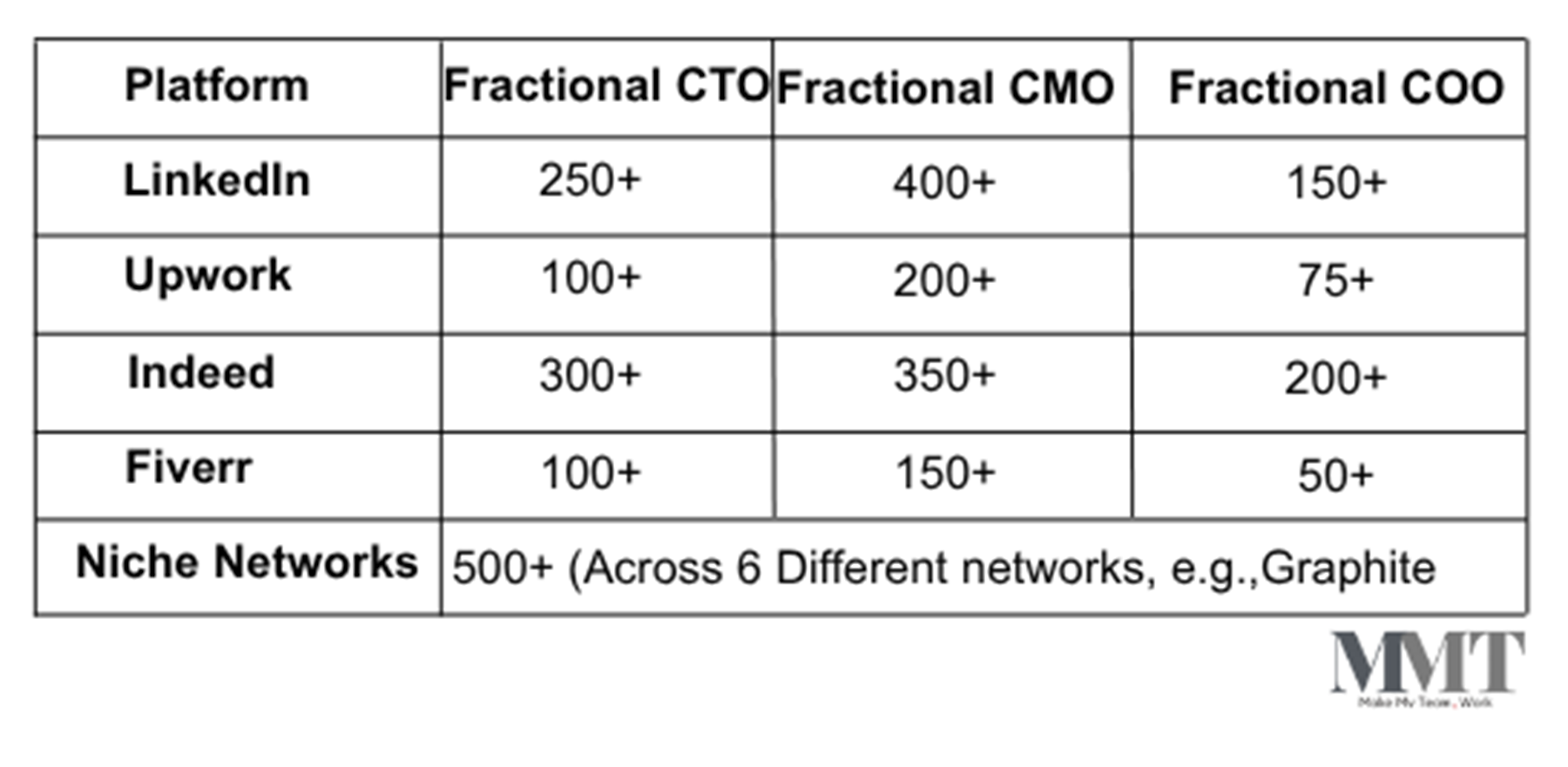
Data Points:
- The “State of Fractional Industry Report 2024” (Frak) found ~120,000 fractional leaders in the U.S. in 2024, up from ~60,000 in 2022.
- In Australia, SEEK reports fractional and interim executive job postings up ~35% over two years.
- Deloitte Australia survey reports that ~63% of large companies are either considering or already using fractional executive roles.
What Kind of Roles are Suitable for Fractional Jobs?
Not all fractional hires are created equal. Each role solves a different problem, depending on whether your business is still chasing product-market fit, scaling to meet demand, or running at full throttle but struggling to keep up with complexity.
Here’s how different fractional roles fit into the business puzzle:
Fractional Chief Marketing Officer (CMO)
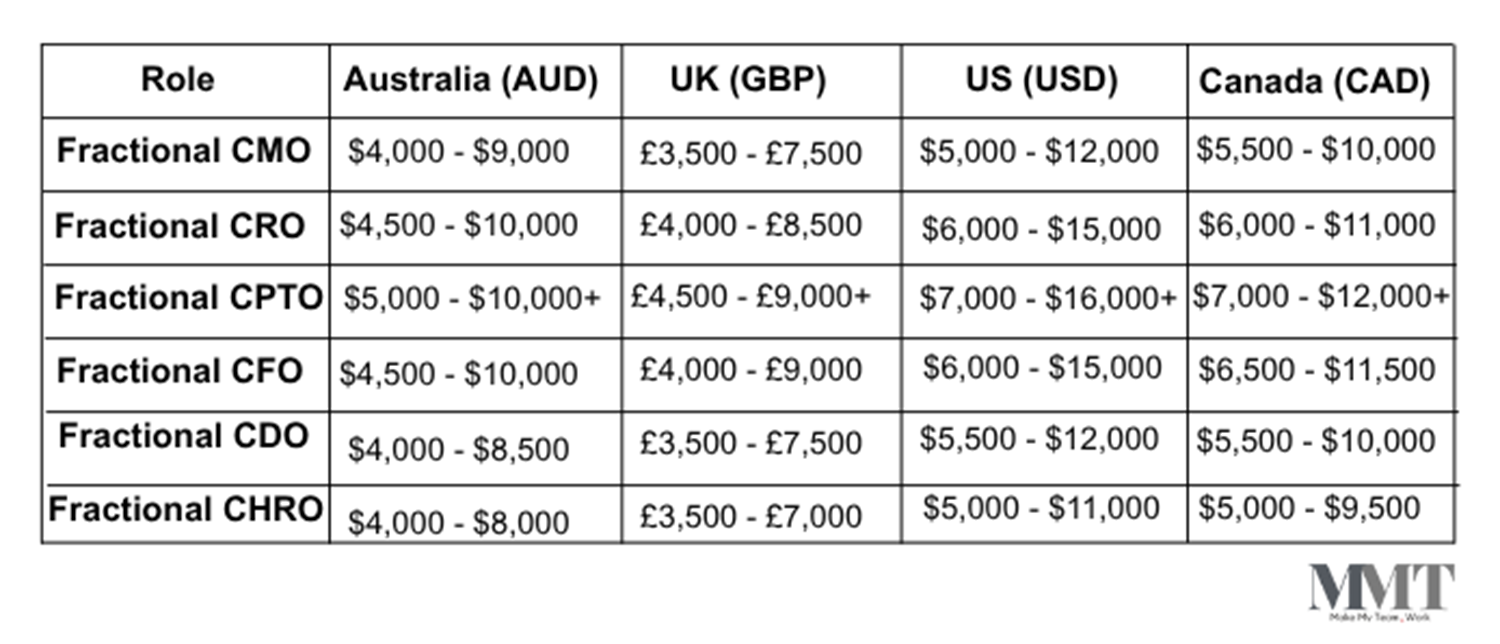
The perfect fit for: B2B startups that have found Product-Market Fit (PMF) and need to scale demand generation; B2C startups ready to build a brand; and small to mid-sized businesses looking to move beyond random acts of marketing.
What they do: They build the growth engine. This leader translates your PMF into a scalable, predictable pipeline. They own the strategy for everything from content and SEO to paid acquisition and marketing automation, ensuring your message reaches the right people and converts them into customers.
Fractional Chief Revenue Officer (CRO)
The perfect fit for: B2B startups that are still searching for PMF and small to mid-sized businesses where sales and marketing are misaligned.
What they do: They are the revenue detective. While a CMO focuses on marketing, the CRO owns the entire revenue cycle from lead to closed deal. They perfect your sales process, pricing, and customer success motions, figuring out the most efficient way to monetize your offering.
Fractional Chief Product and Technology Officer (CPTO)
The perfect fit for: Any technology startup, and especially small to mid-sized businesses looking to productize a service into a scalable software offering.
What they do: They are your product visionary and technical architect rolled into one. They bridge the gap between what customers need and what your engineers build, creating a product roadmap that delivers real value while ensuring your technology stack is robust and scalable.
Fractional Chief Financial Officer (CFO)
The perfect fit for: Startups that have solidified PMF and are preparing for a fundraise, and scale-ups navigating growth up to Series B.
What they do: They speak the language of investors and numbers. They move beyond basic bookkeeping to manage cash flow, build financial models, lead fundraising rounds, and provide the strategic financial insight needed to make high-stakes decisions.
Fractional Chief Digital Officer (CDO)
The perfect fit for: Mid-size businesses with revenue between $25M to $100M that have traditional operations but need to transform for the digital age.
What they do: They are your digital modernizer. This leader oversees the integration of technology across the entire business, from e-commerce and data analytics to customer experience, driving efficiency and creating new digital revenue streams.
Fractional Chief Human Resources Officer (CHRO)
The perfect fit for: Scale-ups and mid-size businesses ($25M – $100M revenue) experiencing growing pains in their culture, recruiting, and retention.
What they do: They architect your company culture. They build the systems for talent acquisition, performance management, and professional development, transforming your people operations from administrative to strategic
 .
.
So, before you post another job description, ask yourself one question: Is it a full-time body we need, or is it a specific piece of expert brainpower?
Skills to Evaluate when Selecting Fractional Talent
Finding someone with an impressive title is easy. Finding the right fractional leader who can seamlessly integrate and drive results is the real art. The wrong hire can drain time and resources, while the right one can transform your business in months. That’s why evaluating the right mix of core leadership traits and role-specific expertise is non-negotiable.
Core Skills Every Fractional CxO Should Bring:
- Strategic Vision: They need to see beyond the immediate tasks and align decisions with your company’s long-term goals.
- Communication: A fractional leader is often the bridge between teams, executives, and stakeholders. Clear and persuasive communication is paramount.
- Change Management: These roles often enter companies mid-stream, so the ability to navigate resistance and guide teams through change is crucial.
- Data-Driven Decision-Making: From revenue forecasting to product adoption, they must rely on insights, not just instincts.
- Adaptability: Fractional executives juggle multiple companies. They need to hit the ground running, absorb context fast, and adapt their playbook to your business.

Layer on Role-Specific Skills:
- Fractional CTO/CPTO: Expertise in scaling platforms, AI adoption, cybersecurity, and turning technical roadmaps into market-ready products.
- Fractional CMO: Mastery of demand generation, digital marketing analytics, and building brand authority in crowded markets.
- Fractional CRO: Proven ability to design repeatable sales processes, manage revenue pipelines, and align sales with marketing.
- Fractional CFO: Strength in financial modeling, capital raising, compliance, and investor reporting.
- Fractional CDO: Strong background in digital transformation, process automation, and data governance.
- Fractional CHRO: Skills in building scalable people systems, talent retention strategies, and compliance with labor laws.
This blend of strategic leadership and cutting-edge technical skill is rare. Vetting for it is a full-time job in itself. This is the precise challenge MMT.work is designed to solve. Every professional in the MMT network is vetted to bring this hybrid mix of leadership, adaptability, and job-specific mastery, so SMBs can focus less on “if they’re qualified” and more on “how fast can we scale.”
Combining Fractional CxO and Freelancer to Build a Great Work Team
Imagine building a powerhouse team without ever committing to full-time payroll. That’s the beauty of pairing fractional leadership with freelance execution. You get senior-level direction plus hands-on delivery, all without the heavy baggage of employee overhead. Hiring a group of freelancers without strategic oversight often leads to misaligned efforts and wasted resources.
A fractional leader is the executor of your business’s vision. Think of them as the architects of your workforce: they set the strategy, define the KPIs, and then bring in freelancers to execute the plan. The result? Your business gets world-class leadership guiding specialized talent without the inflated costs of hiring everyone in-house.
Here is how the dynamic combo works:
- Sales and revenue: A Fractional CRO builds the sales playbook and hires freelance SDRs or account managers to execute it.
- Marketing: A Fractional CMO designs your go-to-market strategy, while freelancers handle content, ads, and design.
- Technology: A Fractional CTO scopes out your product roadmap, then manages freelance developers, UI/UX designers, and testers.
- HR: A Fractional CHRO develops your talent strategy while freelancers manage recruiting campaigns, payroll tools, or compliance tasks.
Now, compare that with full-time hiring. Traditional employees come with layers of extra costs: health insurance, retirement benefits, payroll tax, paid leave, training, and the hidden expense of downtime when business needs shift. The fractional-plus-freelance model bypasses all of this. You pay only for the expertise and hours you actually need, while skipping the long-term liabilities that weigh heavily on SMBs.
Cost of Hiring a Fractional CxO
Let’s talk numbers. Bringing a fractional leader onto your team is a strategic decision made to engineer the trajectory of your business. The cost reflects the immense value of compressing years of executive experience into a few focused days each month. Rates vary significantly based on geography, the specific role, and the complexity of your challenges.
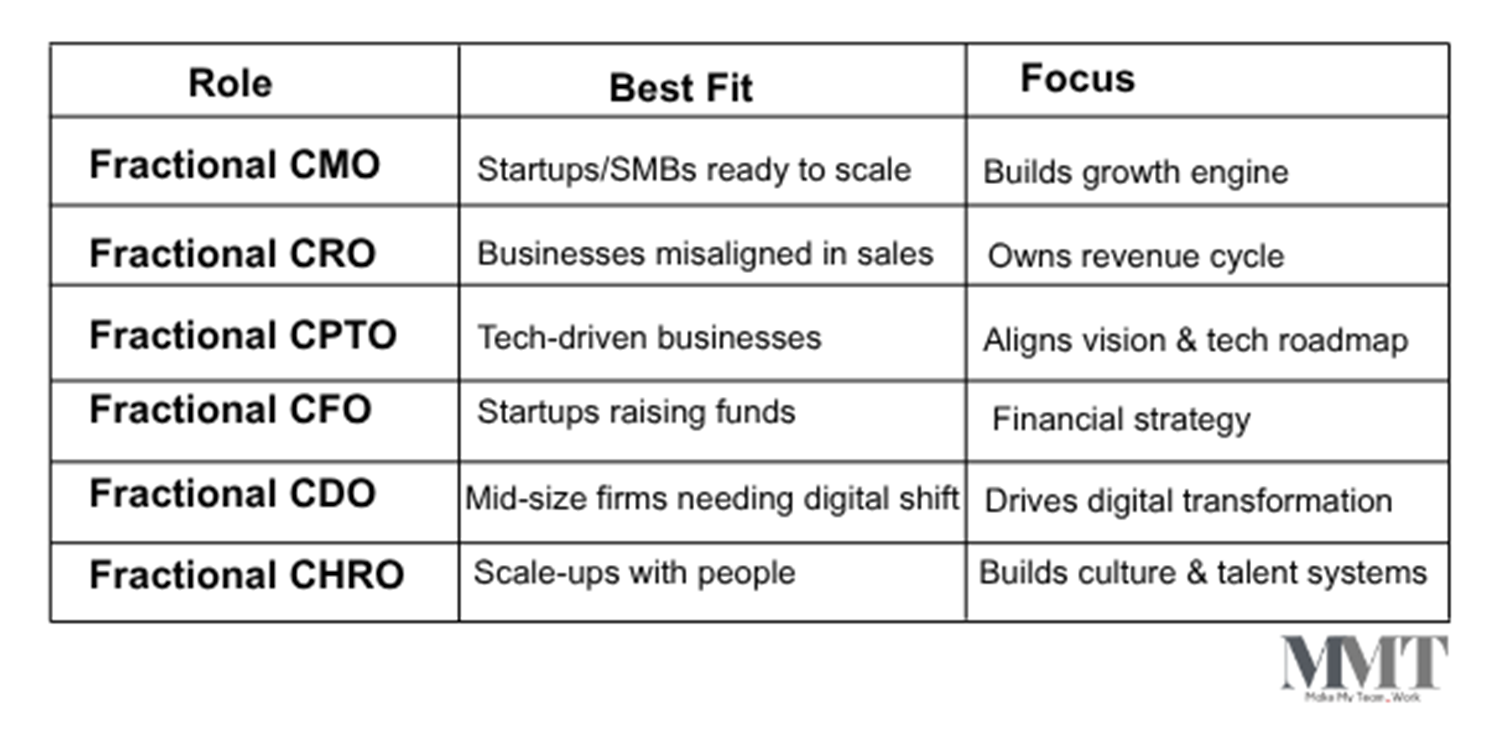
Here’s an average cost breakdown for CMO Role (Monthly Retainer) Across Countries expected to commit 2-3 days a week:
- Australia: ~$4,000 – $10,000
- United States (Silicon Valley / NYC / major tech hubs): ~$5,000 – $12,000 (for experienced CMO doing both strategy + oversight)
- UK (London/Major Cities): ~£3500 – £7000
- Canada (Toronto, etc): CAD 5,500 – CAD 10,000+ (≈USD $6,000-11,000 depending on scope)
- Europe (Western): ~€4,000-€9,000+ depending on role, city, and how much execution vs oversight is required.
And here’s a more detailed breakdown:Note: These are monthly retainer ranges for a 2-3 day per week engagement. High-complexity situations or roles requiring very niche expertise can command rates at the top end or beyond these ranges.
Where to Find the Fractional Talent
Finding the right fractional executive is about connecting with the right professional who understands your stage, your industry, and your goals. The digital landscape is crowded with platforms promising talent, but not all are created equal when your goal is to find a true strategic partner.
Here are some of the most common places to look:
- MMT.work: The platform is built for small and mid-sized business owners and founders who don’t necessarily come from a tech background but know they need technology to compete. As an invite-only talent platform, MMT.work helps companies hire fractional tech leaders, deploy best practices in product development, and implement the right digital tools to modernize operations.
Unlike open marketplaces, MMT.work vets its experts, ensuring you don’t waste cycles on trial-and-error hires. If you’re serious about AI-powered products, scaling your operations, or translating your vision into real technology, this is the platform designed for you.
- LinkedIn: LinkedIn has become the world’s de facto professional directory. You’ll find plenty of professionals advertising fractional CxO services, and it’s easy to reach out directly. The downside? It can be overwhelming. Sorting through noise, verifying credibility, and negotiating terms all fall on your plate.
- Upwork: Offers a massive pool of freelancers, and yes, you’ll find fractional executives offering their services there. But the platform was built around gig-style freelance work, not embedded leadership. Many executives on Upwork focus on short-term projects, not ongoing strategic roles, which makes it harder to build the continuity that fractional hires are meant to deliver.
- Fiverr: Is well-known for affordable freelance services. It’s great for quick tasks, like graphic design or one-off copywriting, but not the natural habitat for CxOs. Fractional executives usually avoid Fiverr because the platform is optimized for transactional work.
- Indeed: Job boards like Indeed occasionally feature fractional listings, often as “contract” or “part-time” roles. The advantage is reach. You can get your opportunity in front of thousands of candidates. But quantity doesn’t equal quality. You’ll have to wade through many mismatched applications, and the vetting process can drag on, leaving SMBs right back at square one.
While open marketplaces like Upwork or Fiverr are useful for freelancers, they rarely deliver the strategic firepower a growing SMB needs. Platforms like MMT.work exist to cut through the noise, match you with vetted fractional leaders, and make sure your business scales on the shoulders of proven expertise.
Getting Work Done from Fractional Talent
Hiring a fractional executive is only half the journey. Ensuring they deliver transformative results is another. The handshake is over. Now comes the work of building a rhythm of success. The transition from hopeful hire to tangible outcomes hinges on one critical practice: Clarity from day one.
The Execution Roadmap:
First 90 days: This is the diagnostic and foundation-laying phase. The goal is a deep immersion and a clear action plan. Outcomes should include a comprehensive assessment of the current state and a detailed roadmap for the next six months. Hold weekly reviews to ensure alignment is tight and course corrections happen quickly.
Next 90 days (180-day mark): This is the execution and early results phase. The focus shifts to implementing the plan and demonstrating initial traction. KPIs here should show clear movement: increased lead flow, a refined product roadmap, or improved cash flow forecasts. Transition to fortnightly reviews to maintain strategic oversight while granting autonomy.
Each Quarter Thereafter: The relationship now operates at a strategic altitude. Quarterly business reviews (QBRs) are essential to assess progress against long-term goals, refine the strategy, and set objectives for the next quarter.
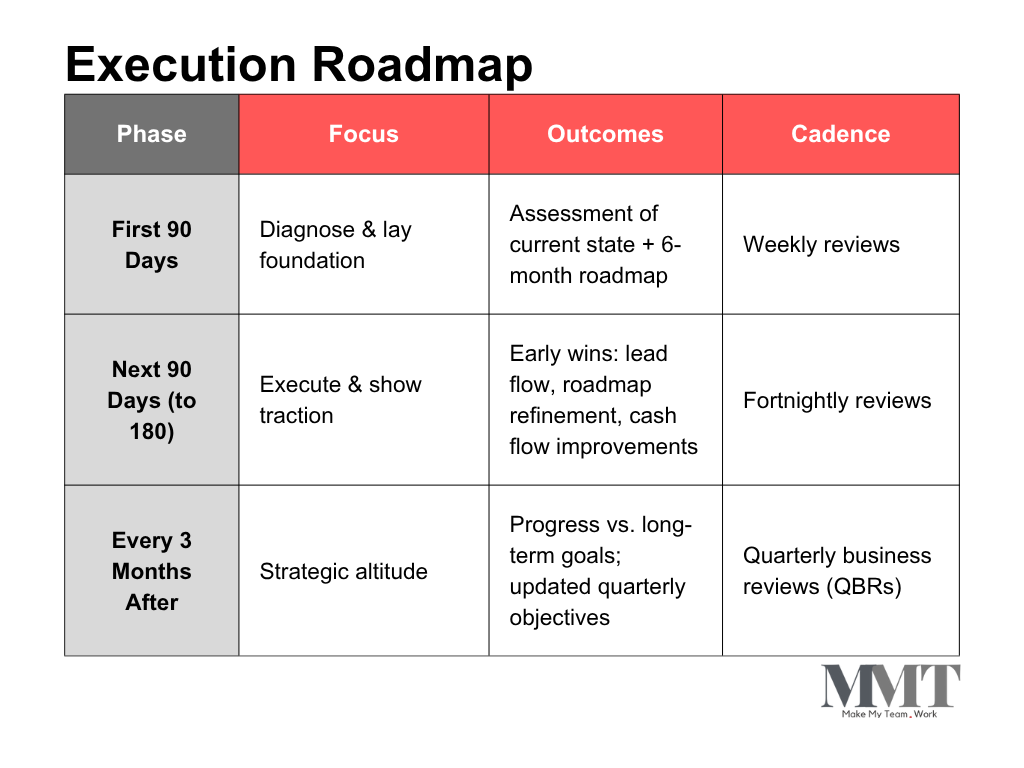
This structured approach transforms a part-time engagement into a high-impact partnership. It creates a shared scoreboard and ensures everyone is running toward the same finish line.
Conclusion: The Smarter Way to Scale
Fractional work is becoming the growth playbook for SMBs worldwide. We’ve explored what fractional jobs are, how they differ from freelance work, why demand is soaring, the most impactful roles to hire, and even the costs across markets. The message is clear: if you’re a small or mid-sized business, fractional leadership is the lever that lets you punch above your weight, getting strategic firepower without the full-time overhead.
The businesses that thrive in this new era will be the ones that master agility by bringing in fractional experts at the right moments, aligning them with sharp KPIs, and embedding them as co-pilots in the growth journey.
And for SMBs ready to make that leap, MMT.work is the partner built for you. With its invite-only model, vetted talent, and a focus on AI-powered growth and digital modernization, MMT makes sure fractional hiring is your smartest competitive advantage.
FAQ’s
What is a fractional job?
A fractional job is a model where a highly experienced professional, often at an executive level, works for a company on a part-time, ongoing basis. They integrate deeply into your team, providing strategic leadership and owning business outcomes rather than just completing tasks. It’s a way to access top-tier talent without the cost of a full-time salary.
How are fractional jobs different from freelance jobs?
The core difference is ownership versus execution. A freelancer is hired to complete a specific project with a defined end date. A fractional executive is hired to own an entire business function, like marketing or finance, on a long-term basis. They are accountable for strategic results, not just deliverables.
Who is a fractional CxO?
A fractional CxO is a seasoned executive (like a Chief Marketing, Technology, or Financial Officer) who works part-time for several companies simultaneously. They bring their years of experience to solve high-level strategic problems, build departments, and guide growth, acting as a member of your leadership team.
Where to find Fractional CxO?
You can find them on specialized platforms like MMT.work, which curates vetted talent for a strategic fit, or on general marketplaces like LinkedIn and Upwork. The key is choosing a platform that prioritizes quality and cultural alignment over just presenting a long list of profiles.
What will it cost to hire a fractional talent?
Costs vary by role and location, but are typically a monthly retainer. For a 2-3 day per week engagement, expect to invest between $4,000 and $15,000+ per month. This is a strategic investment that avoids the extensive hidden costs of a full-time employee, such as benefits and overhead.










[…] Fractional talent brings precision to your budget. You pay for sharp expertise only when your roadmap demands it. This approach keeps your spending light while your technical progress stays strong. […]